Key Findings
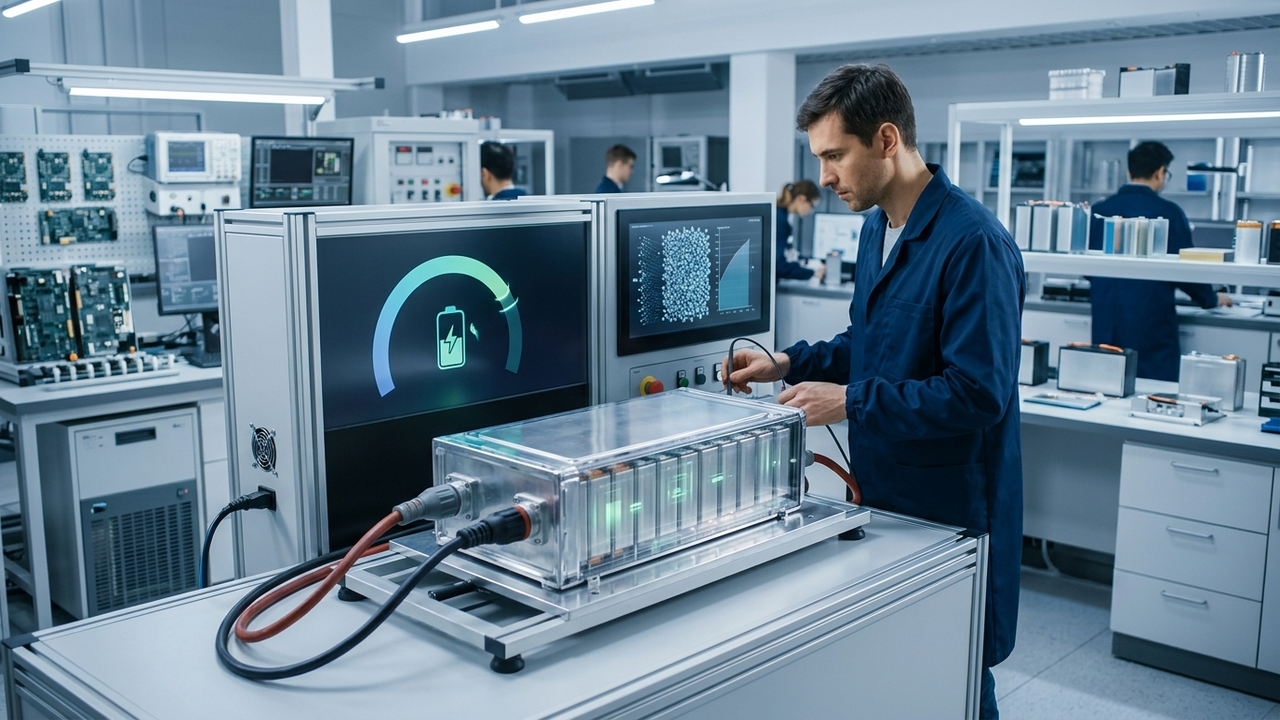
Greater Bay Technology, based in the United States, has made remarkable progress in solid-state battery technology. The company’s developed 77 Ah high-capacity cell achieved a high gravimetric energy density of 375 Wh/kg and demonstrated ultra-fast charging capability, replenishing its battery capacity from 15% to 90% in just 18 minutes. This achievement holds the potential to fundamentally resolve the range and charging time anxieties faced by electric vehicle (EV) users.
Technical and Manufacturing Details
Solid-state batteries inherently offer superior safety by replacing the liquid electrolyte of conventional lithium-ion batteries with a solid electrolyte, significantly reducing the risk of thermal runaway. Furthermore, solid electrolytes enable the stable use of lithium metal anodes, which theoretically possess the potential to double the energy density compared to existing lithium-ion batteries. Greater Bay Technology’s battery successfully delivers both enhanced safety and high energy density. The report notes that Toyota is establishing optimized cathode material supply chains for sulfide-based electrolytes, and Japan’s Idemitsu Kosan is expanding lithium sulfide production, suggesting active movements in building supply chains for solid-state battery commercialization.
Background and Industry Context
Solid-state batteries are widely anticipated as a key technological breakthrough to accelerate EV adoption, drawing significant expectations from automakers and battery companies worldwide. Ultra-fast charging capabilities promise to bring EV convenience closer to that of gasoline vehicles, alleviating ‘range anxiety’ during long-distance travel. Concurrently, high energy density extends EV driving range and enables EV deployment across a wider variety of vehicle types. Greater Bay Technology’s innovation presents concrete solutions to these major challenges and is viewed as playing a crucial role in the solid-state battery development race within the United States.
Future Outlook
This technological advancement by Greater Bay Technology marks a significant step forward for the commercialization of solid-state batteries. Future efforts will focus on establishing mass production techniques for this 77 Ah cell, cost reduction, and validating long-term reliability and durability. Particularly for full-scale integration into electric vehicles, stringent safety and durability requirements must be met. If the company’s technology proves successful at a mass-production level, it is expected to have ripple effects not only in the EV market but also in other sectors such as drones, robotics, and stationary energy storage, contributing significantly to the formation of the next-generation battery market.
Source: https://www.intelligentliving.co/us-solid-state-batteries-2026-greater-bay/
Get our weekly technology intelligence — free
Receive an infographic that lets you judge at a glance whether each field’s analysis report is worth reading.
Subscribe Free — Weekly Tech Intelligence
By subscribing, you’ll receive Troy-Technical’s weekly technology intelligence newsletter.
- Your email and selected fields are used only to deliver the newsletter.
- We never share your information with third parties.
- You can unsubscribe anytime via the link in each email.
See our Privacy Policy for details.
Takes about a minute · Unsubscribe anytime




Comments