Key Findings
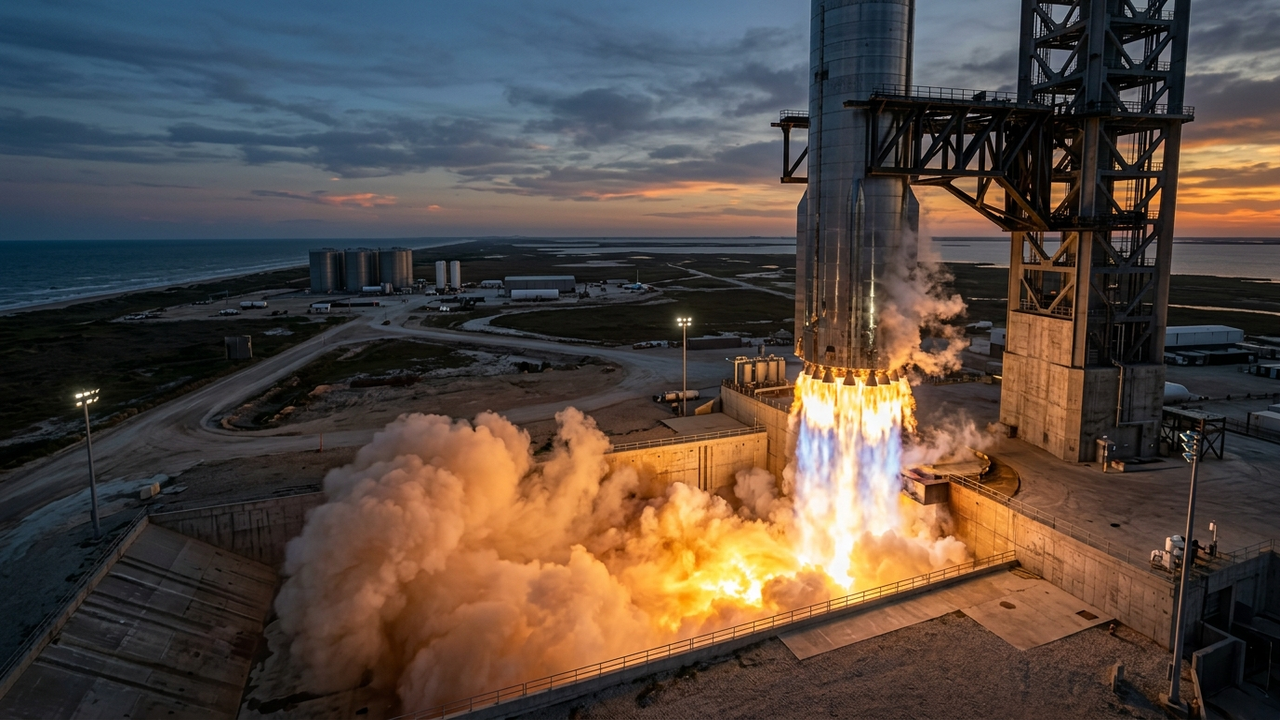
SpaceX has successfully completed the static fire test of all 33 Raptor engines on the Super Heavy booster designated for the Starship Flight 14 mission. This crucial preparatory step marks a significant advancement toward Starship’s first comprehensive orbital test flight, demonstrating the booster’s ability to generate its designed thrust and operate stably.
Technical and Operational Details
- Significance of Static Fire Test: A static fire test involves igniting the rocket’s engines for a short duration while the vehicle remains anchored to the launch pad, allowing engineers to collect vital performance data on thrust, fuel flow, pressure, and vibrations. Firing all 33 Raptor engines simultaneously on the Super Heavy booster provides comprehensive validation of the entire booster’s system integration and performance under near-flight conditions. This is essential for ensuring reliability during the complex environment of launch.
- Objectives of Starship Flight 14: Flight 14 aims to demonstrate Starship’s full orbital launch capability. Previous test flights primarily focused on the upper stage (Starship) flight characteristics and landing technologies. In contrast, this mission will involve the fully integrated Super Heavy booster and Starship upper stage attempting to achieve Earth orbital insertion.
- FCC Application for Starlink: SpaceX has also filed an application with the Federal Communications Commission (FCC) to operate Starlink communication terminals in orbit during this flight. This move is indicative of SpaceX’s broader strategy to integrate Starship with its Starlink constellation, potentially for large-scale Starlink satellite deployments and in-orbit data transmission capability validation.
Background and Industry Context
SpaceX’s Starship program is an exceptionally ambitious project designed to transport humans to the Moon and Mars, ultimately aiming to make space travel routine. Its success is pivotal for dramatically reducing launch costs and expanding the frequency and scale of space access. The completion of the 33-engine static fire test for the Super Heavy booster represents a major triumph over incredibly complex technical and operational challenges. It is a critical milestone in the global race to realize a fully reusable, giant space transportation system that fundamentally differs from conventional expendable rockets.
Strategic Significance and Outlook
The successful static fire test suggests that Starship Flight 14 is on track for its targeted mid-September launch window. A successful orbital test flight would instill immense confidence in Starship’s design and operational capabilities, solidifying its role as a lunar lander for NASA’s Artemis program and paving the way for future Martian missions. The in-orbit testing of Starlink terminals further advances SpaceX’s integrated space ecosystem strategy. The global space industry watches with bated breath for the success of this potentially historic launch.
Get our weekly technology intelligence — free
Receive an infographic that lets you judge at a glance whether each field’s analysis report is worth reading.
Subscribe Free — Weekly Tech Intelligence
By subscribing, you’ll receive Troy-Technical’s weekly technology intelligence newsletter.
- Your email and selected fields are used only to deliver the newsletter.
- We never share your information with third parties.
- You can unsubscribe anytime via the link in each email.
See our Privacy Policy for details.
Takes about a minute · Unsubscribe anytime






Comments