Key Findings
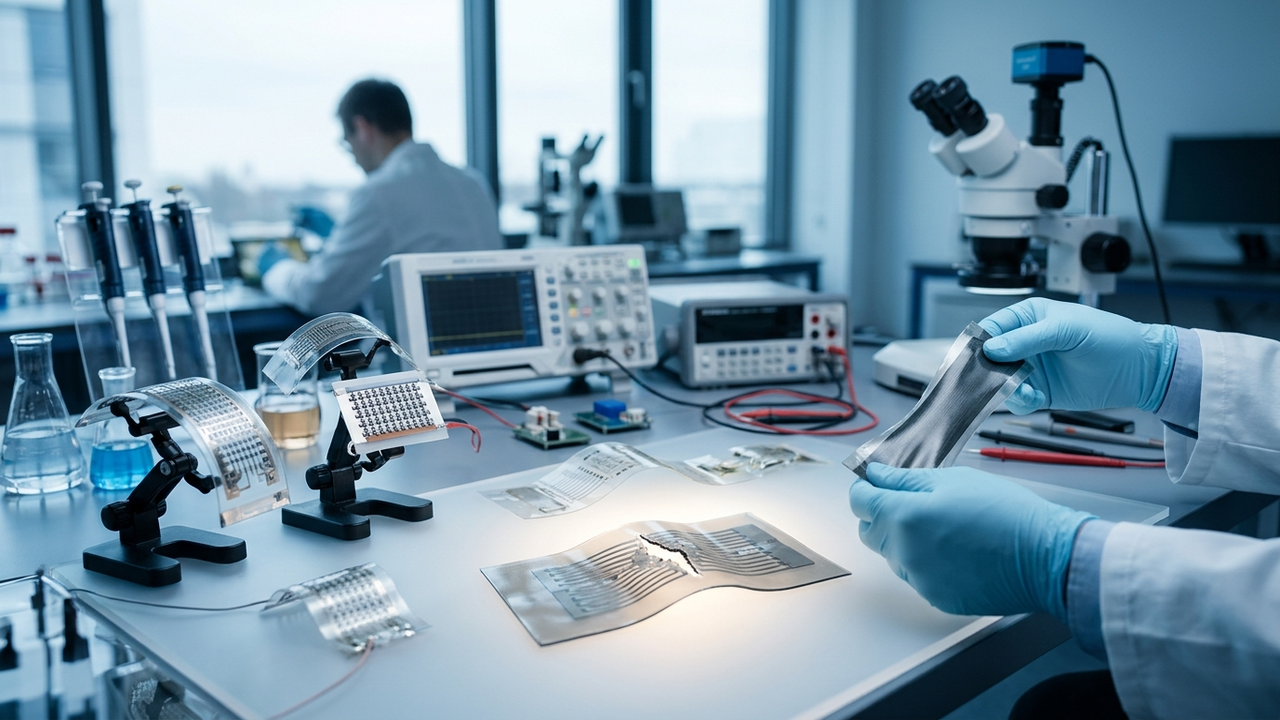
Researchers have successfully engineered a flexible composite film, based on PEDOT:PSS, Nafion, and Poly(vinyl Alcohol) (PVA), that exhibits high thermoelectric performance, remarkable stretchability, and intrinsic self-healing capabilities. This innovative ternary composite material can withstand significant strain, up to 141%, and uniquely mend physical cuts while effectively maintaining its thermoelectric properties, marking a significant advancement in functional materials.
Technical / Clinical Details
The composite material is formulated by combining PEDOT:PSS, a conductive polymer known for its thermoelectric efficiency, with Nafion, which aids in the dispersion and stability of PEDOT:PSS, and PVA, which provides the critical flexibility and self-healing mechanism through hydrogen bonding. This synergistic integration allows the material to not only convert thermal energy into electrical energy efficiently but also to autonomously repair physical damage, such as cuts, restoring both electrical conductivity and thermoelectric conversion capabilities without external intervention. Experimental results confirm the film’s exceptional mechanical resilience, enduring strains of up to 141%, and its high sensitivity to both temperature fluctuations and mechanical strain. These properties make it an ideal candidate for developing wearable thermoelectric generators that can harvest energy from body heat, as well as highly sensitive sensors capable of real-time monitoring of skin temperature changes and physiological movements.
Background & Context
The burgeoning fields of wearable electronics and IoT devices demand advanced materials that are not only flexible and high-performing but also self-powered and robust. Traditional thermoelectric materials are often rigid and lack stretchability, limiting their application in wearable contexts. Furthermore, device damage can lead to complete functional failure, making self-healing capabilities crucial for enhancing reliability and longevity. The composite material developed in this study addresses these challenges simultaneously, opening new avenues for medical wearable sensors and personal healthcare devices. The advancement in energy harvesting through such materials also promises to reduce reliance on conventional batteries, contributing to the miniaturization and lightweighting of future electronic devices.
Strategic Significance & Outlook
This PEDOT:PSS/Nafion/PVA composite material stands as a strong contender for enabling the next generation of wearable thermoelectric power generators and sensors. Its inherent stretchability and self-healing properties are expected to significantly extend device lifespan and enhance reliability in demanding use environments. Future research will likely focus on further improving power generation efficiency, adapting the material to more complex geometries, and rigorously evaluating its biocompatibility for direct skin contact applications. Ultimately, this technology holds immense promise for practical implementation in smart textiles, health monitoring patches, soft robotics, and a broad range of other applications. It is poised to play a vital role in shaping the future of sustainable and intelligent electronic devices by providing self-powered, adaptive, and resilient functional components.
Get our weekly technology intelligence — free
Receive an infographic that lets you judge at a glance whether each field’s analysis report is worth reading.
Subscribe Free — Weekly Tech Intelligence
By subscribing, you’ll receive Troy-Technical’s weekly technology intelligence newsletter.
- Your email and selected fields are used only to deliver the newsletter.
- We never share your information with third parties.
- You can unsubscribe anytime via the link in each email.
See our Privacy Policy for details.
Takes about a minute · Unsubscribe anytime







Comments