Key Findings
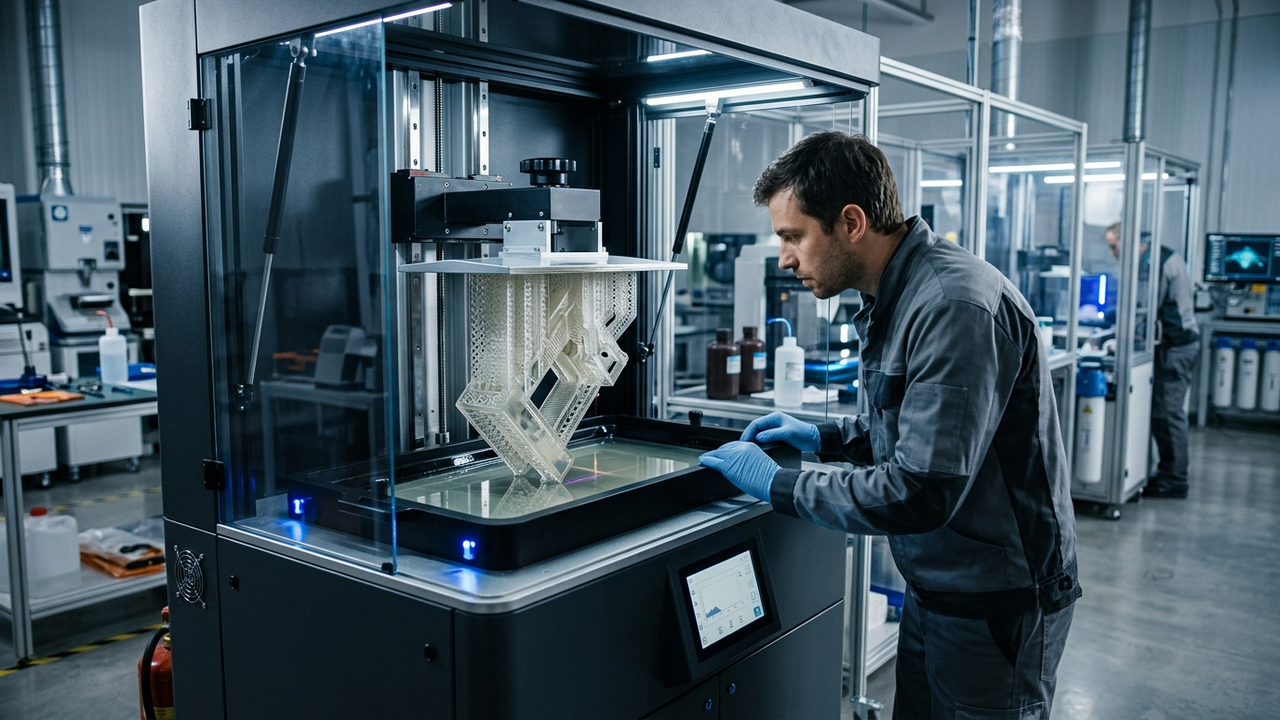
3DCeram, a French pioneer in advanced ceramic 3D printing, has announced that Vat Photopolymerization, also known as ceramic Stereolithography (SLA), is the most effective additive manufacturing process for producing advanced ceramic parts with complex geometries and extremely fine details. This technology enables the production of high-precision, high-performance ceramic components for aerospace, medical, industrial, and defense sectors, where traditional manufacturing methods are either unfeasible or uneconomical.
Technical / Product Details
The Vat Photopolymerization process fundamentally consists of four main steps:
- Printing: A photosensitive ceramic slurry, composed of ceramic powder dispersed in photopolymer resin, is filled into a resin vat. A build platform is immersed into the slurry. A UV laser or projector selectively cures the surface of the slurry, forming the first ceramic green layer. The platform then moves, and the next layer is printed. This iterative process builds the 3D part. A key characteristic of this technology is its ability to control layer thickness with extreme precision (down to a few micrometers), resulting in exceptionally smooth surfaces and high detail accuracy.
- Cleaning: After printing, the ceramic green part is cleaned to remove uncured excess slurry. This step is crucial for ensuring the density and purity of the final component.
- Debinding: The cleaned green part is then heated in a thermal furnace to remove the photopolymer resin binder. This process requires careful control of the temperature profile to prevent structural degradation of the part.
- Sintering: The debound ceramic part is further heated to much higher temperatures, causing the remaining ceramic particles to fuse together, forming a dense, solid final component. At this stage, the part acquires its final mechanical properties and dimensions. Sintering typically achieves densities ranging from 97% to 99% of theoretical density.
3DCeram’s ceramic SLA technology is compatible with a variety of high-performance ceramic materials, including alumina, zirconia, and tricalcium phosphate, allowing for application in a wide range of uses from biocompatible ceramics to heat and wear-resistant ceramics. For example, it is used to produce customized bone implants in the medical field, lightweight high-strength components in aerospace, and wear-resistant nozzles in industrial sectors.
Background & Context
Advanced ceramic materials are indispensable across many high-performance industries due to their superior hardness, heat resistance, wear resistance, electrical insulation, and biocompatibility. However, traditional ceramic manufacturing methods (e.g., injection molding, machining) face challenges such as high production costs, long lead times, and limited design freedom for complex geometries or small batch production. Additive manufacturing technologies like ceramic SLA overcome these limitations, significantly enhancing design freedom and unlocking new possibilities for material utilization. This enables on-demand production of customized, high-functional components, thereby shortening product development cycles.
Strategic Significance & Outlook
Ceramic SLA technology is expected to continue expanding its performance and application range. Particularly, advancements in materials science will enable the printing of an even wider variety of ceramic materials, including composite ceramics. Furthermore, larger and faster printers, coupled with process automation, are expected to further improve production capacity and cost efficiency. This technology will accelerate the realization of innovative ceramic components previously difficult to manufacture, such as micro-reactors, heat exchangers, custom medical devices, and high-performance sensors for defense applications, profoundly impacting the industrial landscape. Companies like 3DCeram will continue to drive the frontier in this field, shaping future engineering solutions.
Source: https://3dceram.com/vat-photopolymerization-for-advanced-ceramics/
Get our weekly technology intelligence — free
Receive an infographic that lets you judge at a glance whether each field’s analysis report is worth reading.
Subscribe Free — Weekly Tech Intelligence
By subscribing, you’ll receive Troy-Technical’s weekly technology intelligence newsletter.
- Your email and selected fields are used only to deliver the newsletter.
- We never share your information with third parties.
- You can unsubscribe anytime via the link in each email.
See our Privacy Policy for details.
Takes about a minute · Unsubscribe anytime







Comments