Key Findings
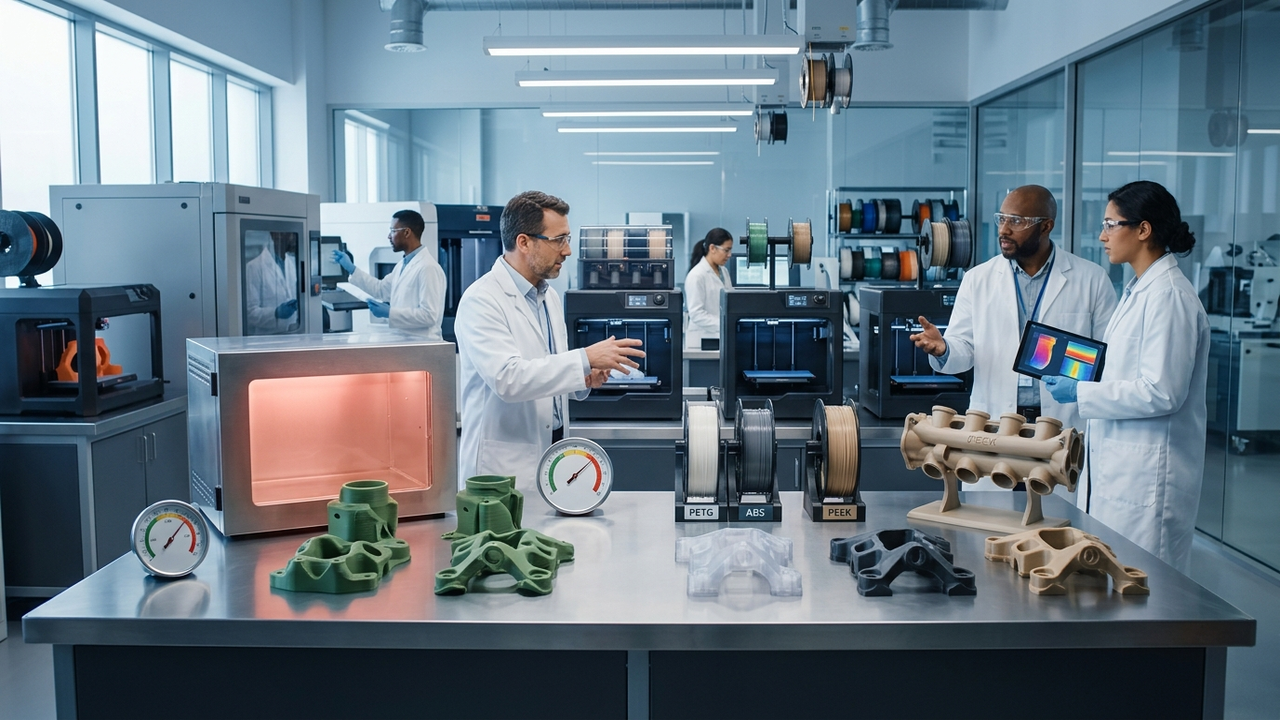
JLC3DP has published crucial guidelines regarding the heat resistance of PLA (Polylactic Acid), one of the most widely used filaments in 3D printing. The article clarifies that PLA typically begins to lose its rigidity within a temperature range of 55°C to 65°C, establishing that its practical heat resistance limit is significantly lower than its melting point (150°C to 180°C). Based on this information, JLC3DP advises designers and engineers to consider switching to materials with higher thermal stability, such as PETG, ABS, ASA, PA12-CF, or PEEK, for applications requiring sustained thermal exposure above 50°C to 60°C, thereby assisting in proper material selection.
Technical / Product Details
PLA is popular in many 3D printing applications due to its biodegradability and ease of printing. However, its primary drawback is its sensitivity to heat. The article explains the following thermal behavior of PLA:
- Heat Deflection Temperature (HDT) / Glass Transition Temperature (Tg): The glass transition temperature (Tg) of PLA is typically around 50°C to 60°C. Above this temperature, the material begins to soften, and its mechanical properties rapidly degrade. This is the temperature at which the plastic transitions from a rigid, glassy state to a more flexible, rubbery state. The Heat Deflection Temperature (HDT) also falls within this range, indicating the temperature at which a material begins to deform under a specified load.
- Melting Point: While PLA’s melting point is stated as 150°C to 180°C, this is the temperature at which the material completely melts and differs from its practical heat resistance. Parts made from PLA will begin to deform and creep (a slow, time-dependent deformation under constant stress) well before reaching their melting point.
The article highlights specific issues with using PLA parts in high-temperature environments, such as part sagging, loss of dimensional accuracy, and functional failure. In response, it proposes the following alternatives with better heat resistance:
- PETG: Offers an HDT of approximately 80°C, providing better heat resistance than PLA and good chemical resistance.
- ABS/ASA: With HDTs around 100°C, these materials combine excellent mechanical strength with higher heat resistance. ASA is an improved, weather-resistant version of ABS.
- PA12-CF (Carbon Fiber Reinforced Nylon 12): Can have an HDT above 150°C, balancing high strength with significant heat resistance.
- PEEK (Polyether Ether Ketone): Offers exceptionally high heat resistance (HDT above 150°C, continuous service temperature up to 260°C), making it ideal for extreme environment applications.
Background & Context
With the proliferation of 3D printing, its application range has expanded from prototyping to the manufacturing of functional parts. However, while novice and hobbyist users often opt for inexpensive and easy-to-print PLA, problems frequently arise when parts fail to perform as expected due to exposure to unforeseen thermal environments. This guide aims to prevent such material selection mismatches and particularly raise awareness of appropriate high-performance materials for functional parts and industrial applications. Thermal stability is an indispensable property for many engineering applications, including components within automotive engine bays, outdoor sensor housings, or internal structures of electronic devices.
Strategic Significance & Outlook
The 3D printing market will continue to see diversification and performance enhancement of materials. The availability of a wide range of options, from basic materials like PLA to advanced high-performance polymers like PEEK and carbon fiber-reinforced composites, will enable responsiveness to more complex and demanding applications. Educational content from platforms like JLC3DP serves as a crucial resource for users to understand the characteristics and limitations of each material, ensuring optimal material selection for project success. In the future, the development of more environmentally friendly yet thermally stable PLA-based composites and bio-derived high-performance polymers is anticipated, pursuing a balance between sustainability and performance.
Source: https://jlc3dp.com/blog/pla-temperature-resistance
Get our weekly technology intelligence — free
Receive an infographic that lets you judge at a glance whether each field’s analysis report is worth reading.
Subscribe Free — Weekly Tech Intelligence
By subscribing, you’ll receive Troy-Technical’s weekly technology intelligence newsletter.
- Your email and selected fields are used only to deliver the newsletter.
- We never share your information with third parties.
- You can unsubscribe anytime via the link in each email.
See our Privacy Policy for details.
Takes about a minute · Unsubscribe anytime






Comments