
Key Findings
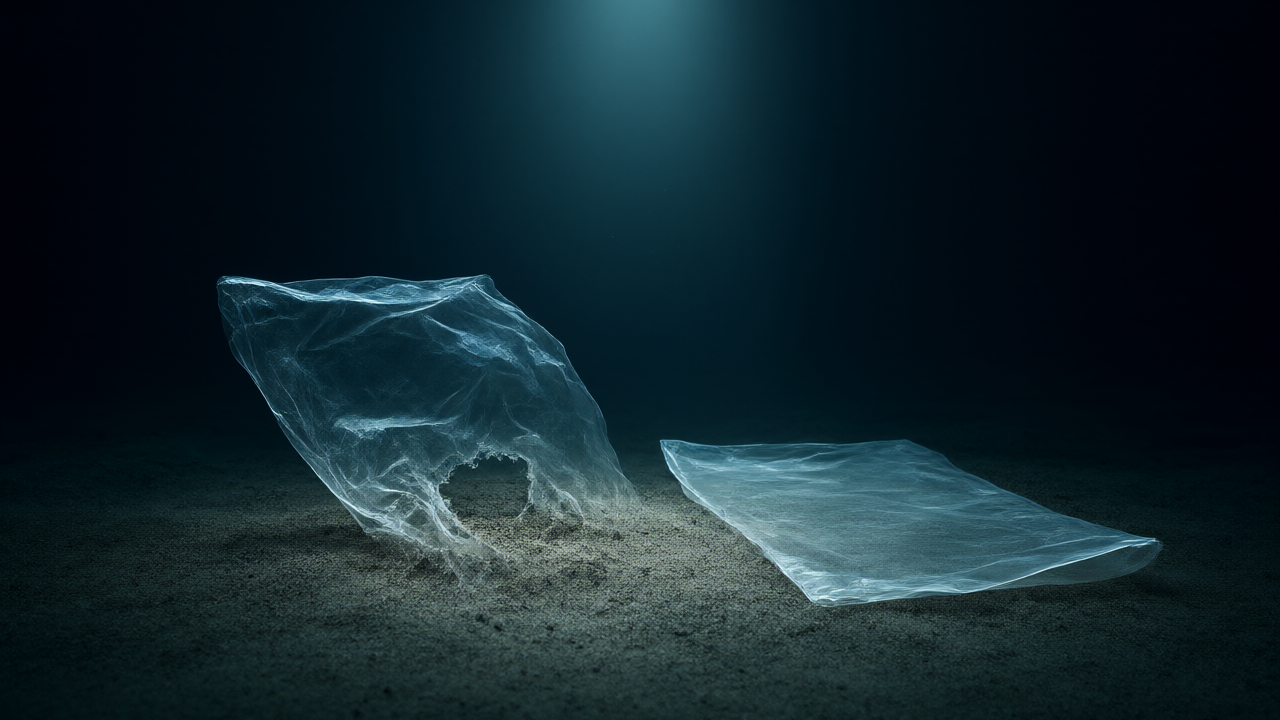
Enzyme-embedded polyesters demonstrated significantly accelerated biodegradation in deep-sea environments compared to controls. At a depth of 757 m and temperatures near 4°C, films made of PBS, PBSA, and PCL embedded with Humicola insolens cutinase (HiC) nearly completely degraded within five months. In contrast, identical films without enzymes showed a maximum weight loss of 3.4%. At the deepest test site of 5,503 m, degradation was moderate rather than complete, indicating that extreme pressure and cold limit the effectiveness of the enzymes.
Technical Details
The team mixed trace amounts of natural degrading enzymes—specifically HiC and Candida antarctica lipase B (CaLB)—directly into compostable polyester films during thermal processing. The samples were 4 cm squares and 100 micrometres thick. The enzymes act as protein catalysts that snip ester links in the polymer chains. A loading of 0.1 wt% (one gram of enzyme per kilogram of plastic) was sufficient to drive rapid degradation and microbial mineralisation in coastal trials.
- PBS, PBSA, PCL: Aliphatic polyesters that were nearly completely degraded at 757 m in five months with HiC.
- PBAT: An aromatic polymer that showed accelerated breakdown compared to controls but did not vanish completely.
- Switching Function: Enzymes remain dormant in dry conditions and activate only when water reaches the embedded proteins via surface abrasion or fragmentation.
Background & Context
The research, funded under NEDO’s Moonshot programme, involved the University of Tokyo, JAMSTEC, and Gunma University. Samples were deployed via the crewed submersible Shinkai 6500 at depths ranging from 757 m to 5,503 m. This approach differs from previous compost enzyme plastics by targeting cold, high-pressure seawater where degrading microbes are scarce.
Significance & Outlook
The study confirms that enzymatic breakdown reshapes the surrounding microbiome, enriching taxa that feed on polymer fragments to facilitate mineralisation into carbon dioxide, water, and biomass. However, the technology is limited to specific compostable polyesters and does not apply to conventional plastics like polyethylene, PET, polypropylene, or polystyrene. Manufacturing scale, product lifetimes, and costs remain untested.
Source: https://www.intelligentliving.co/enzyme-bioplastic-deep-sea-limits/
Get our weekly technology intelligence — free
Receive an infographic that lets you judge at a glance whether each field’s analysis report is worth reading.
Subscribe Free — Weekly Tech Intelligence
By subscribing, you’ll receive Troy-Technical’s weekly technology intelligence newsletter.
- Your email and selected fields are used only to deliver the newsletter.
- We never share your information with third parties.
- You can unsubscribe anytime via the link in each email.
See our Privacy Policy for details.
Takes about a minute · Unsubscribe anytime