


Background
Early disease detection and diagnosis are indispensable for improving treatment success rates and reducing healthcare costs. However, many existing diagnostic technologies face challenges such as requiring large sample volumes, lengthy analysis times, or specialized equipment. Particularly for diseases like cancer and infectious diseases, accurate diagnosis at an early stage significantly impacts patient prognosis. Lab-on-a-chip technology has garnered attention as a promising platform to address these challenges, simplifying and accelerating diagnostic processes. The ‘twisted light’ technology further extends the capabilities of lab-on-a-chip, enabling ultra-sensitive and rapid analysis from extremely minute samples, thus opening new frontiers in diagnostics.
Key Findings
On September 10, 2026, ARTIC, citing research from Adelaide University, reported a groundbreaking technology that leverages the properties of ‘twisted light’ (light with Orbital Angular Momentum: OAM). This technique holds the potential to dramatically enhance the speed and sensitivity of medical tests, especially when dealing with minute sample volumes. This innovation is expected to be integrated into compact lab-on-a-chip devices, enabling real-time analysis of extremely small biological samples. It promises to have a significant impact on advancing next-generation point-of-care testing (POCT), thereby improving early disease detection and streamlining the overall diagnostic process.
Technical / Clinical Details
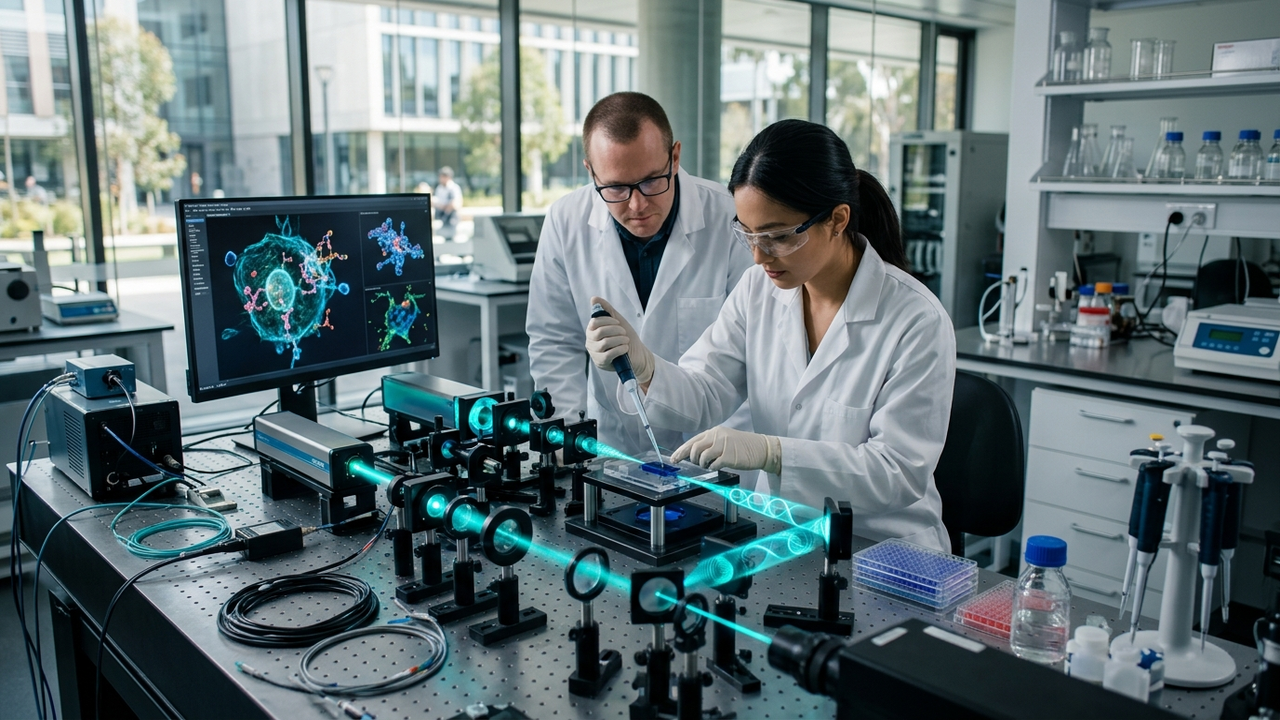
‘Twisted light’ (light carrying Orbital Angular Momentum: OAM) possesses unique properties due to its helical wavefront, distinct from conventional light. Researchers at Adelaide University have developed a system that exploits the peculiar behavior of this OAM light when interacting with minute particles and molecules to detect the presence and concentration of analytes with high sensitivity. Specifically, by precisely controlling samples within a microfluidic chip and illuminating them with OAM light, it became possible to identify specific biomarkers (e.g., proteins secreted by cancer cells or viral particles) in very small volumes of liquid more rapidly and accurately than conventional methods. This technology is exceptionally sensitive to subtle changes in the optical properties of the target analytes, significantly reducing measurement time while pushing detection limits even lower. This enables applications such as early detection of disease markers from blood samples of less than 10 μL.
Strategic Significance & Outlook
This ‘twisted light’ technology is expected to have broad applications in the medical diagnostics field. Particularly, if integrated into small, portable POCT devices, it could enable rapid, specialized testing in outpatient clinics, remote healthcare settings, and even patients’ homes. This would dramatically improve disease screening, diagnosis, and treatment monitoring. For example, it could enhance the accuracy and speed of ‘liquid biopsies’ for detecting cancer biomarkers from a single drop of blood, or enable real-time monitoring of viral loads for infectious diseases. In the future, by combining this technology with AI and machine learning, intelligent diagnostic systems capable of diagnosing diseases from complex biomarker patterns and proposing personalized treatment strategies may become a reality. This innovation is expected to contribute significantly to the advancement of precision medicine.
Source: https://artic.org.au/2026/09/10/twisted-light-breakthrough-could-enable-earlier-disease-detection/
Get our weekly technology intelligence — free
Receive an infographic that lets you judge at a glance whether each field’s analysis report is worth reading.
Subscribe Free — Weekly Tech Intelligence
By subscribing, you’ll receive Troy-Technical’s weekly technology intelligence newsletter.
- Your email and selected fields are used only to deliver the newsletter.
- We never share your information with third parties.
- You can unsubscribe anytime via the link in each email.
See our Privacy Policy for details.
Takes about a minute · Unsubscribe anytime