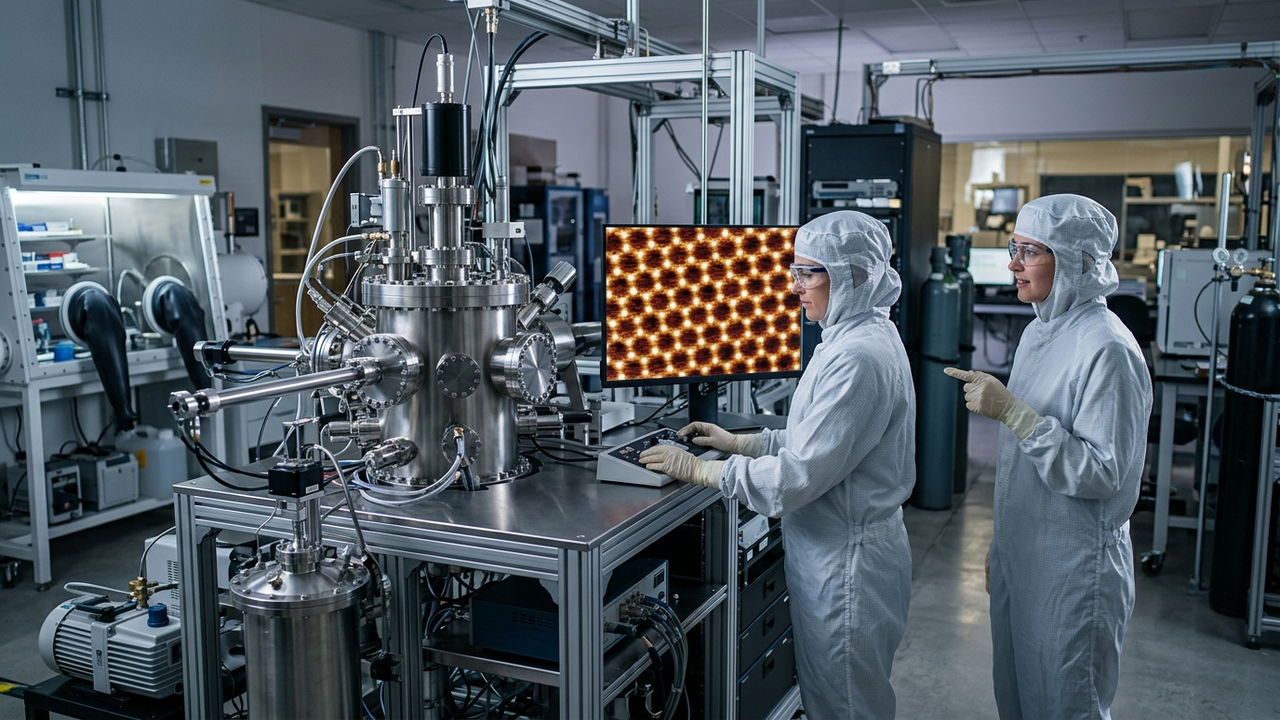
Since the discovery of graphene, two-dimensional (2D) materials have remained one of the most active research areas in materials science. Researchers at Argonne National Laboratory have set a new milestone in this field by successfully synthesizing, for the first time, a single-atom-thick sheet of the metallic element boron, known as ‘borophene.’ This achievement holds the potential to revolutionize future energy and electronic technologies.
Key Findings
- Researchers at Argonne National Laboratory successfully synthesized borophene, a metallic single-atom-thick boron, for the first time.
- Attracts attention as a next-generation 2D material with potential comparable to or exceeding graphene.
- Created new boron-based 2D structures with unique electronic properties and high mechanical strength.
- Opened up broad application possibilities for future energy storage, catalysis, and electronic devices.
Technical Details
The synthesis of borophene was achieved by depositing boron atoms onto a specific substrate (e.g., silver or copper surfaces) under an ultra-high vacuum environment. Due to the complexity of its electronic structure, boron was predicted to form various polymorphs rather than a simple honeycomb structure like graphene. Researchers successfully grew stable single-atom-layer boron sheets, borophene, by precisely controlling the interaction with the substrate. The obtained borophene was thoroughly characterized for its atomic structure and electronic states using advanced analytical techniques such as scanning tunneling microscopy (STM) and X-ray photoelectron spectroscopy (XPS). Notably, metallic electronic transport properties consistent with theoretical calculations and excellent mechanical properties comparable to existing 2D materials were confirmed. Since borophene, unlike graphene, does not exist as a natural 2D sheet and has been considered extremely difficult to synthesize, this successful synthesis represents a major technological breakthrough.
Background & Context
2D materials like graphene and molybdenum disulfide (MoS₂) are anticipated to have applications in next-generation electronics, sensors, and energy storage devices due to their superior electrical, optical, and mechanical properties. The extreme thinness of single-atom thickness, in particular, brings new dimensions to material properties. Boron, while having a similar atomic number to carbon, possesses different electronic properties, so borophene is expected to offer unique functionalities distinct from graphene. For example, it may exhibit properties difficult to achieve with conventional 2D materials, such as superconductivity, excellent hydrogen storage capacity, and high catalytic activity. This discovery further expands the diverse family of 2D materials and opens new avenues for scientific exploration.
Strategic Significance & Outlook
The first successful synthesis of borophene by Argonne National Laboratory will have immeasurable impact on the fields of materials science and nanotechnology. Future efforts will focus on developing large-scale synthesis methods for borophene, exploring its growth behavior on different substrates, and evaluating its application potential as electronic devices, batteries, catalysts, and superconductors. For instance, it holds promise for ultra-small, high-efficiency transistors, high-capacity hydrogen storage materials, new types of sensors, and even as a room-temperature superconductor. This groundbreaking material is expected to stimulate fundamental scientific research and serve as a new platform driving future technological innovation. Borophene will garner significant attention from researchers and engineers worldwide as the ‘next frontier’ in 2D materials.
Source: https://www.anl.gov/article/nanoscience-where-big-breakthroughs-start-small
Get our weekly technology intelligence — free
Receive an infographic that lets you judge at a glance whether each field’s analysis report is worth reading.
Subscribe Free — Weekly Tech Intelligence
By subscribing, you’ll receive Troy-Technical’s weekly technology intelligence newsletter.
- Your email and selected fields are used only to deliver the newsletter.
- We never share your information with third parties.
- You can unsubscribe anytime via the link in each email.
See our Privacy Policy for details.
Takes about a minute · Unsubscribe anytime









Comments