Key Findings
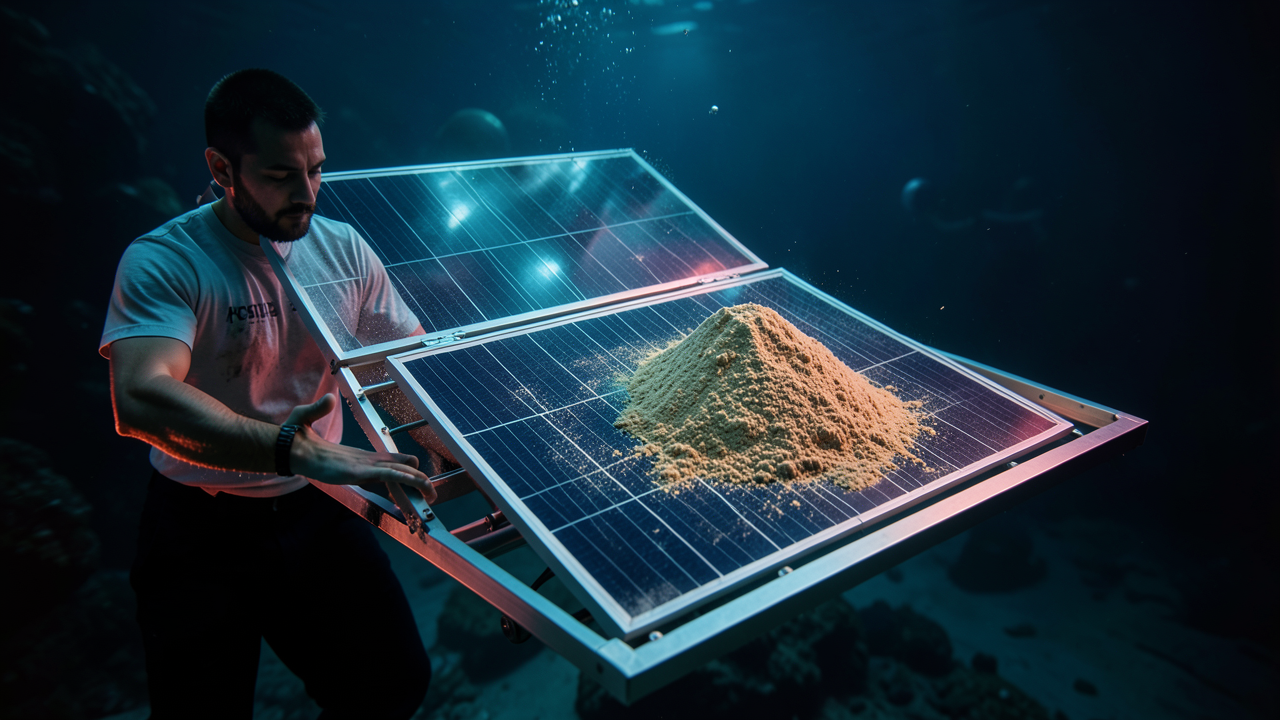
A research team at Yunnan University in China has successfully developed a groundbreaking technology enabling perovskite solar cells (PSCs) to operate efficiently in an underwater environment at a depth of 10 meters. This achievement pioneers the use of underwater solar power as a new application area for photovoltaics, demonstrating the ability to harvest 324 milliwatt-hours (mWh) of energy at that depth. Furthermore, laboratory tests reported conversion efficiencies nearing 35%, with each device expected to have a relatively long lifespan of 5.5 years.
Technical / Clinical Details
The research team combined specialized encapsulation techniques and material design to ensure the perovskite solar cells maintain their performance under harsh underwater conditions. While conventional solar cells are typically vulnerable to water, Yunnan University’s technology prevents water-induced degradation while efficiently converting attenuated sunlight underwater into electricity. As depth increases, the light spectrum shifts, with blue-green light preferentially penetrating. Optimizing the perovskite material to match these specific light characteristics was crucial. The near 35% conversion efficiency strongly suggests the high theoretical potential of perovskite materials for underwater applications. The 5.5-year lifespan is a practical duration for long-term operations required by applications such as underwater observation equipment and autonomous underwater drones.
Background & Context
The world’s oceans represent a vast, untapped energy resource, and power supply in underwater environments has long been a challenge for marine science research, environmental monitoring, subsea resource exploration, and autonomous underwater vehicle operations. Traditional underwater power sources have relied on batteries or external supply via cables, both limited by operational duration and high costs. The underwater application of perovskite solar cells offers an innovative solution to these challenges. This breakthrough will significantly enhance the autonomy of equipment in marine environments, enabling more sustainable and extensive oceanographic activities.
Strategic Significance & Outlook
This research by Yunnan University in China marks a crucial step towards the commercialization and practical implementation of underwater solar power technology. Future efforts are expected to accelerate research and development focused on performance evaluation at greater depths, long-term stability validation, and cost reduction and durability improvements for mass production. If realized, underwater solar power could provide clean and sustainable energy to various marine applications, including ocean buoys, subsea sensor networks, and autonomous underwater vehicles (AUVs), potentially revolutionizing the entire marine industry. This technology holds the potential to expand the frontier of renewable energy into the oceans, fundamentally transforming how humanity utilizes marine resources.
Get our weekly technology intelligence — free
Receive an infographic that lets you judge at a glance whether each field’s analysis report is worth reading.
Subscribe Free — Weekly Tech Intelligence
By subscribing, you’ll receive Troy-Technical’s weekly technology intelligence newsletter.
- Your email and selected fields are used only to deliver the newsletter.
- We never share your information with third parties.
- You can unsubscribe anytime via the link in each email.
See our Privacy Policy for details.
Takes about a minute · Unsubscribe anytime








Comments