
Key Findings
Google DeepMind’s GNoME AI model has successfully discovered an unprecedented 2.2 million novel crystal structures, predicting 380,000 of these to be stable. This monumental achievement is estimated to be equivalent to 800 years of experimental findings, unequivocally demonstrating the transformative power of artificial intelligence in materials science. Generative AI models, specifically systems like MatterGen and AtomGPT, are now capable of directly proposing and designing molecular and crystalline structures optimized for specific target properties, thereby revolutionizing the entire materials research and development paradigm.
Technical / Clinical Details
GNoME employs an AI framework that integrates reinforcement learning with fundamental physics principles, allowing for the efficient exploration of vast compositional spaces and the prediction of stable inorganic materials. This approach dramatically accelerates material exploration compared to traditional, human-hypothesis-driven ‘trial-and-error’ experimental processes, enabling far greater speed and scope. Companies such as Citrine Informatics are leveraging AI and data-driven methodologies by training models on historical experimental data and simulation results to model the complex relationships between material composition, structure, processing conditions, and resulting properties. This enables the design of optimized new materials and is significantly reducing the time from discovery to development and market launch.
Background & Context
The field of materials science has consistently sought innovation, as the discovery of materials with novel functionalities drives advancements across diverse industries, including batteries, semiconductors, medicine, and aerospace. However, conventional material development has historically relied on extensive experimental validation, which is both time-consuming and costly. The introduction of AI addresses this bottleneck by enabling a predictive and highly efficient approach to derive new insights from data. Generative AI and deep learning models, in particular, possess the capability to identify solutions within complex material design spaces that are often beyond human intuition.
Strategic Significance & Outlook
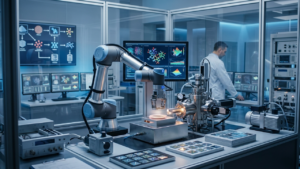
The accelerated pace of AI-driven materials discovery is poised to bring about groundbreaking advancements in various sectors, including green energy technologies (e.g., high-efficiency solar cells, next-generation batteries), advanced electronics, and lightweight, high-strength structural materials. By compressing the time-to-market for new materials from decades to mere months, the societal implementation of new technologies will accelerate, profoundly impacting global economies. Future developments integrating AI with robotics to create autonomous experimental systems promise even faster and more automated material discovery and optimization, laying the groundwork for future technological innovation.
Source: https://www.alcimed.com/en/insights/ai-materials/
Get our weekly technology intelligence — free
Receive an infographic that lets you judge at a glance whether each field’s analysis report is worth reading.
Subscribe Free — Weekly Tech Intelligence
By subscribing, you’ll receive Troy-Technical’s weekly technology intelligence newsletter.
- Your email and selected fields are used only to deliver the newsletter.
- We never share your information with third parties.
- You can unsubscribe anytime via the link in each email.
See our Privacy Policy for details.
Takes about a minute · Unsubscribe anytime







Comments