
Key Findings
As of 2026, most commercially available ‘solid-state batteries’ are, in fact, semi-solid hybrid designs, not true all-solid-state batteries (ASSBs). However, a significant number of leading automotive manufacturers and battery developers are actively planning to commence pilot-scale production of genuine all-solid-state batteries between 2027 and 2028. Full-scale mass production is not expected until after 2030, reflecting the ongoing challenges in technological maturation and cost-efficiency required for widespread adoption.
Technical / Clinical Details
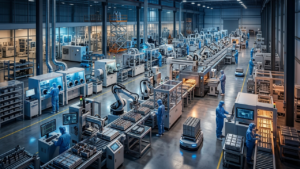
Companies are setting ambitious targets. US-based QuantumScape aims for pilot production in 2026, with mass production starting in 2027-2028. Their anode-free solid-state battery claims a volumetric energy density of 844 Wh/L, a gravimetric energy density of 301 Wh/kg, and a 10-80% charge time of approximately 12 minutes. In China, Geely plans to complete its 400 Wh/kg energy density solid-state battery pack by 2026. Dongfeng has already operationalized a 0.2 GWh pilot production line and aims for mass production of a 350 Wh/kg energy density battery pack with a 1,000 km range in 2027. These figures represent significant improvements over current high-performance lithium-ion batteries and promise to revolutionize EV capabilities.
Background & Context
All-solid-state batteries are heralded as the ultimate battery technology, poised to resolve critical issues faced by existing liquid-electrolyte lithium-ion batteries, including safety, energy density, and lifespan. Extending driving range and significantly reducing charging times are essential for accelerating EV adoption. Governments and corporations globally are investing heavily in this technology, engaging in intense competition to lead the next-generation battery market. The transition from semi-solid to true all-solid-state batteries is considered the next major breakthrough following lithium-ion technology.
Strategic Significance & Outlook
The commencement of pilot production from 2027 marks a crucial step towards the practical implementation of all-solid-state battery technology. However, significant challenges remain for subsequent mass production, including technological maturity, cost reduction, and the establishment of robust supply chains. Particularly, compatibility with existing lithium-ion battery manufacturing processes and improving production efficiency will be key to market penetration. With full market introduction anticipated after 2030, EV performance is expected to further improve, enhancing their competitiveness against gasoline-powered vehicles. This technological innovation has the potential to impact not only the automotive industry but also broader sectors such as energy storage and aerospace.
Source: https://www.evinfrastructurenews.com/ev-battery/solid-state-vs-lithium-ion-batteries
Get our weekly technology intelligence — free
Receive an infographic that lets you judge at a glance whether each field’s analysis report is worth reading.
Subscribe Free — Weekly Tech Intelligence
By subscribing, you’ll receive Troy-Technical’s weekly technology intelligence newsletter.
- Your email and selected fields are used only to deliver the newsletter.
- We never share your information with third parties.
- You can unsubscribe anytime via the link in each email.
See our Privacy Policy for details.
Takes about a minute · Unsubscribe anytime







Comments