Key Findings
Nvidia CEO Jensen Huang has projected that Nvidia’s chip sales will double next year, concurrently accelerating the transition to HBM4 (4th-generation High Bandwidth Memory), a critical component for high-performance computing and AI applications. However, a primary constraint for this rapid growth remains TSMC’s CoWoS (Chip-on-Wafer-on-Substrate) advanced packaging capacity, identified as the main shipping bottleneck.
Technical / Clinical Details
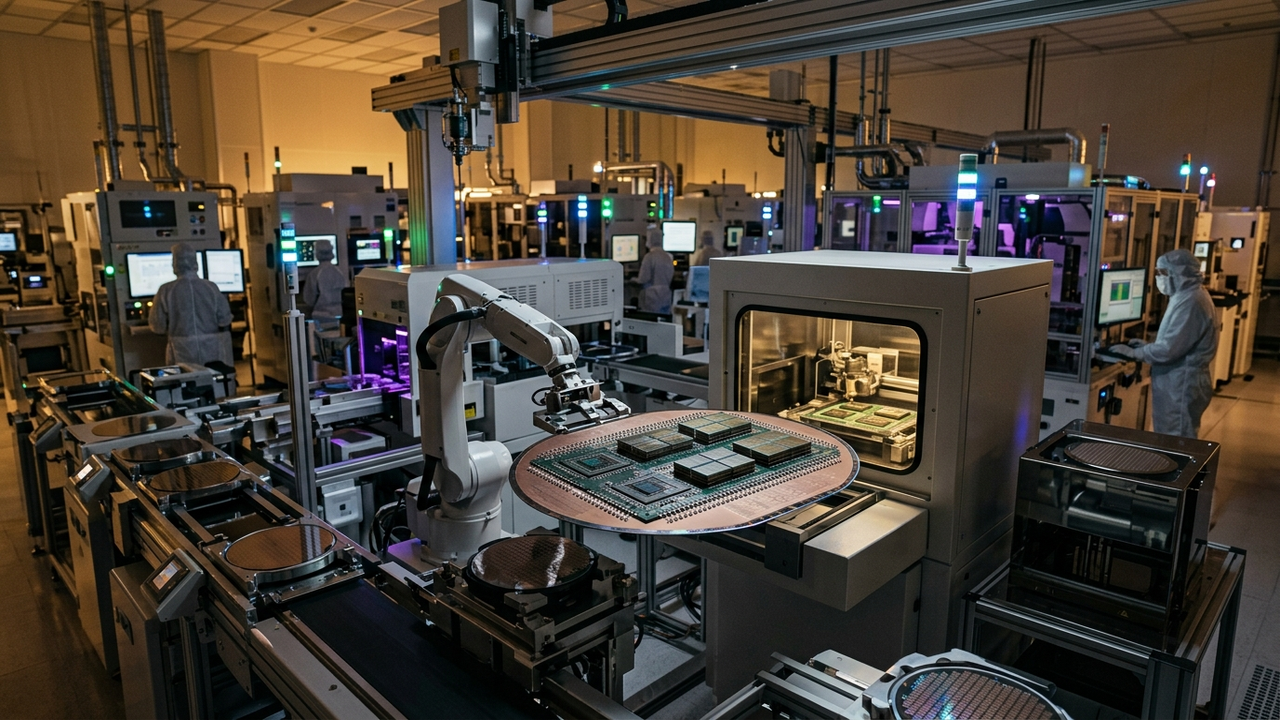
Nvidia’s graphics processing units (GPUs) are manufactured at TSMC, utilizing the CoWoS process to integrate the GPU with HBM in a single, unified package. This CoWoS technology is indispensable for achieving the high integration density and superior data bandwidth required to maximize the performance of AI accelerators. Currently, CoWoS production capacity lags behind the insatiable demand for Nvidia’s products, creating a significant shipping bottleneck. In response, TSMC is actively executing plans to substantially expand its monthly CoWoS capacity, aiming to double it from approximately 130,000 wafers by the end of 2026 to around 260,000 wafers by the end of 2028. This capacity augmentation is paramount for Nvidia to meet its future shipment targets and ensure a smooth transition to HBM4, enabling more powerful and efficient AI systems.
Background & Context
The explosive growth of AI has driven unprecedented demand for high-performance GPUs and their associated HBM. As a leader in the AI chip market, Nvidia is a primary beneficiary of this demand. CEO Huang’s prediction of doubled chip sales underscores that global investment in AI infrastructure is still in its early phases, with high levels of spending expected to continue for the long term. The CoWoS bottleneck in the supply chain affects not only Nvidia but also other AI chip developers, making large-scale investments in packaging capacity by TSMC and other OSAT (Outsourced Semiconductor Assembly and Test) providers an urgent industry-wide priority.
Strategic Significance & Outlook
Nvidia’s robust growth forecast and accelerated HBM4 transition will have a profound impact across the semiconductor industry, particularly in advanced packaging and memory sectors. If TSMC’s plan to double CoWoS capacity proceeds as scheduled, Nvidia’s shipping bottlenecks are expected to ease progressively, allowing more AI chips to reach the market. This will further accelerate the proliferation of AI technologies, fostering innovation in diverse fields such as autonomous driving, robotics, and advanced data analytics. The key challenge ahead will be how the entire semiconductor supply chain adapts and collaborates to support this AI-driven growth trajectory, ensuring sustained technological advancement.
Source: https://finance.biggo.com/news/d81ffb54-2ad9-4684-805d-14a08d4f7eeb
Get our weekly technology intelligence — free
Receive an infographic that lets you judge at a glance whether each field’s analysis report is worth reading.
Subscribe Free — Weekly Tech Intelligence
By subscribing, you’ll receive Troy-Technical’s weekly technology intelligence newsletter.
- Your email and selected fields are used only to deliver the newsletter.
- We never share your information with third parties.
- You can unsubscribe anytime via the link in each email.
See our Privacy Policy for details.
Takes about a minute · Unsubscribe anytime







Comments