Key Findings
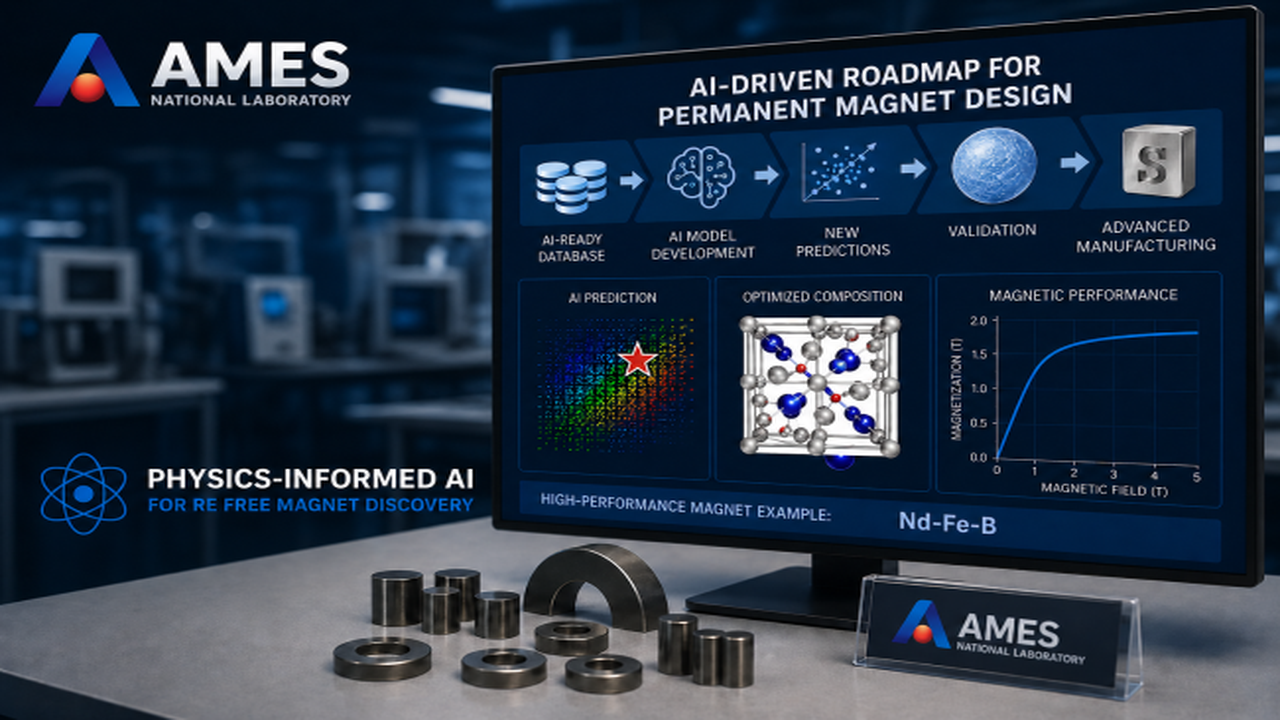
Researchers at Ames National Laboratory are pioneering an AI-driven roadmap to accelerate the discovery and design of rare-earth-free permanent magnets. This advanced framework integrates fundamental physics, high-throughput simulations, and reasoning-based AI to efficiently identify promising material candidates, moving beyond conventional trial-and-error methods. As a core component of the U.S. Department of Energy’s (DOE) Genesis Mission, this initiative aims to significantly reduce dependence on foreign rare earth supplies and facilitate the development of high-performance, lower-cost magnets, thereby strengthening domestic supply chains.
Technical / Clinical Details
- AI-Driven Material Discovery: The traditional process of discovering new permanent magnet materials is characterized by extensive experimental synthesis and characterization, which is time-consuming and costly. The AI-driven roadmap employs machine learning algorithms and vast materials databases to rapidly screen potential compositions and structures, drastically narrowing the search space.
- Physics-Informed AI: Unlike purely data-driven AI, this approach embeds fundamental physical principles (e.g., quantum mechanics, solid-state physics) into the AI models. This allows for more accurate predictions of magnetic properties from atomic structures and electronic behaviors, ensuring that proposed materials are not only novel but also physically feasible and likely to exhibit desired performance characteristics.
- High-Throughput Simulations: Candidate materials identified by the AI are rapidly evaluated using high-throughput computational simulations, such as density functional theory (DFT) calculations. This enables prediction of critical magnetic properties like magnetic moment, coercivity, and Curie temperature before experimental synthesis, focusing resources on the most promising candidates.
- Reasoning-Based AI: Incorporating past materials science knowledge and expert insights, reasoning-based AI helps derive new design principles and uncover hidden correlations that might be overlooked by human researchers, leading to more intelligent material design strategies.
Background & Context
Permanent magnets are indispensable components in a wide array of modern technologies, including electric vehicles (EVs), wind turbines, robotics, and advanced electronics. The highest-performing magnets currently rely heavily on rare earth elements like Neodymium (Nd) and Samarium (Sm). However, the supply of these elements is concentrated in a few countries, posing geopolitical risks and price volatility. The U.S. seeks to bolster its national security and economic independence by developing high-performance, rare-earth-free or reduced-rare-earth magnets.
Strategic Significance & Outlook
The AI-driven roadmap from Ames National Laboratory is a powerful tool for accelerating the discovery of rare-earth-free permanent magnets. By integrating millennia of existing materials knowledge with novel design principles, this approach significantly increases the probability of identifying overlooked, high-performance material candidates. The expected outcomes include:
- Rapid Material Discovery: Substantially shortening the material development cycle, enabling quicker market deployment of new magnet technologies.
- Cost Reduction: Lowering manufacturing costs by reducing or eliminating the need for expensive rare earth elements.
- Supply Chain Diversification: Enhancing domestic production capabilities for magnet materials, mitigating supply chain vulnerabilities.
This research underscores the central role AI plays in shaping the future of functional materials and provides an essential foundation for the development of next-generation clean energy technologies and high-performance electronics. While direct commercialization remains a long-term goal, this systematic, AI-accelerated approach is critical for achieving a more secure and sustainable materials future.