Key Findings
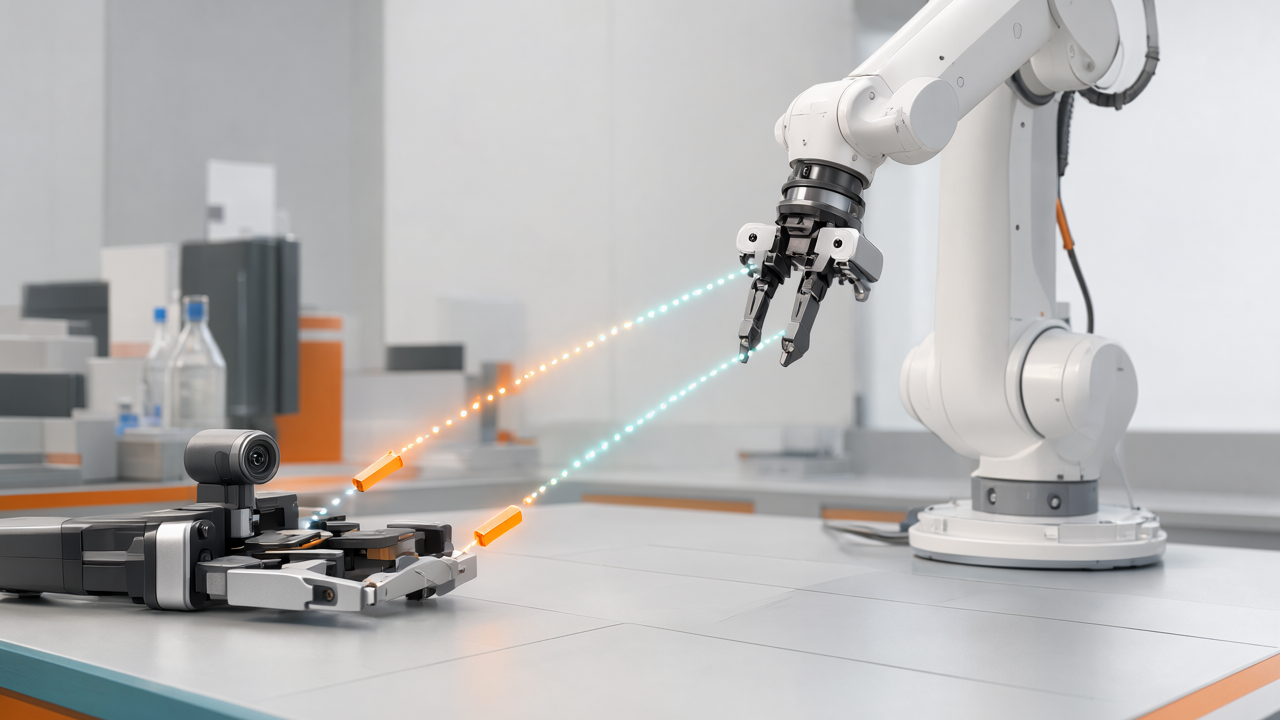
This paper introduces “HIL-UMI (Human-in-the-Loop Universal Manipulation Interface),” a novel framework designed to streamline post-training for robot Vision-Language-Action (VLA) models. HIL-UMI achieves a separation of data collection and robot deployment by querying the current policy during handheld UMI demonstrations, detecting mismatches between human trajectories and policy inference as outlier regions, and subsequently triggering targeted data collection in those areas. This approach demonstrates potential for dramatically improving VLA model training processes while sustaining iterative and policy-aware human-in-the-loop learning.
Technical / Clinical Details
The essence of the HIL-UMI framework lies in its ability to effectively provide feedback to a robot’s policy (action-decision rules) without direct human manipulation of the robot itself. The specific process unfolds as follows:
- **Policy-Guided Data Collection:** A human demonstrates a desired task using a handheld Universal Manipulation Interface (UMI). During this demonstration, HIL-UMI queries the current robot policy in real-time, identifying “outlier” regions where human movements significantly diverge from the policy’s predictions.
- **Targeted Data Collection in Mismatch Regions:** When an outlier is detected, the system is triggered to collect that specific sequence of actions as data. This focused data collection ensures that highly relevant information, particularly from areas where the policy struggles or misinterprets, is gathered efficiently.
- **Separation of Data Collection and Deployment:** A major advantage of this method is the ability to decouple the data collection process from actual robot deployment. High-quality data can be generated offline by humans without lengthy engagement of expensive physical robots, thereby reducing training costs and time, and minimizing robot downtime.
- **Iterative and Policy-Aware Learning:** The collected data is used for fine-tuning the VLA model, iteratively refining the policy to more accurately reflect human intent. This cycle ensures that robot behavior evolves to become more reliable and aligned with human expectations.
Background & Context
VLA models represent a next-generation AI technology integrating image recognition, natural language understanding, and robot action planning, enabling robots to perform complex tasks through natural interaction with humans. However, training these models requires vast amounts of high-quality real-world data, especially challenging in domains where robot malfunctions or hazards are possible. While direct human operation of robots for data provision (learning from demonstration) is effective, it poses challenges in terms of safety and scalability. HIL-UMI presents an ingenious solution to these issues, maintaining humans in the learning loop while circumventing the constraints of physical robots.
Strategic Significance & Outlook
The development of frameworks like HIL-UMI is poised to dramatically enhance the efficiency and safety of VLA model training, accelerating the realization of general-purpose robots. This will make the deployment of more intelligent and autonomous robots in diverse sectors such as industry, healthcare, services, and households a tangible reality. For example, it will enable non-experts to easily teach new tasks to robots, fostering the widespread adoption of customized robot solutions. In the future, robots that adapt to unfamiliar environments and perform complex tasks safely and efficiently, acting as “smart assistants” through intuitive human operation, are expected to become indispensable members of society.
Source: https://www.alphaxiv.org/abs/2609.20659
Get our weekly technology intelligence — free
Receive an infographic that lets you judge at a glance whether each field’s analysis report is worth reading.
Subscribe Free — Weekly Tech Intelligence
By subscribing, you’ll receive Troy-Technical’s weekly technology intelligence newsletter.
- Your email and selected fields are used only to deliver the newsletter.
- We never share your information with third parties.
- You can unsubscribe anytime via the link in each email.
See our Privacy Policy for details.
Takes about a minute · Unsubscribe anytime






Comments