Key Findings
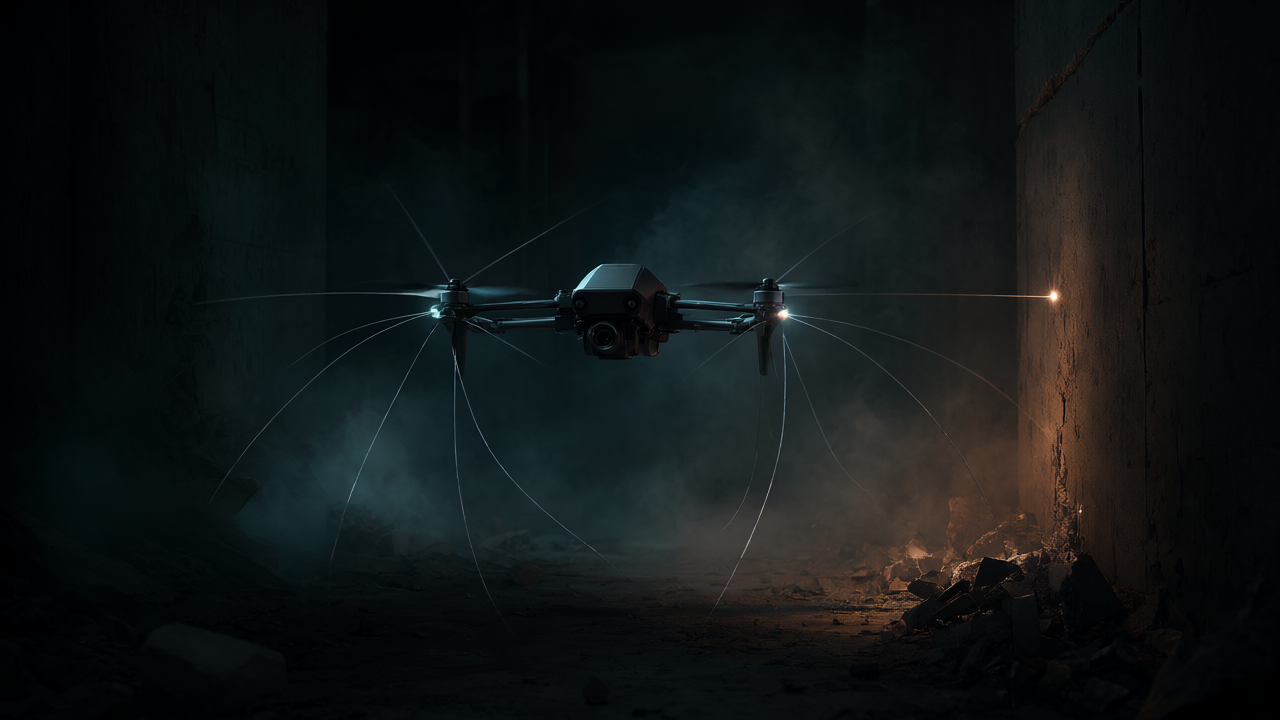
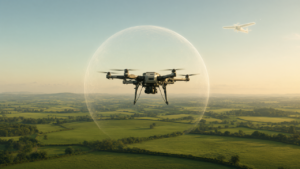
Researchers at Delft University of Technology have successfully developed and integrated lightweight, bio-inspired tactile sensors, modeled after rat whiskers, into small autonomous drones. This innovative technology enables drones to effectively navigate using only their sense of touch in environments where visual information is severely compromised, such as darkness, dust, or smoke. The artificial whiskers provide continuous feedback upon contact with the surroundings, allowing the drones to explore unknown spaces and construct detailed tactile maps in real-time, independent of cameras or other vision-based sensors.
Technical / Clinical Details
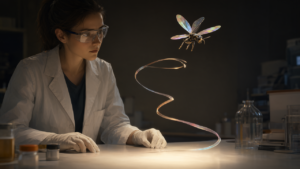
The bio-inspired sensors are crafted from extremely lightweight and flexible materials, minimizing any impact on the drone’s flight performance. When a whisker makes contact with an object, the sensor converts information such as contact point, force, and vibration into electrical signals, which are then transmitted to the drone’s control system. This tactile data serves as crucial input for the drone to perceive the distance and shape of obstacles, enabling it to determine its path while actively avoiding collisions. In environments where visual sensors are rendered ineffective, this tactile information can become the sole reliable means of navigation. Similar to how rats precisely map their surroundings with whiskers, these drones can reconstruct a 3D environmental structure from tactile data.
Background & Context
While the applications of drones are rapidly expanding, operating in environments with limited visual information — such as smoke-filled fire sites, rubble-strewn disaster zones, or subterranean spaces and enclosed industrial facilities with poor visibility — remains a significant challenge. Conventional drones heavily rely on vision-based sensors like cameras and LiDAR, which suffer severe performance degradation or complete failure in such conditions. The research from Delft University of Technology overcomes these limitations, dramatically enhancing the practicality and safety of drone operations, particularly for critical tasks like search and rescue or hazardous material inspection. This work also stands as a notable success story in applying superior biological sensory systems to robotics.
Strategic Significance & Outlook
The development of drones equipped with rat-whisker-inspired tactile sensors opens new frontiers for autonomous robot operations in adverse environments. Future advancements are expected to refine this technology further, enabling the identification of finer textures and the integration of information from multiple whisker sensors for more complex environmental perception. This will allow drones to become more effective tools in extremely challenging missions, including locating survivors in disaster areas, inspecting toxic gas leaks, or exploring unknown caves in space. Moreover, tactile sensing technology holds potential beyond drones, extending to other autonomous robots (e.g., humanoids or exploration robots working in visually impaired conditions), thereby promising a broad impact across the robotics domain.
Source: https://www.eurekalert.org/news-releases/1144453
Get our weekly technology intelligence — free
Receive an infographic that lets you judge at a glance whether each field’s analysis report is worth reading.
Subscribe Free — Weekly Tech Intelligence
By subscribing, you’ll receive Troy-Technical’s weekly technology intelligence newsletter.
- Your email and selected fields are used only to deliver the newsletter.
- We never share your information with third parties.
- You can unsubscribe anytime via the link in each email.
See our Privacy Policy for details.
Takes about a minute · Unsubscribe anytime



Comments