Key Findings
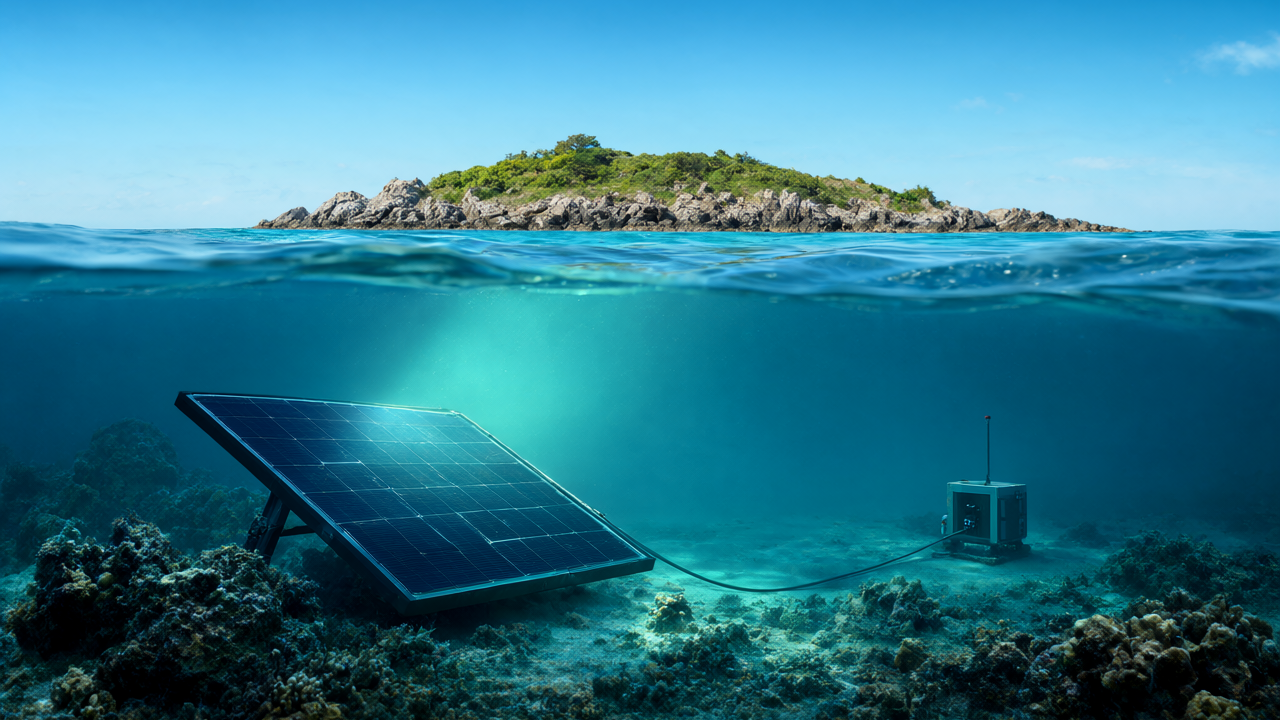
A team of Chinese scientists has successfully deployed wide-bandgap perovskite solar cells 10 meters underwater off Weizhou Island in the South China Sea, generating 324 mWh of power. This groundbreaking achievement overcomes the significant challenges of corrosion and continuous power supply in subsea environments, aiming to substantially expand China’s marine surveillance capabilities. The technology’s ability to efficiently harvest blue-green light, which penetrates water effectively, coupled with enhanced stability, marks a pivotal development in underwater energy solutions.
Technical & Clinical Details
The perovskite solar cells utilized in this deployment were specifically tuned to capture blue-green light, the spectrum that penetrates deepest into water. This optimization was achieved through precise material engineering, including the use of specific additives to reduce defects and suppress ion migration within the perovskite structure. These modifications enhance the cell’s efficiency and stability under harsh marine conditions, characterized by high pressure, salinity, and low temperatures. The 324 mWh of generated electricity is sufficient to continuously power small subsea sensors and communication modules, enabling prolonged operation without external power sources. This capability promises to drastically reduce operational costs associated with the deployment and maintenance of marine infrastructure.
Background & Context
Providing reliable power in marine environments has been a persistent challenge for various applications, including undersea sensor networks, oceanographic research robots, and military reconnaissance systems. Traditional battery-powered systems have limited lifespans, necessitating frequent maintenance or replacement. While solar power is widely used on land and in space, efficient underwater energy generation has been difficult due to light absorption characteristics and corrosion issues in water. Perovskite solar cells, with their high light absorption coefficients and material tunability, offer a promising avenue for optimization in aquatic settings, and this success opens a new frontier in the field.
Strategic Significance & Outlook
The successful deployment of underwater perovskite solar cells has significant implications across marine science, defense, and resource exploration. In the future, it is anticipated that this technology could enable power supply to even deeper waters and the construction of extensive self-powered marine sensor networks. It also has the potential to dramatically extend the operational range and endurance of unmanned underwater vehicles (UUVs), further bolstering China’s maritime presence and technological edge. This innovation demonstrates how renewable energy can be extended to previously untapped domains of the planet, opening new possibilities for exploration and strategic advantage.
Source: https://energygeopoliticsandstatecraft.substack.com/p/submerged-power-surface-control-chinas
Get our weekly technology intelligence — free
Receive an infographic that lets you judge at a glance whether each field’s analysis report is worth reading.
Subscribe Free — Weekly Tech Intelligence
By subscribing, you’ll receive Troy-Technical’s weekly technology intelligence newsletter.
- Your email and selected fields are used only to deliver the newsletter.
- We never share your information with third parties.
- You can unsubscribe anytime via the link in each email.
See our Privacy Policy for details.
Takes about a minute · Unsubscribe anytime







Comments