


Key Findings
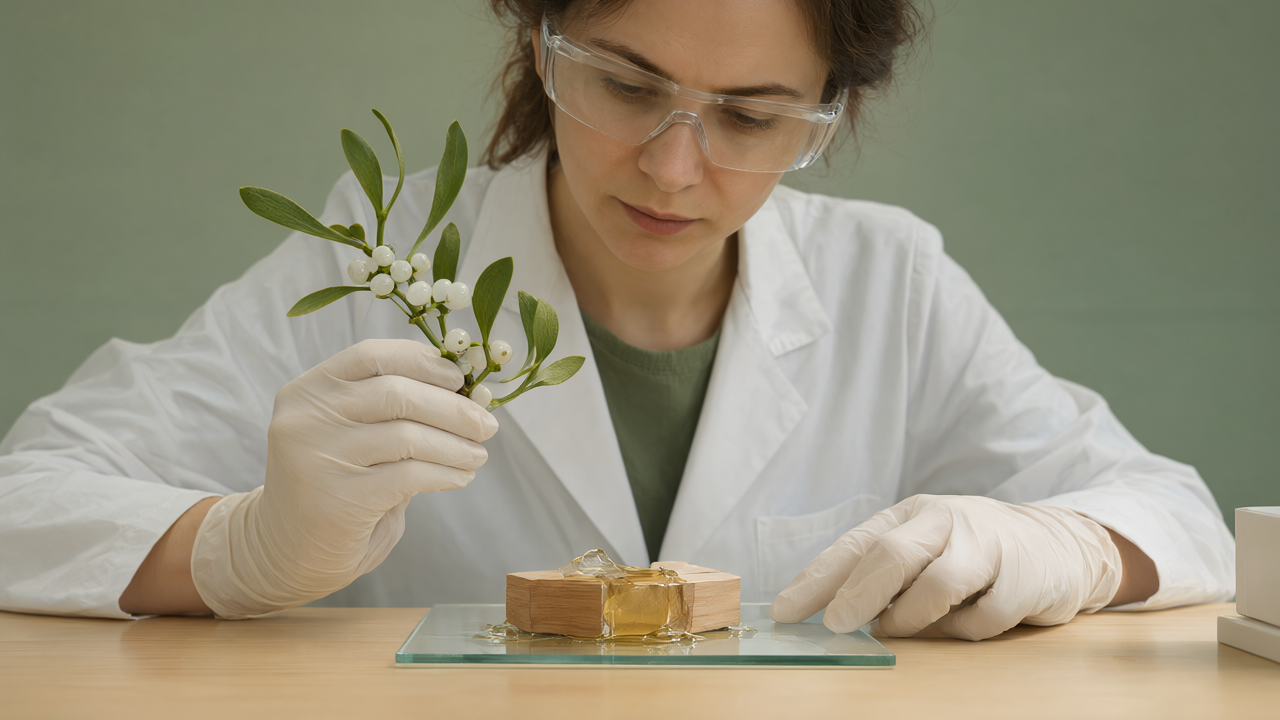
A research team at the Technical University of Munich (TUM) has developed a groundbreaking, high-performance, fully bio-based adhesive using components extracted from mistletoe berries. This novel adhesive demonstrates exceptional bonding strength, achieving shear strengths greater than 10 Megapascals (MPa) on a wide range of materials, including challenging substrates like wood, metal, glass, and even Teflon. A standout feature is its ability to maintain adhesive performance at cryogenic temperatures as low as -150°C. Furthermore, the adhesive exhibits remarkable reversibility, allowing for debonding and subsequent reactivation by heating to approximately 90°C.
Technical / Clinical Details
- Source Material and Production: The adhesive’s primary component is viscin, a viscous substance found in mistletoe berries. The research team successfully optimized the chemical properties of this natural material to maximize its functionality as a high-performance adhesive. The production process is anticipated to have a lower environmental footprint compared to conventional synthetic adhesives.
- Adhesive Performance: During testing, the bio-based adhesive recorded shear strengths exceeding 10 MPa on various substrates. This performance level is comparable to many structural adhesives used in industrial applications, suggesting potential uses in construction, automotive, and aerospace sectors.
- Cryogenic Resilience: The ability to maintain adhesive integrity at temperatures as low as -150°C opens up unique application possibilities in extreme environments, such as space engineering and cryopreservation technologies.
- Reversibility and Recyclability: The capacity for debonding via heating to 90°C and subsequent reactivation significantly simplifies product repair, recycling, and reprocessing. This feature is crucial for reducing waste and promoting resource efficiency, thereby accelerating the transition towards a circular economy.
Background & Context
Increasing environmental awareness has spurred a strong demand for bio-based alternatives to fossil fuel-derived materials. In the adhesive industry, there has been a growing need for high-performance yet sustainable options. Historically, bio-based adhesives have faced challenges in matching the performance of their synthetic counterparts. The TUM research represents a significant breakthrough by demonstrating that high performance can be achieved from natural sources, overcoming previous limitations.
Strategic Significance & Outlook
This mistletoe-derived adhesive, with its unique properties, is poised to enable innovative applications across numerous fields. Its cryogenic performance makes it suitable for specialized bonding needs in aerospace and medical sectors. The debonding and reactivation capabilities are expected to contribute to easily repairable electronics, modular construction, and efficient recycling systems. This development marks a new frontier in sustainable materials science, promising to drive significant advancements in environmentally conscious product design and lifecycle management.
Get our weekly technology intelligence — free
Receive an infographic that lets you judge at a glance whether each field’s analysis report is worth reading.
Subscribe Free — Weekly Tech Intelligence
By subscribing, you’ll receive Troy-Technical’s weekly technology intelligence newsletter.
- Your email and selected fields are used only to deliver the newsletter.
- We never share your information with third parties.
- You can unsubscribe anytime via the link in each email.
See our Privacy Policy for details.
Takes about a minute · Unsubscribe anytime