

Key Findings
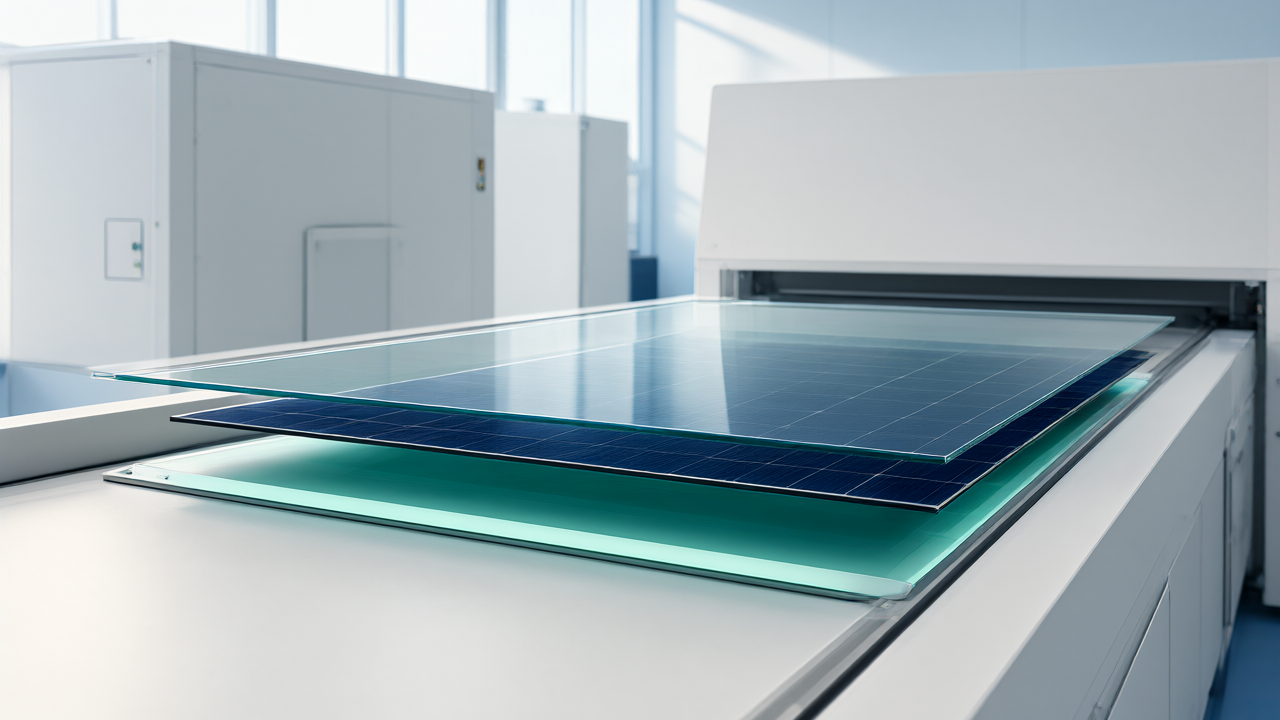
Researchers from the University of New South Wales (UNSW) and the Korea Electronics Technology Institute (KETI) have achieved a near-complete recovery of PV module components. Using a modified glass-to-glass design and induction heating, the team recovered 99.8% of the total module mass, including the glass, silicon cells, and polymer encapsulant. In the fastest recorded test, module layers separated in 5.4 seconds.
Technical Details
The process utilizes a water-cooled copper induction coil operating between 270 kHz and 300 kHz to rapidly heat the metal contacts of passivated emitter and rear contact (PERC) cells. This creates a temperature difference of over 200 C between the cell and the glass at a coil current of 100 A, triggering localized decomposition of the ethylene vinyl acetate (EVA) encapsulant at the cell interface.
The researchers employed specific design modifications to facilitate this separation:
- Simulation: Comsol Multiphysics was used to analyze the effects of operating frequency, coil current, coil-to-cell distance, and electrode thickness.
- Module Design: Mini-modules (5 cm × 8 cm, 1 mm thick glass) incorporated Polytetrafluoroethylene (PTFE) release films with 1.8 cm × 1.8 cm central openings to allow gases to escape during heating.
- Separation Method: Modules were suspended in a custom jig facing downward to utilize gravity-assisted separation.
Separation times varied by coil current: 18.6 seconds at 100 A, 8.3 seconds at 150 A, and 5.4 seconds at 200 A. Post-delamination, EVA was mechanically scraped from the glass with less than 10% mass loss.
Significance and Outlook
Microscopy and spectroscopy confirmed that recovered cells showed no significant structural damage or polymer residue, and the remaining EVA largely retained its chemical structure. The team intends to scale this process from mini-modules to full-size commercial PV panels for use in industrial recycling operations.
]]
Get our weekly technology intelligence — free
Receive an infographic that lets you judge at a glance whether each field’s analysis report is worth reading.
Subscribe Free — Weekly Tech Intelligence
By subscribing, you’ll receive Troy-Technical’s weekly technology intelligence newsletter.
- Your email and selected fields are used only to deliver the newsletter.
- We never share your information with third parties.
- You can unsubscribe anytime via the link in each email.
See our Privacy Policy for details.
Takes about a minute · Unsubscribe anytime