Key Findings
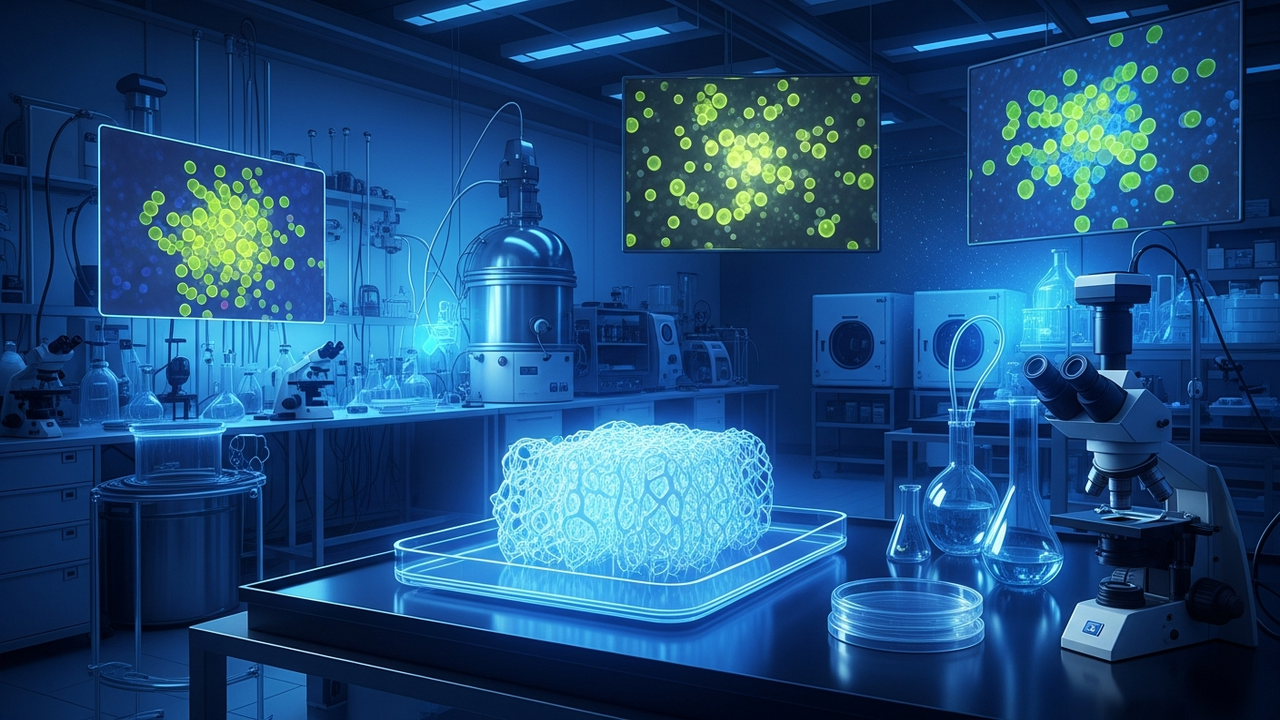
A novel 3D zwitterionic hydrogel, PCB-LN511, inspired by Laminin-511, has been shown to significantly outperform conventional 3D Matrigel in human pluripotent stem cell (hPSC) culture. This breakthrough addresses long-standing challenges in maintaining hPSC pluripotency and achieving scalable expansion, with profound implications for regenerative medicine and drug discovery.
Technical / Clinical Details
- Novel Hydrogel Development: PCB-LN511 is a 3D hydrogel combining highly biocompatible zwitterionic polymers with peptide sequences mimicking the cell adhesion functions of Laminin-511. This design is optimized to facilitate hPSC proliferation in an environment closely resembling in vivo conditions.
- Superiority Over Matrigel: The study demonstrated that PCB-LN511 hydrogel significantly enhanced cell proliferation rates and total cell yield compared to 3D Matrigel, a widely used matrix for hPSC culture. While specific quantification is not provided in the summary, the term “significantly more hPSCs” emphasizes its superior performance.
- Maintenance of Pluripotency: hPSCs cultured in PCB-LN511 consistently maintained excellent expression of pluripotency markers, confirming their capacity for long-term culture in an undifferentiated state. This is crucial for ensuring the quality of hPSCs as starting materials for differentiation into various cell lineages.
- Contribution to Scalability: Traditional 2D cultures face surface area limitations, and Matrigel suffers from batch-to-batch variability. PCB-LN511 provides a 3D environment and, being a synthetic material, offers higher reproducibility and promising scalability for large-scale hPSC production.
Background & Context
hPSCs hold immense promise as a cell source for regenerative medicine, disease modeling, and drug screening, yet their culture presents challenges in maintaining pluripotency while ensuring stable, large-scale supply. Clinical applications, in particular, require xeno-free and chemically defined media and substrates. Animal-derived components like Matrigel pose limitations for clinical use due to risks of xeno-immunoreactions and compositional heterogeneity. The development of synthetic 3D hydrogels like PCB-LN511 is a critical step towards overcoming these challenges and accelerating the clinical translation of hPSC-based therapies.
Strategic Significance & Outlook
Novel 3D hydrogels like PCB-LN511 are poised to reduce hPSC manufacturing costs and improve quality consistency, thereby accelerating the commercialization of cell therapies in regenerative medicine. Furthermore, the availability of high-quality hPSCs in large quantities will significantly boost the efficiency of high-throughput screening in drug discovery, facilitating the identification of new therapeutic compounds. Future efforts will focus on further validating the safety and efficacy of PCB-LN511 for clinical-grade hPSC culture and evaluating its differentiation potential across various cell types. This technology is expected to strengthen the foundation of stem cell research towards the realization of personalized medicine.