Key Findings
At the OFC 2026 panel, leading industry players presented their latest advancements in achieving ultra-low-power photonic scale-up interconnects, a critical requirement for next-generation AI data centers. Broadcom’s VCSEL Near-Package Optics (NPO) solution attained approximately 1 pJ/bit, while Coherent demonstrated an even lower 0.18 pJ/bit of core optoelectronic energy, setting new benchmarks for efficiency. Marvell’s silicon photonics Co-Packaged Optics (CPO) approach, integrating analog DSP, achieved 3 pJ/bit for the total link, providing a more complete solution for bandwidth scaling through WDM.
Technical Details
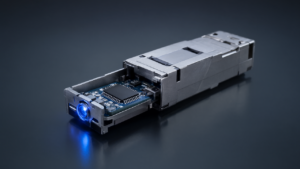
- Broadcom’s VCSEL NPO: Broadcom’s strategy focuses on 100G/200G VCSELs due to their cost-effectiveness and manufacturability. Their NPO implementation delivered an energy efficiency of approximately 1 pJ/bit, positioning VCSELs as a strong contender for raw power efficiency in certain applications.
- Coherent’s Optoelectronic Energy: Coherent showcased a remarkable 0.18 pJ/bit in core optoelectronic energy. This figure represents the energy consumption within the core optical-to-electrical conversion components, indicating highly optimized device-level performance.
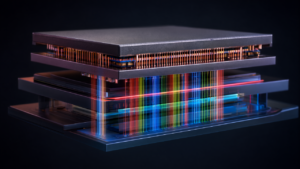
- Marvell’s Silicon Photonics CPO: Marvell’s solution leverages silicon photonics with external lasers and analog DSP, offering a scalable approach via WDM. While its total link energy consumption was 3 pJ/bit, this includes the full link budget, providing a practical solution for deploying high-bandwidth AI clusters, particularly post-2027.
- NVIDIA’s Direction: NVIDIA is also actively pursuing high-bandwidth-density silicon photonics CPO with external lasers and analog DSP for its top-tier AI clusters, aligning with Marvell’s vision for future AI networking architectures.
Background & Context
The explosive growth of AI workloads demands unprecedented bandwidth and ultra-low power consumption for interconnects within data centers. As AI clusters scale to thousands of accelerators, even marginal improvements in pJ/bit energy efficiency can translate into significant operational cost savings and reduced environmental impact. The discussion at OFC 2026 highlighted a divergence in technological roadmaps, with some favoring VCSELs for their established manufacturing and cost advantages, while others champion silicon photonics CPO for its integration density and scalability for advanced AI fabrics. The evolving AI infrastructure increasingly seeks open, multi-vendor Scale-Up fabrics, creating a layered coexistence model where proprietary and open Ethernet-based technologies compete and complement each other.
Strategic Significance & Outlook
The panel discussion underscores the intense innovation in photonic interconnects, driven by the insatiable demands of AI. The competing technologies—VCSEL-based NPO versus silicon photonics CPO with external lasers and analog DSP—each offer distinct advantages. VCSELs excel in raw power efficiency and cost for shorter reaches, while silicon photonics CPO promises higher integration density and bandwidth for larger, more complex AI clusters. The industry is moving towards a future where hybrid solutions and application-specific optimizations will likely dictate market adoption. The continuous push for sub-1 pJ/bit interconnects will be pivotal in enabling the next generation of AI supercomputers, impacting everything from data center design to sustainable computing practices.
Source: https://www.simpletechtrend.com/en/post/ofc2026-ai-scale-up-cpo-vcsel-photonics-analysis-en
Get our weekly technology intelligence — free
Receive an infographic that lets you judge at a glance whether each field’s analysis report is worth reading.
Subscribe Free — Weekly Tech Intelligence
By subscribing, you’ll receive Troy-Technical’s weekly technology intelligence newsletter.
- Your email and selected fields are used only to deliver the newsletter.
- We never share your information with third parties.
- You can unsubscribe anytime via the link in each email.
See our Privacy Policy for details.
Takes about a minute · Unsubscribe anytime