Key Findings
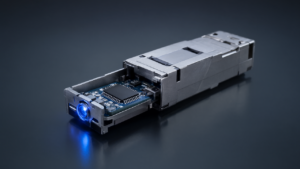
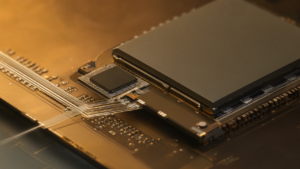
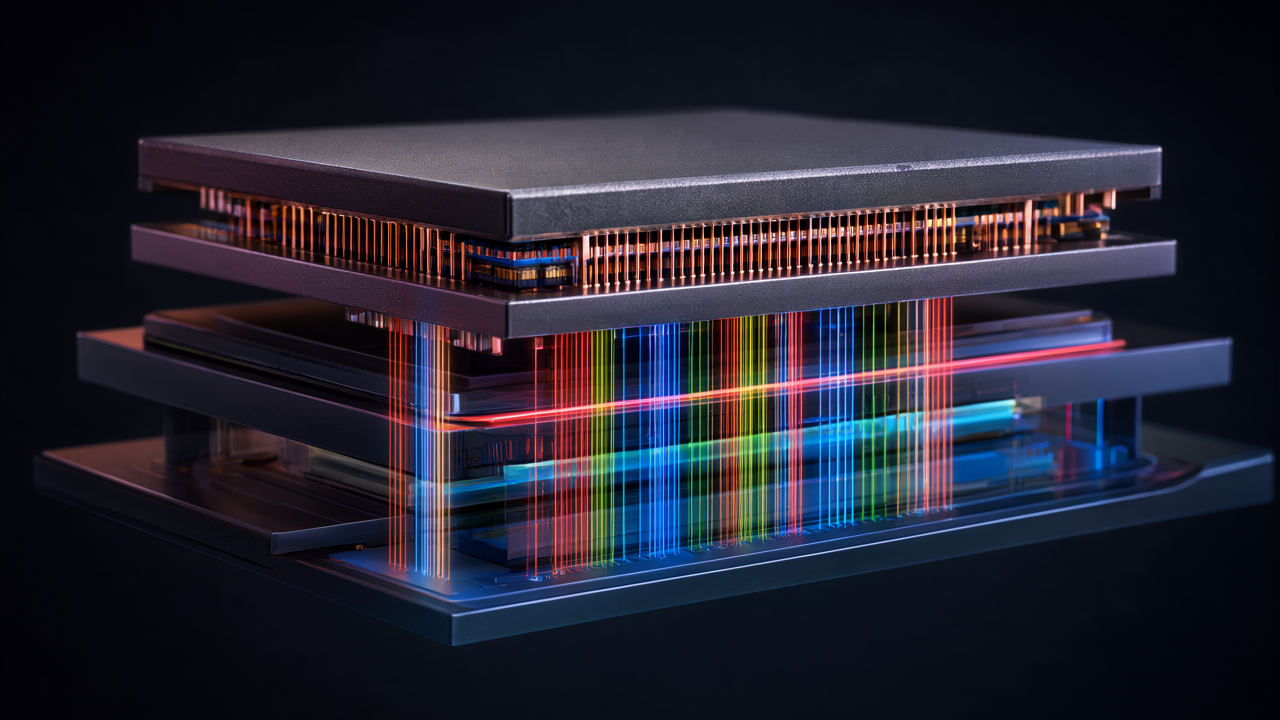
At OFC 2026, NVIDIA unveiled a groundbreaking 256 Gigabits per second (Gb/s) Dense Wavelength Division Multiplexing (DWDM) optical I/O technology tailored for AI infrastructure. This novel technology achieves an astonishingly low power consumption of 2.6 picojoules per bit (pJ/bit) by intimately integrating Electronic Integrated Circuits (EIC) and Photonic Integrated Circuits (PIC) through advanced 3D stack packaging. Furthermore, leveraging TSMC’s Co-packaged Optics Using an Embedded Die (COUPE) platform and Cu-Cu hybrid bonding (SoIC) technology, this innovation dramatically reduces parasitic capacitance, resulting in a remarkable 30% to 40% reduction in laser power requirements.
Technical / Clinical Details
As AI systems scale, inter-chip data transfer speed and energy efficiency become paramount. NVIDIA’s 256 Gb/s DWDM optical I/O provides a cutting-edge solution to this challenge. DWDM technology allows multiple wavelengths of optical signals to be transmitted simultaneously over a single optical fiber, substantially increasing effective bandwidth. The 3D stack packaging of EIC and PIC dramatically shortens signal paths, enhancing the conversion efficiency between electrical and optical signals. The ultra-low power consumption of 2.6 pJ/bit represents an order-of-magnitude improvement in efficiency compared to conventional optical modules, fundamentally addressing the operational costs and thermal management issues of large-scale AI data centers. TSMC’s COUPE platform and SoIC technology enable high-precision chip bonding, optimizing the electrical characteristics of interconnects. This minimizes signal degradation and significantly reduces the power required to drive lasers, thereby maximizing overall system energy efficiency.
Background & Context
The proliferation of AI, particularly large language models (LLMs) and generative AI, is placing unprecedented demands on data transfer between GPUs and AI accelerators in data centers. Conventional electrical wiring and packaging technologies are struggling to meet these requirements, accelerating the shift towards optical interconnects, especially Co-Packaged Optics (CPO) and Near-Packaged Optics (NPO). As a leader in AI hardware, NVIDIA is pioneering innovations in optical interconnect technology, with its close collaboration with TSMC being a critical factor in achieving these breakthroughs. TSMC’s advanced packaging technologies are key to overcoming the limits of semiconductor scaling across the industry, and when combined with NVIDIA’s expertise, they unlock new possibilities for computing in the AI era.
Strategic Significance & Outlook
NVIDIA’s 256 Gb/s DWDM optical I/O technology is poised to revolutionize the future design of AI data centers. The breakthrough low power consumption of 2.6 pJ/bit will dramatically enhance the sustainability and scalability of AI infrastructure, enabling the development and deployment of more powerful and efficient AI models. The widespread adoption of this technology is expected to accelerate innovation in diverse fields such as drug discovery, autonomous driving, and climate modeling. Future challenges include establishing mass production capabilities for this 3D-stacked silicon photonics platform, optimizing cost-efficiency, and ensuring its adoption as an industry standard. The collaboration between NVIDIA and TSMC will play a decisive role in solving one of the most challenging problems facing computing in the AI era and in laying the foundation for next-generation AI factories.
Source: https://www.simpletechtrend.com/en/post/ofc2026-nvidia-dwdm-optical-io-3d-stacked-en
Get our weekly technology intelligence — free
Receive an infographic that lets you judge at a glance whether each field’s analysis report is worth reading.
Subscribe Free — Weekly Tech Intelligence
By subscribing, you’ll receive Troy-Technical’s weekly technology intelligence newsletter.
- Your email and selected fields are used only to deliver the newsletter.
- We never share your information with third parties.
- You can unsubscribe anytime via the link in each email.
See our Privacy Policy for details.
Takes about a minute · Unsubscribe anytime