

Key Findings
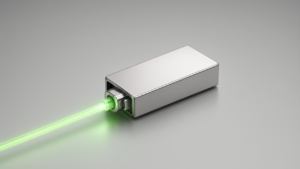
The reported photonic integrated blue laser operates at 461 nm and achieves a sub-30-kHz linewidth while delivering over 1 mW of optical output power. A primary achievement of this architecture is its frequency agility; the system supports mode-hop-free linear frequency chirps up to 900 MHz at repetition rates up to 1 MHz, maintaining tuning nonlinearity below 2%.
Technical Details
The device utilizes a hybrid integration approach combining a gallium-nitride-based laser diode with a high-Q microresonator. The microresonator is fabricated on a silicon nitride (Si3N4) photonic platform using 25-nm-thick waveguides. This specific thickness reduces optical confinement and scattering losses compared to 50-nm-thick waveguides, resulting in a propagation loss of ~0.4 dB cm−1 and intrinsic quality factors (Q) exceeding 2.5 × 10⁶. To enable high-speed modulation of the refractive index and laser frequency tuning, aluminium nitride (AlN) piezoelectric actuators are monolithically integrated onto the photonic circuitry.
Background and Context
Frequency-agile lasers in the ultraviolet-blue spectral range (360–480 nm) are critical for technologies such as optical atomic clocks, Rydberg-atom-based quantum computing, and underwater optical communications. While semiconductor diode lasers (specifically Fabry–Pérot designs) are commonly used, they typically operate in multimode regimes and require complex external free-space cavities or gratings for stabilization. These external components limit portability and environmental robustness. Previous photonic integrated implementations have lacked the fast wavelength-tuning mechanisms necessary for active frequency stabilization via the Pound–Drever–Hall technique and dynamic coherent sensing.
Significance and Outlook
The integration of low-noise performance with fast chirping capabilities addresses a distinct challenge in visible-light photonics. The ability to operate at 461 nm is particularly relevant for the laser cooling and state preparation of strontium (Sr). The researchers have already demonstrated the potential of this integrated laser through experiments in coherent aerosol sensing and underwater communication, where shorter wavelengths offer lower attenuation in water and stronger scattering in air.
Source: https://www.nature.com/articles/s41566-026-02040-9
Get our weekly technology intelligence — free
Receive an infographic that lets you judge at a glance whether each field’s analysis report is worth reading.
Subscribe Free — Weekly Tech Intelligence
By subscribing, you’ll receive Troy-Technical’s weekly technology intelligence newsletter.
- Your email and selected fields are used only to deliver the newsletter.
- We never share your information with third parties.
- You can unsubscribe anytime via the link in each email.
See our Privacy Policy for details.
Takes about a minute · Unsubscribe anytime