
Key Findings
The CeO2/Fe3O4-0.2 catalyst, developed by researchers at Chengdu University, enables water splitting at a cell voltage of 1.56 volts to drive a current density of 10 milliamperes per square centimeter. In a 1 molar potassium hydroxide environment, the material demonstrated an overpotential of 305 millivolts for the oxygen evolution reaction (OER) and 73 millivolts for the hydrogen evolution reaction (HER) at the same current density. These figures approach the performance levels typically reserved for platinum and iridium catalysts.
Technical Details
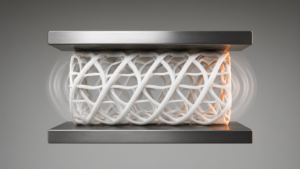
The catalyst is a composite of cerium dioxide and magnetite. The synthesis process began with the growth of a metal-organic framework (MIL-88), where iron atoms are integrated into a crystalline scaffold of organic linkers. This was followed by hydrothermal treatment and high-temperature calcination, resulting in a spindle-shaped particle architecture where the two oxides are intimately interwoven.
The technical efficiency is driven by the Ce4+/Ce3+ redox couple of the ceria. This cycling creates oxygen vacancies in the crystal lattice, which serve as active sites for water molecule adsorption and dissociation. Furthermore, the ceria acts as a regulator for surface reconstruction; it guides the transformation of the catalyst surface into a stable, active configuration, preventing the chaotic or unstable reconstruction often seen in pre-catalysts.
Background & Context
The study, published in the journal Ionics, addresses the bottleneck of water electrolysis: the high cost and fragility of electrodes. While magnetite provides a conductive electronic highway, the ceria domains provide electronic flexibility and oxygen vacancies. This synergy improves charge transfer and the interface between the electrode and the electrolyte.
Significance & Outlook
The catalyst demonstrated strong durability, with the OER electrode showing only slight potential changes over 100 hours of continuous operation. By utilizing earth-abundant materials and the precision of metal-organic framework pyrolysis, this approach provides a high-surface-area, porous oxide structure that avoids the economic burden of rare noble metals.
Get our weekly technology intelligence — free
Receive an infographic that lets you judge at a glance whether each field’s analysis report is worth reading.
Subscribe Free — Weekly Tech Intelligence
By subscribing, you’ll receive Troy-Technical’s weekly technology intelligence newsletter.
- Your email and selected fields are used only to deliver the newsletter.
- We never share your information with third parties.
- You can unsubscribe anytime via the link in each email.
See our Privacy Policy for details.
Takes about a minute · Unsubscribe anytime