

Key Findings
A joint research team led by Dr. SeJin Ahn (KIER) and Dr. Dong Suk Kim (UNIST) has developed a manufacturing process that enables perovskite solar cells to retain 95% of their initial conversion efficiency after 1,000 hours of exposure to 85°C and 85% relative humidity. In separate maximum power point tracking (MPPT) tests under 1 sun illumination (1,000 watts per square meter), devices produced via this process retained more than 90% of their initial efficiency after 500 hours, significantly outperforming comparison devices.
Technical Details
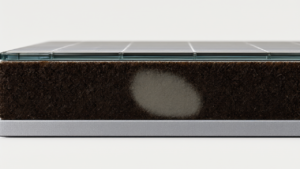
The team targeted the hole transport layer (HTL), specifically the organic semiconductor spiro-OMeTAD. To improve conductivity, spiro-OMeTAD is typically p-doped using lithium bis(trifluoromethanesulfonyl)imide (LiTFSI) and 4-tert-butylpyridine (tBP). However, volatile tBP and mobile lithium ions (Li⁺) often trigger degradation through ion migration and the formation of voids. The new process utilizes micrometer-sized nickel oxide (NiOₓ) powder added to the precursor solution to achieve the following:
- Accelerated Oxidation: NiOₓ promotes the redox reactions that oxidize spiro-OMeTAD to generate necessary radical cations.
- Ion Capture: The NiOₓ particles capture lithium ions on their surfaces.
- Filtration: The NiOₓ and captured ions are filtered out of the solution before the film is formed, removing degradation-causing components while maintaining efficiency.
Background and Significance
The findings, published in Advanced Science on January 26, 2026, address a long-standing trade-off where reducing additives to improve durability typically resulted in insufficient conductivity and lower power conversion efficiency (PCE). By performing the oxidation in solution and removing the catalysts via filtration, the team avoided the need for conventional additives that compromise stability.
While the 1,000-hour damp-heat test is a standard for international reliability testing, the researchers note that these laboratory results do not directly prove the 20- to 30-year service life required for commercial rooftop panels, as real-world conditions involve simultaneous exposure to light, heat, moisture, and electrical load.
Source: https://xenospectrum.com/en/kier-perovskite-solar-cell-catalytic-filtration-damp-heat-stability/
Get our weekly technology intelligence — free
Receive an infographic that lets you judge at a glance whether each field’s analysis report is worth reading.
Subscribe Free — Weekly Tech Intelligence
By subscribing, you’ll receive Troy-Technical’s weekly technology intelligence newsletter.
- Your email and selected fields are used only to deliver the newsletter.
- We never share your information with third parties.
- You can unsubscribe anytime via the link in each email.
See our Privacy Policy for details.
Takes about a minute · Unsubscribe anytime