
Key Findings
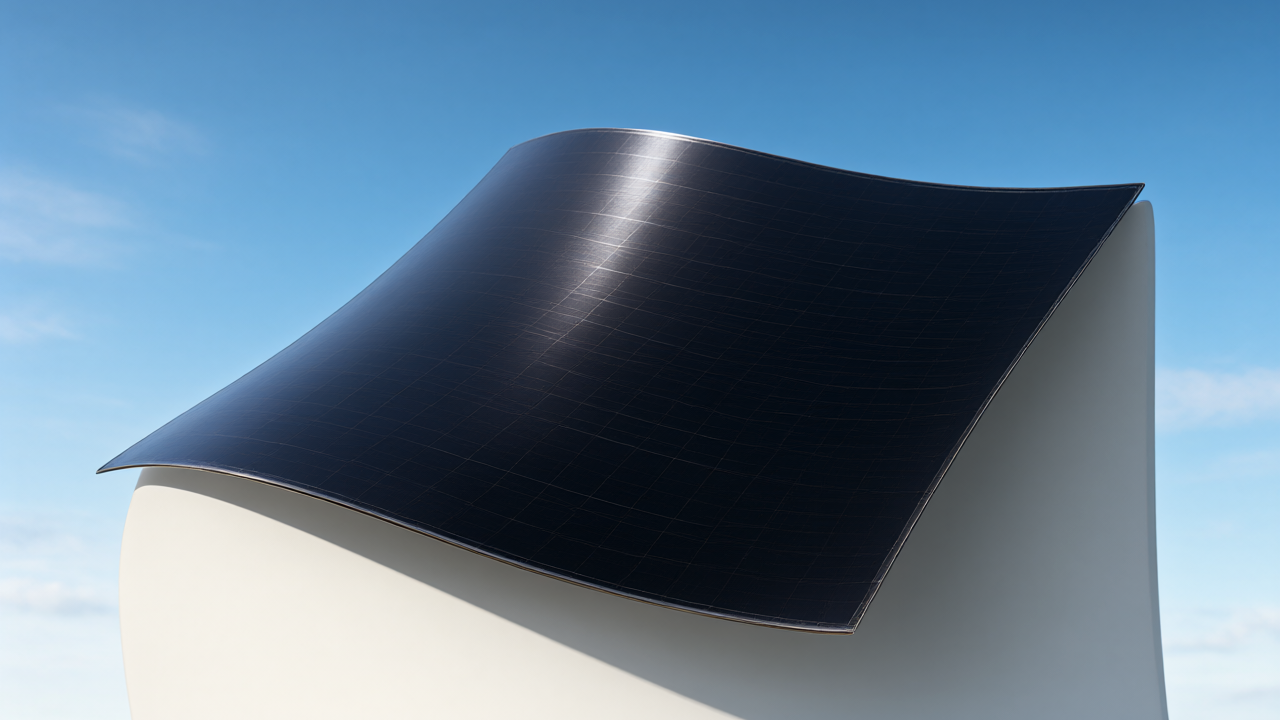
Chinese scientists have achieved a power conversion efficiency of 26.9% for flexible solar cells. A critical breakthrough is the ability to scale these cells without the significant performance drops typical of flexible modules. Specifically, the team achieved record efficiencies across three different module sizes: 22.31% for 25 square centimeters, 20.63% for 100 square centimeters, and 20.15% for 900 square centimeters (where the active solar area is 750 square centimeters).
Technical Details
The research, published in Science, focuses on perovskite materials deposited on thin plastic foils. To solve the issue of irregular crystal growth and poor adhesion on flexible substrates, the team developed a manufacturing process that separates two chemical reactions. By introducing a specially developed additive molecule, they prevented interfering interactions between the light-absorbing perovskite and the thin transport layer. This ensures a more uniform coating and controlled crystal growth, reducing material defects and improving power yield on larger surfaces.
Durability and Testing
The modules were subjected to rigorous stress tests, including temperature cycling between -40 and +85 degrees Celsius. In a long-term stability test, a module operated for 1,044 hours at 85 degrees Celsius and 65% relative humidity while continuously providing electrical power; it retained approximately 92% of its original efficiency. The modules also met all requirements of the international standard IEC TS 63163 for flexible photovoltaic modules.
Significance and Outlook
While the process provides a technical foundation for integrating solar power into curved surfaces, such as automotive roofs and wearable gear, the researchers noted that long-term outdoor operation and mass-production readiness have not yet been demonstrated. Future development will focus on roll-to-roll manufacturing to enable high-volume production and investigating the compatibility of this process with tandem solar cells that combine multiple light-absorbing layers.
Source: https://de.nachrichten.yahoo.com/flexible-solarzellen-26-9-prozent-131458373.html
Get our weekly technology intelligence — free
Receive an infographic that lets you judge at a glance whether each field’s analysis report is worth reading.
Subscribe Free — Weekly Tech Intelligence
By subscribing, you’ll receive Troy-Technical’s weekly technology intelligence newsletter.
- Your email and selected fields are used only to deliver the newsletter.
- We never share your information with third parties.
- You can unsubscribe anytime via the link in each email.
See our Privacy Policy for details.
Takes about a minute · Unsubscribe anytime