Key Findings
GNNs have successfully identified numerous high-performance materials for the hydrogen evolution reaction (HER) and oxygen evolution reaction (OER). In HER research, the DimeNet-LSCG model identified 12 platinum alloys with activity comparable to Pt(111), including Cu3Pt and FeCuPt2. Other frameworks identified 43 high-performance alloys from 2,973 candidates and four inexpensive candidates (Fe2Sb4, Cu6Sb2, Cu6Sn2, Ni2Sb2) using Equiformer V2. For OER, researchers identified 14 novel single-atom catalysts with theoretical overpotentials lower than commercial IrO2 and identified 122 bulk-stable and 68 nanoscale-stable potential catalysts from 4,119 oxide materials using GemNet-OC.
Technical Details
GNNs represent molecules or crystals as graphs, treating atoms as vertices and chemical bonds or spatial proximity as edges. Through “message passing,” atoms aggregate information from neighbors to learn topological and geometric features automatically. The review categorizes GNN architectures into three paradigms:
- Invariant models: (e.g., DTNN, SchNet, DimeNet, GemNet) Convert 3D coordinates into scalars for predicting properties like band gap.
- Equivariant models: (e.g., EGNN, PaiNN, NequIP, MACE) Handle both scalar and vector features, essential for molecular dynamics and forces.
- Transformer-based models: (e.g., Graphormer, TorchMD-Net, SE(3)-Transformer, Equiformer) Combine global context modeling with geometric symmetry.
Background & Context
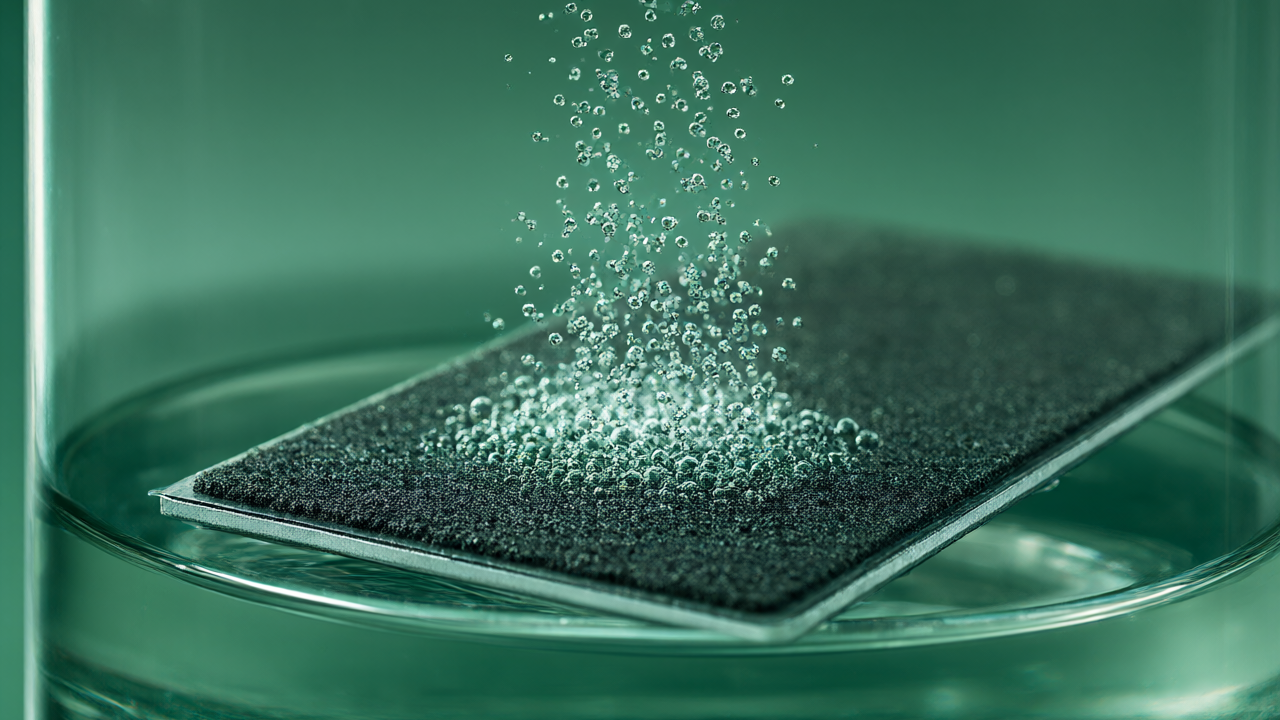
Green hydrogen production relies on catalysts for HER at the cathode and OER at the anode. Traditional machine learning relied on manual feature engineering—converting structures into numerical descriptors like electronegativity or d-band center—which is time-consuming and requires deep domain expertise. While density functional theory (DFT) provides high-throughput screening, it remains too costly to exhaustively explore all possible material combinations.
Significance & Outlook
By preserving topological integrity and spatial fidelity, GNNs eliminate the bottleneck of manual descriptor design. This shift toward a GNN-driven paradigm, supported by large-scale public databases such as the Open Catalyst Project (OC20), provides a methodological framework to drastically reduce the time and cost of discovering sustainable, high-performance electrocatalytic materials.
Source: https://bioengineer.org/graph-neural-networks-reshape-electrocatalyst-design-for-green-hydrogen/
Get our weekly technology intelligence — free
Receive an infographic that lets you judge at a glance whether each field’s analysis report is worth reading.
Subscribe Free — Weekly Tech Intelligence
By subscribing, you’ll receive Troy-Technical’s weekly technology intelligence newsletter.
- Your email and selected fields are used only to deliver the newsletter.
- We never share your information with third parties.
- You can unsubscribe anytime via the link in each email.
See our Privacy Policy for details.
Takes about a minute · Unsubscribe anytime