Key Findings: South Korea and China Vie for Perovskite Mass Production Dominance in Space Solar
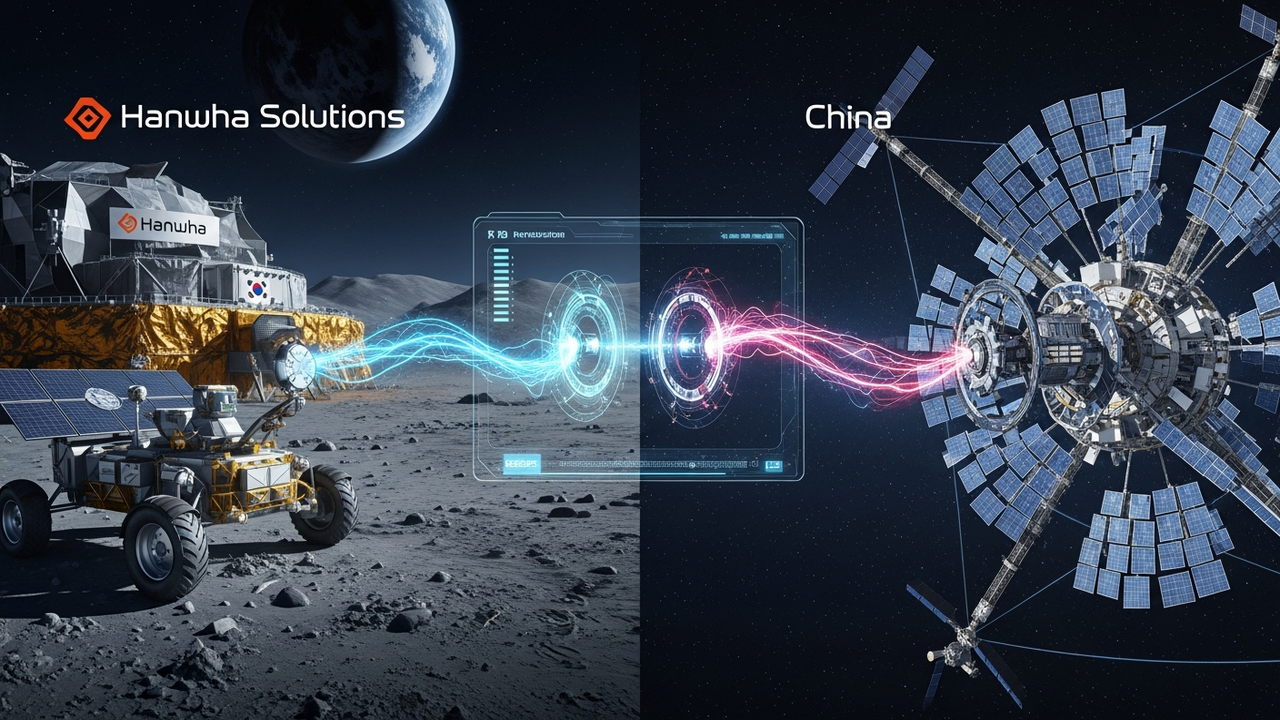
A fierce mass production race for perovskite solar cells is underway between South Korea and China, specifically targeting the rapidly expanding space solar power market. Hanwha Solutions of South Korea is consolidating its foothold in the space sector through participation in a lunar probe demonstration project. In parallel, leading Chinese solar companies have formed a new space energy alliance, fast-tracking the development of perovskite solar cells for satellite applications. This trend underscores perovskite technology’s potential to open new frontiers beyond terrestrial uses, addressing critical power supply needs in outer space.
Technical & Strategic Details: Contrasting Space Strategies from Korea and China
Hanwha Solutions is participating in a lunar probe demonstration project with the objective of validating the performance of high-efficiency, lightweight perovskite solar cells in the extreme space environment. This is a crucial step towards proving their reliability and durability for future space missions and infrastructure. Concurrently, a consortium of Chinese solar companies, backed by national initiatives, is accelerating the development of space energy technologies, focusing keenly on perovskite’s potential as a power source for satellites. Perovskites are highly advantageous for space applications due to their lightweight nature, flexibility, and promising radiation resistance compared to traditional silicon-based solar cells. Both nations are striving to translate these technological advantages into mass production to establish leadership in the burgeoning space market.
Background & Industry Context: Expanding Space Economy and Energy Demands
The recent rapid expansion of the space industry, driven by increased satellite launches and ambitious lunar and Martian exploration plans, has dramatically amplified the demand for high-efficiency, reliable power solutions in space. The space environment presents extreme challenges, including drastic temperature fluctuations, intense radiation, and micrometeoroids, making it far more demanding than terrestrial conditions. Developing solar cells that can function stably in such an environment is critical for the success of space exploration, and perovskite technology, with its inherent lightweight and manufacturing flexibility, has emerged as a compelling candidate to address this formidable challenge.
Strategic Significance & Outlook: Global Diffusion of Perovskite in Space
The intensifying mass production race for space-grade perovskite solar cells between South Korea and China is a harbinger of the technology’s widespread adoption in the extraterrestrial market. Both nations’ competition is expected to further accelerate technological innovation, fostering the development of even higher-performance and more durable space-ready solar cells. In the long term, perovskite solar cells could become indispensable power sources for various space infrastructures, including lunar bases, orbital space stations, and vast satellite constellations, potentially ushering in a new era of space development and exploration.
Source: https://unicornfactory.co.kr/news/2026061708230559648
Get our weekly technology intelligence — free
Receive an infographic that lets you judge at a glance whether each field’s analysis report is worth reading.
Subscribe Free — Weekly Tech Intelligence
By subscribing, you’ll receive Troy-Technical’s weekly technology intelligence newsletter.
- Your email and selected fields are used only to deliver the newsletter.
- We never share your information with third parties.
- You can unsubscribe anytime via the link in each email.
See our Privacy Policy for details.
Takes about a minute · Unsubscribe anytime