
Key Findings
A research team led by Jiang Zhongyi and He Guangwei at Tianjin University has developed a molecular-level ultra-thin carbon membrane that reaches a thickness of approximately 2nm. This material overcomes the traditional trade-off between thickness, precision sieving, and mechanical strength. The membrane demonstrates high CO2 separation performance across various gas mixtures, including CO2-N2, H2-CO2, and CO2-CH4.
Technical Details
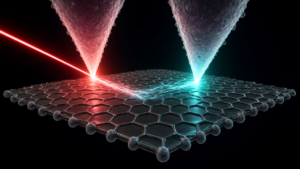
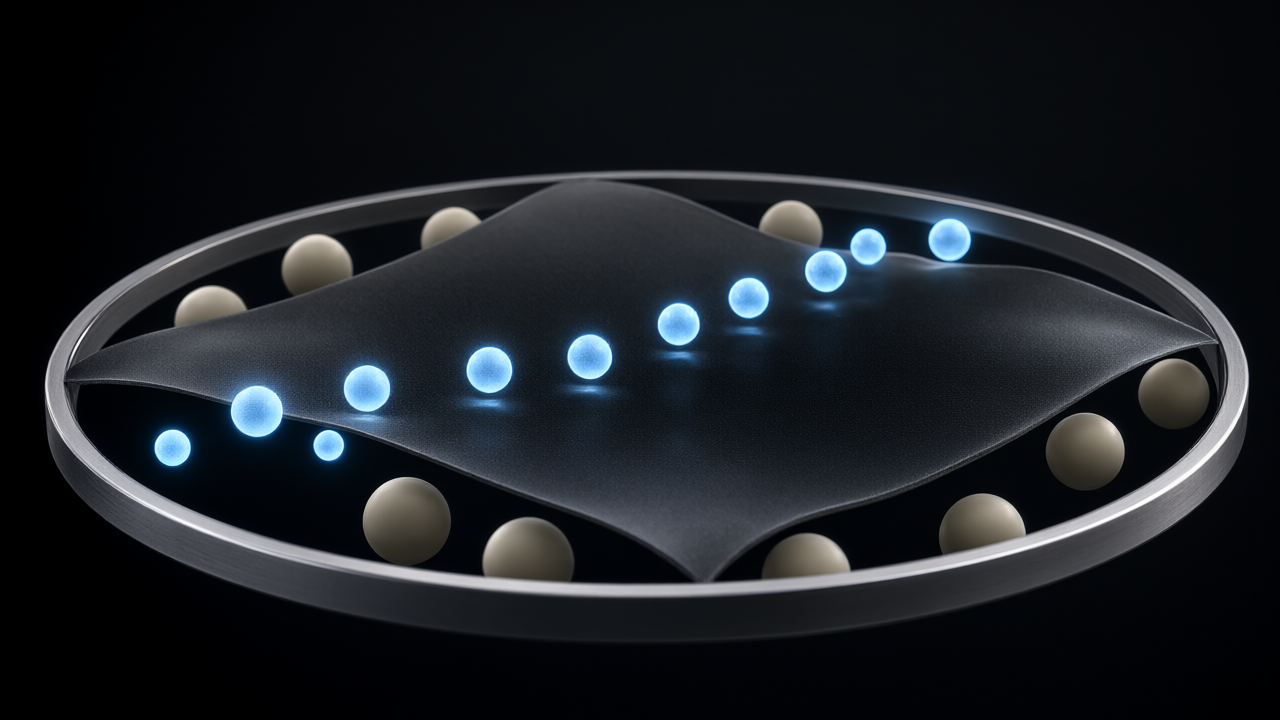
The team utilized a strategy of graphene-guided polymer transformation rather than traditional graphene drilling. By assembling polymers on a graphene surface and applying heat treatment, they leveraged a “super-spreading effect” to grow a precise amorphous carbon sieve layer. This creates a dual-layer heterostructure where graphene serves as the load-bearing skeleton and the amorphous carbon layer passivates defects and homogenizes stress.
- Mechanical Properties: The membrane achieves a Young’s modulus of 27GPa and a breaking strength exceeding 10GPa.
- Structural Discovery: Using aberration-corrected electron microscopy, the team observed that the pores in these molecular-level carbon membranes are primarily near-circular, contradicting the long-held industry belief that carbon molecular sieve pores are “slit-shaped.”
Background and Context
The research was published in Nature Sustainability on October 23, following a separate achievement in Nature Energy on October 7 regarding COF all-organic mixed matrix membranes. The project was a collaborative effort involving Tianjin University, Nanjing Industrial University (Jin Wanqin and Zhao Jing teams), the Swiss Federal Institute of Technology Lausanne (Kumar V. Agrawal team), and Fudan University (Zeng Yuwen team). The work was supported by the National Natural Science Foundation and the School of Chemical Engineering at Tianjin University.
Significance and Outlook
By reducing the membrane to a molecular-level thickness while maintaining high mechanical stability, the team has created a highly permeable and selective filter. This breakthrough provides a new pathway for carbon capture from industrial sources and offers a new characterization method for understanding the real pore structures of carbon molecular sieve membranes.
Source: https://www.sohu.com/a/1095400840_355396
Get our weekly technology intelligence — free
Receive an infographic that lets you judge at a glance whether each field’s analysis report is worth reading.
Subscribe Free — Weekly Tech Intelligence
By subscribing, you’ll receive Troy-Technical’s weekly technology intelligence newsletter.
- Your email and selected fields are used only to deliver the newsletter.
- We never share your information with third parties.
- You can unsubscribe anytime via the link in each email.
See our Privacy Policy for details.
Takes about a minute · Unsubscribe anytime