
Key Findings
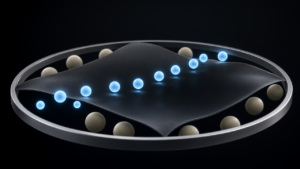
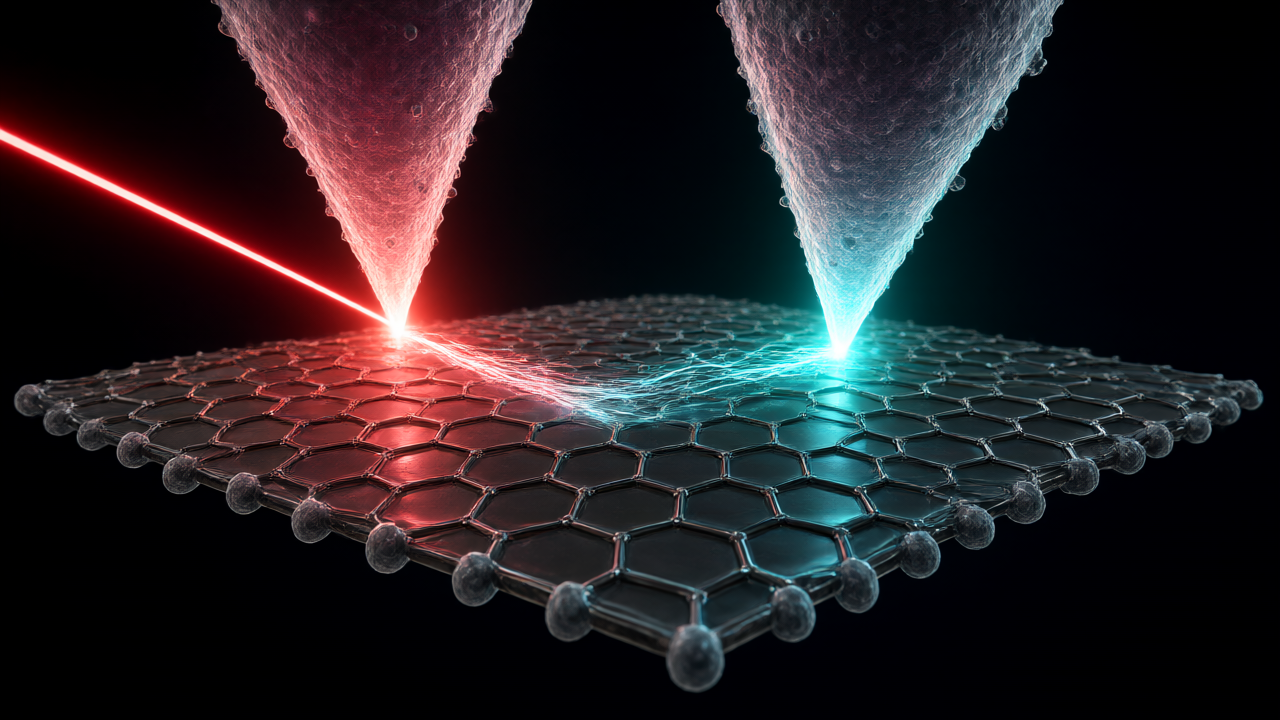
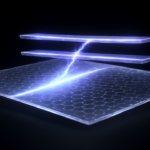
A research team from the University of Regensburg, Philipps University of Marburg, Forschungszentrum Jülich, the Jülich Aachen Research Alliance (JARA), and RWTH Aachen University has achieved the first direct imaging of electrons crossing the energy gap in graphene. The team observed Landau-Zener-Majorana tunneling, where electrons jump from the valence band to the conduction band while moving through an avoided crossing in the band structure. The researchers reported tunneling probabilities reaching up to 100%.
Technical Details
The imaging technique utilizes a combination of a phase-stable, few-cycle mid-infrared pulse to drive electrons and an extreme ultraviolet probe pulse. A photoemission momentum microscope was employed to record the energy and momentum of every emitted electron. This approach provides several technical advantages over previous subcycle photoemission experiments:
- Increased accessible momentum area by more than two orders of magnitude.
- Increased usable field strengths by one order of magnitude.
- Ability to track motion across the entire first Brillouin zone.
The experiments were conducted using epitaxial monolayer graphene grown on silicon carbide at Jülich, utilizing a rotated (0°) orientation. The electric field accelerated electrons along graphene’s Dirac cone, stretching the electron distribution into an ellipse along the field direction.
Background & Context
The study specifically quantifies the factors limiting coherent control in these materials. The mean scattering time for electrons was measured at approximately 9 fs. Simulations conducted by the team indicate that scattering with optical phonons is the fastest channel for redistributing momentum, occurring more rapidly than electron-electron scattering.
Significance & Outlook
These results establish the time and length scales necessary for the development of lightwave electronics, where oscillating light fields control electrons directly instead of using voltages. According to Giacomo Inzani of the University of Regensburg, the ability to follow electron movement through a material’s energy landscape in real time is a significant advancement that can be applied to other quantum materials.
Source: https://www.graphene-info.com/new-technique-films-light-driven-quantum-tunneling-electrons-graphene
Get our weekly technology intelligence — free
Receive an infographic that lets you judge at a glance whether each field’s analysis report is worth reading.
Subscribe Free — Weekly Tech Intelligence
By subscribing, you’ll receive Troy-Technical’s weekly technology intelligence newsletter.
- Your email and selected fields are used only to deliver the newsletter.
- We never share your information with third parties.
- You can unsubscribe anytime via the link in each email.
See our Privacy Policy for details.
Takes about a minute · Unsubscribe anytime