

Key Findings
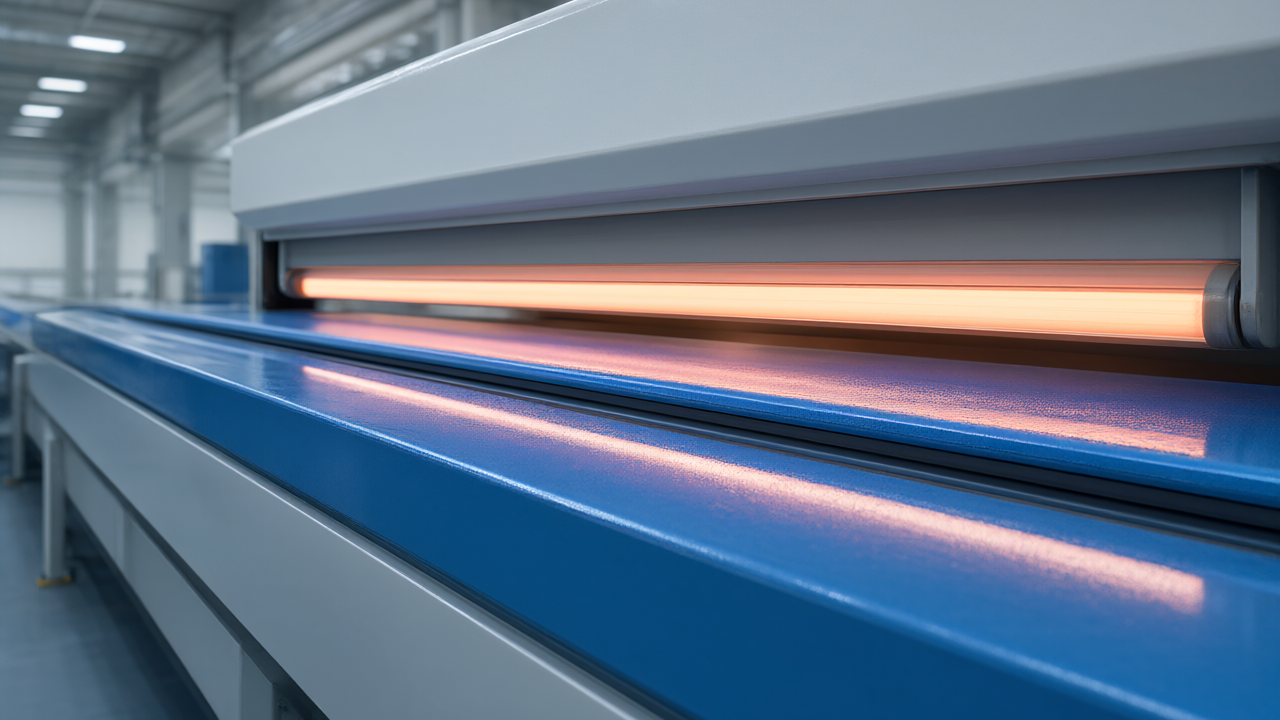
The integration of the Tabular Prior-data Fitted Network (TabPFN) and the Non-dominated Sorting Genetic Algorithm II (NSGA-II) has successfully optimised the quality of catalytic infrared (CIR)-cured thermosetting powder coatings. Experimental validation showed that CIR curing reduces curing time by 47–77% compared to conventional hot-air curing. While mechanical properties were improved, the study noted that high radiation intensity negatively impacts the visual appearance of the coating.
Technical Details
The researchers tested one polyester coating and two hybrid coatings using 150 experimental sets generated via Latin hypercube sampling. The framework evaluated five quality parameters: adhesion strength, hardness, impact resistance, gloss, and colour difference (ΔE). The TabPFN model, designed for small-sample learning, achieved accuracy comparable to seven baseline algorithms—including random forest, support vector machine, and artificial neural networks—but required no hyperparameter tuning and completed training in 26 seconds.
To identify optimal curing parameters, the TabPFN-NSGA-II framework was combined with the Technique for Order of Preference by Similarity to Ideal Solution (TOPSIS), resulting in a mean relative error of 8.10% or less. Additionally, Shapley additive explanations (SHAP) analysis revealed that curing distance strongly affects single-sided heating. The analysis highlighted a trade-off: increasing radiation intensity enhances adhesion, impact resistance, and ΔE, but lowers gloss.
Background & Context
While CIR radiation curing offers high performance for thermosetting powder coatings, the industry has lacked precise process control due to a deficiency in predictive models and guidance within coating manuals. This research addresses this gap by providing a multi-objective optimisation framework suitable for engineering deployment.
Significance & Outlook
The TabPFN-NSGA-II approach offers a practical digital tool for industrial applications, allowing formulators and applicators to balance the trade-off between mechanical performance and visual appearance. This advancement contributes to the broader trend of digitalisation in coatings production, enhancing efficiency and accuracy in quality control.
Get our weekly technology intelligence — free
Receive an infographic that lets you judge at a glance whether each field’s analysis report is worth reading.
Subscribe Free — Weekly Tech Intelligence
By subscribing, you’ll receive Troy-Technical’s weekly technology intelligence newsletter.
- Your email and selected fields are used only to deliver the newsletter.
- We never share your information with third parties.
- You can unsubscribe anytime via the link in each email.
See our Privacy Policy for details.
Takes about a minute · Unsubscribe anytime