


Key Findings
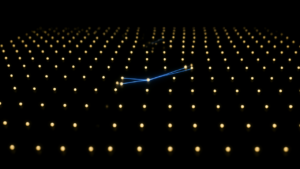
Researchers at NVision Quantum Technologies, in collaboration with German and Israeli academics, have successfully addressed individual molecular qubits using light. The team identified a specific organic “carbene” molecule—consisting of two pairs of phenyl rings connected by a central carbon atom—as a robust qubit candidate. This system utilizes two strongly correlated unpaired electrons located near the central carbon atom to derive its qubit properties.
Technical Details
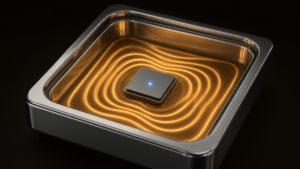
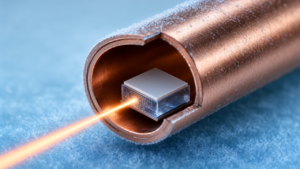
The molecular system was created by doping a rigid crystalline matrix with light-activated precursor molecules. Using a cryo-confocal microscope at 4.5 Kelvin and an orange laser beam, the precursors were converted into carbene qubits. Key performance metrics include:
- Spectral Stability: Center frequencies of two distinct molecular lines varied by no more than a few megahertz over one hour of repeated excitation.
- Spin-Optical Interface: Changing the spin state shifts the optical transition by several gigahertz, which is resolvable against an inhomogeneous linewidth of a few hundred megahertz.
- Coherence and Relaxation: Spin coherence time was measured at roughly 2 milliseconds, with a spin relaxation time of approximately 20 milliseconds.
- Fidelity: The system can store a quantum state with 99% fidelity for around 40 microseconds, an order of magnitude longer than molecular ensembles.
Background & Context
Previous quantum node research focused on wide-bandgap semiconductor defects, such as nitrogen-vacancy centers in diamond. However, these solid-state systems often suffer from electron defects and charge variations that distort optical properties. NVision’s approach replaces continuous covalent networks with artificial crystals of weakly bound molecules to overcome these distortions.
Significance & Outlook
The stability and coherence of these carbene crystals make them suitable for quantum repeaters, which transmit quantum states over long distances by storing information in matter qubits to perform Bell measurements. NVision has partnered with HyperLight to manufacture photonic chips using thin-film lithium niobate, with the first prototype integrated chips expected by the end of the year. The long-term roadmap targets 1,000 physical qubits, progressing to 1,000 logical fault-tolerant qubits by 2030.
Source: https://www.optica-opn.org/home/newsroom/2026/november/light_addresses_single_molecular_qubits/
Get our weekly technology intelligence — free
Receive an infographic that lets you judge at a glance whether each field’s analysis report is worth reading.
Subscribe Free — Weekly Tech Intelligence
By subscribing, you’ll receive Troy-Technical’s weekly technology intelligence newsletter.
- Your email and selected fields are used only to deliver the newsletter.
- We never share your information with third parties.
- You can unsubscribe anytime via the link in each email.
See our Privacy Policy for details.
Takes about a minute · Unsubscribe anytime