


Key Findings
Physicists from the University of Regensburg, Philipps-Universität Marburg, and Forschungszentrum Jülich have captured electrons performing “quantum jumps” across forbidden energy gaps in graphene. The study reveals that when exposed to intense pulses of light, electrons can switch between energy bands with a transition probability reaching 100 percent. This phenomenon, known as Landau-Zener-Majorana transitions, allows electrons to bypass intervening energy states that are normally off-limits.
Technical Details
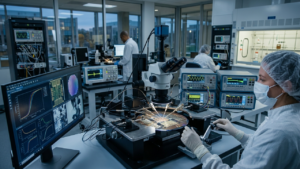
The team utilized a photoemission momentum microscope to track electron behavior in real time. Unlike traditional microscopes that image a material’s surface, this instrument measures electron energies and movement to map their distribution across different energy states. The experimental setup combined advanced laser technology with electron microscopy to capture movements on timescales too short for conventional imaging.
The success of the experiment relied on ultra-pure, one-atom-thick graphene samples manufactured at Forschungszentrum Jülich. Specifically, the use of “rotated” graphene ensured that quantum dynamics emerged clearly without being obscured by atomic-level impurities.
Background & Context
In semiconductors, electrons are typically restricted to specific energy bands, separated by forbidden energy gaps where stable states cannot exist. While quantum tunneling involves particles passing through a physical barrier, Landau-Zener-Majorana transitions are driven by the speed at which electrons approach the gap under the influence of a powerful electric field. This allows them to move between states even when separated by a substantial energy gap.
Significance & Outlook
This imaging technique allows scientists to observe how interactions with a material’s crystal lattice gradually disrupt orderly electron motion. Understanding these disruptions is critical for developing precise control over electron behavior. The findings suggest a path toward future electronic technologies that utilize the rapid oscillations of light to direct electrons, rather than relying entirely on conventional electronic methods.
Source: https://sciencedaily.com/releases/2026/11/261112025523.htm
Get our weekly technology intelligence — free
Receive an infographic that lets you judge at a glance whether each field’s analysis report is worth reading.
Subscribe Free — Weekly Tech Intelligence
By subscribing, you’ll receive Troy-Technical’s weekly technology intelligence newsletter.
- Your email and selected fields are used only to deliver the newsletter.
- We never share your information with third parties.
- You can unsubscribe anytime via the link in each email.
See our Privacy Policy for details.
Takes about a minute · Unsubscribe anytime