

Key Findings
The Optical Compute Interconnect Multi-Source Agreement (OCI-MSA) has emerged as the primary industry consensus for AI scale-up interconnects. Founding members include AMD, Broadcom, Meta, Microsoft, Nvidia, and OpenAI. The consortium aims to break proprietary constraints to ensure cross-vendor compatibility, allowing components like AMD GPUs to communicate with Broadcom switches without vendor lock-in.
Technical Details
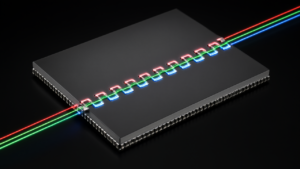
OCI-MSA Gen 1 specifies 8 wavelengths per fiber (4 in each direction), with each wavelength operating at 53.125Gbps NRZ, resulting in an effective data rate of 50Gbps per wavelength after error correction. Wavelengths are spaced slightly more than 2nm apart. The reference model uses 500m SMF-28 fiber with a total insertion loss of 2.5 dB.
The roadmap for bandwidth scaling includes:
- Generational increases: Gen 2 and Gen 3 will each double the bandwidth of the previous generation.
- Scaling vectors: Bandwidth can be increased by expanding wavelengths (from 4 to 8, 16, 32…), increasing speeds (50Gbps to 100, 200, 400Gbps), utilizing two polarizations instead of one, and moving from NRZ to PAM/QAM-n signaling.
- Viability: 200G x 16 wavelengths has already been demonstrated as viable, representing 16 times the bandwidth of Gen 1.
Background & Context
The industry is transitioning from copper to all-optical interconnects over the next five years. While optical already dominates scale-out, it is moving into scale-up to connect racks in large pods of hundreds to thousands of XPUs. To avoid the high power and cost of high-speed PHYs and increased fiber counts associated with pluggable transceivers, the industry is shifting toward multi-wavelength bidirectionality via Near-Packaged Optics (NPO) and Co-Packaged Optics (CPO).
Significance & Outlook
OCI in CPO format offers the best combination of long reach and low link power per bit; for 200G aggregate bandwidth, it consumes one-third the power of a pluggable transceiver. Microsoft plans a phased adoption, starting with CPO on switches and NPO on accelerators, eventually moving to CPO at both ends. Fully functional OCI Gen 1 implementations and interoperability demos are expected in 2027.
Source: https://semiengineering.com/the-optical-super-highway-for-ai/
Get our weekly technology intelligence — free
Receive an infographic that lets you judge at a glance whether each field’s analysis report is worth reading.
Subscribe Free — Weekly Tech Intelligence
By subscribing, you’ll receive Troy-Technical’s weekly technology intelligence newsletter.
- Your email and selected fields are used only to deliver the newsletter.
- We never share your information with third parties.
- You can unsubscribe anytime via the link in each email.
See our Privacy Policy for details.
Takes about a minute · Unsubscribe anytime