


Key Findings
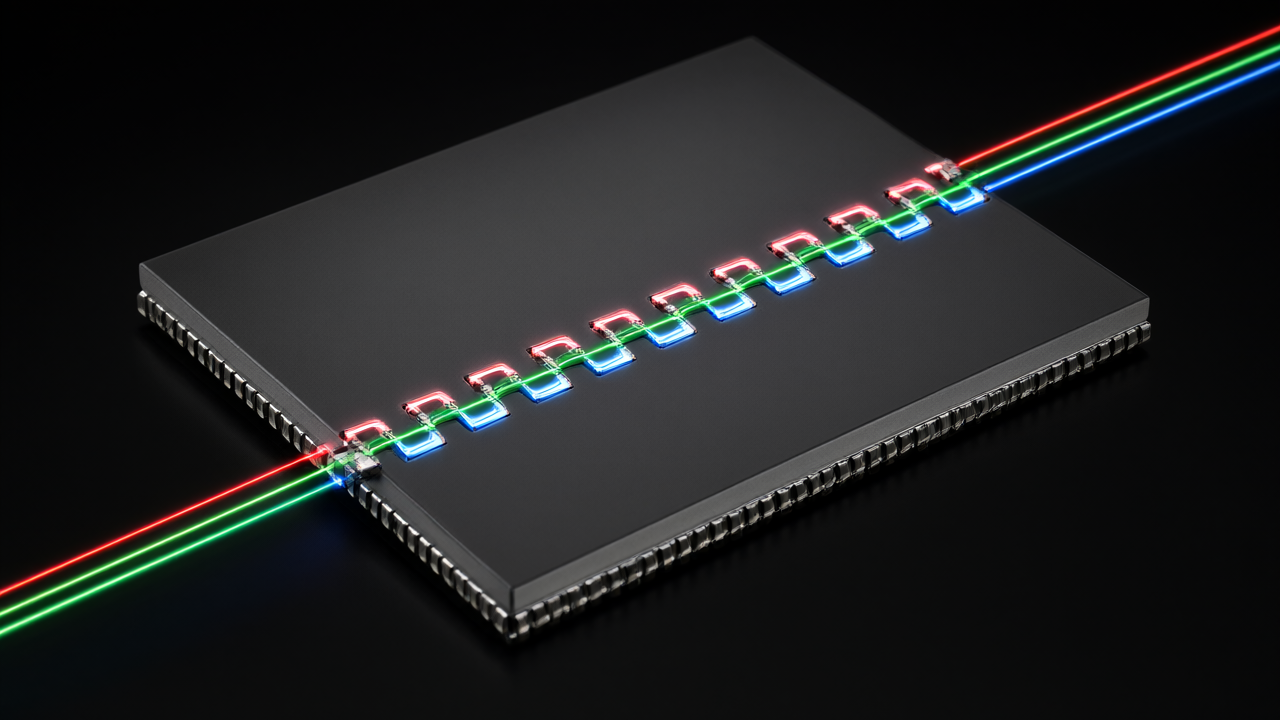
A new photonic circuit architecture achieves signal routing between inputs and outputs using only O(N) programmable phase shifters, a significant reduction from the O(N squared) components required by previous universal transformation meshes. The team demonstrated this via a 3×3 router fabricated on x-cut thin-film lithium niobate, achieving extinction ratios exceeding 11 dB across all output channels.
Technical Details
The architecture centers on signal routing rather than universal transformations, utilizing a passive multimode interferometer that splits light into multiple non-interfering channels coupled with a single row of programmable reflective phase shifters. Key performance specifications include:
- Footprint: 100 μm^2 per programmable component.
- Drive Voltage: Operation at voltages below 5 volts.
- Tuning Efficiency: 1.92 GHz/V resonance tuning efficiency via the Pockels effect.
- Bandwidth: An electro-optic bandwidth of 6.2 GHz.
- Switching Speed: Sequential routing demonstrated at 10 MHz, though the researchers note this rate was limited by testing equipment rather than the circuit itself.
Background & Context
Current reconfigurable optical switches face scalability challenges; as complexity increases, the number of required components grows quadratically, similar to needing a cable from every house on a street to every other house. This has historically limited the speed, size, and energy efficiency of photonic meshes. The new design addresses these bottlenecks by shifting to linear scaling, allowing for simultaneous low voltage operation and compact designs that were previously unattainable together.
Significance & Outlook
While the architecture represents a breakthrough in complexity reduction, achieving continuous gigahertz-level throughput remains a challenge due to material properties. Specifically, the reliance on the Pockels effect introduces constraints regarding capacitance and radio frequency efficiency. Despite these limits, the transition to O(N) scaling provides a foundation for energy-efficient interconnects critical for high-performance computing clusters and modular quantum processors where bandwidth capacity is essential.
Source: https://quantumzeitgeist.com/photonic-router-fewer-phase-shifters-implementation/
Get our weekly technology intelligence — free
Receive an infographic that lets you judge at a glance whether each field’s analysis report is worth reading.
Subscribe Free — Weekly Tech Intelligence
By subscribing, you’ll receive Troy-Technical’s weekly technology intelligence newsletter.
- Your email and selected fields are used only to deliver the newsletter.
- We never share your information with third parties.
- You can unsubscribe anytime via the link in each email.
See our Privacy Policy for details.
Takes about a minute · Unsubscribe anytime