

Key Findings
The developed catalytic hydrogen sensor demonstrates stable performance across ambient temperatures from 22 to 80 °C and relative humidity levels from 0% to 90%. Notably, the sensor can detect hydrogen concentrations as low as 100 parts per million even under extreme conditions of 80 °C and 90% relative humidity. The device meets ISO 26142 humidity-response requirements, shows strong selectivity against 21 potentially interfering gases, and maintained stable operation over 125 days and 100 consecutive sensing cycles.
Technical Details
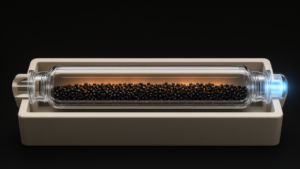
The sensor utilizes a network of palladium nanoparticles characterized by abundant grain boundaries—the interfaces where neighboring crystals meet. According to research combining molecular dynamics, first-principles calculations, and structural tracking, these grain boundaries facilitate the entry of hydrogen into palladium to rapidly form palladium hydride, even when the surface is wet. Because this hydride binds water weakly, catalytic sites remain accessible for the hydrogen-oxygen reaction that generates the sensing signal.
To enhance practical application, the team integrated a machine-learning model into a portable prototype. This system accounts for fluctuations in temperature and humidity, allowing the sensor to estimate hydrogen concentrations with deviations within 5% during randomized prototype tests.
Background & Context
Hydrogen is a key component for cleaner energy systems, but its volatility necessitates reliable leak detection. A primary technical hurdle has been humidity; in hot, moisture-rich environments, water molecules typically cover the active surfaces of detectors, preventing accurate responses. This research was a collaboration between Tohoku University’s Advanced Institute for Materials Research (WPI-AIMR), the University of Utah, and Pacific Northwest National Laboratory.
Significance & Outlook
By eliminating the need for an external heater to remove moisture, this grain-boundary engineering strategy provides a more robust method for hydrogen monitoring. The findings, published in Advanced Materials on October 23, 2026, suggest a promising path for improving safety in industrial facilities and future hydrogen-energy infrastructure.
Get our weekly technology intelligence — free
Receive an infographic that lets you judge at a glance whether each field’s analysis report is worth reading.
Subscribe Free — Weekly Tech Intelligence
By subscribing, you’ll receive Troy-Technical’s weekly technology intelligence newsletter.
- Your email and selected fields are used only to deliver the newsletter.
- We never share your information with third parties.
- You can unsubscribe anytime via the link in each email.
See our Privacy Policy for details.
Takes about a minute · Unsubscribe anytime