

Key Findings
The optimized nanocomposite, consisting of 20 wt% B₄C and 15 wt% MXene, provides 100% proton attenuation at a bulk thickness of 36 mm. This performance is approximately fivefold higher than an aerospace-grade aluminum reference. Simultaneously, the material delivers 54.7 dB of electromagnetic interference (EMI) shielding across the X-band (8.2–12.4 GHz) and maintains an electrical conductivity of 2.1 × 10⁴ S/m.
Technical Details
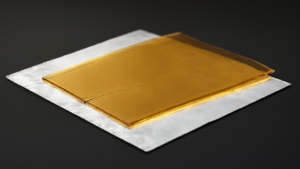
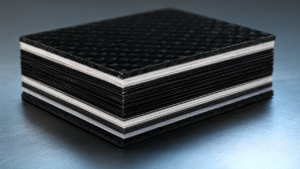
The material system integrates surface-functionalized B₄C nanoparticles (~ 45 nm) and exfoliated MXene nanosheets into a polyimide matrix using solution casting and vacuum-assisted filtration. Design parameters were guided by SRIM/TRIM simulations, which indicated that a boron-rich composition of 31 at% could completely stop 50 MeV protons at approximately 36 mm thickness, with electronic stopping as the primary energy loss mechanism.
Physical and environmental testing confirmed the following specifications:
- Mass Efficiency: Areal mass reduction of ~ 81% relative to a 2.0 mm aluminum reference.
- Mechanical Flexibility: Retention of flexibility down to a 2 mm bend radius.
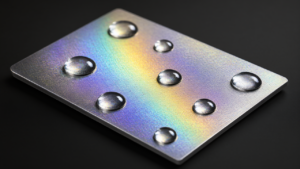
- Environmental Durability: Performance retention after 1,000 h of humidity exposure and 500 thermal cycles, aligned with RTCA DO-160G tests.
- Radiation Dose: MCNP6.2 simulations project an eightfold reduction in processor radiation dose.
Background & Context
Flight-critical avionics at cruise altitudes are simultaneously threatened by atmospheric proton radiation and EMI. Traditional protection requires separate layers—typically aluminum- or lead-based barriers for radiation and conductive copper-mesh for EMI. These separate strategies increase the total mass, volume, and integration complexity of avionics enclosures.
Significance & Outlook
By combining proton attenuation and EMI shielding into a single conformal material, this nanocomposite addresses the mass and volume constraints of aerospace electronics. The balance of shielding effectiveness, flexibility, and mass efficiency supports the development of lightweight, multifunctional protection systems for aerospace environments.
Source: https://doi.org/10.21203/rs.3.rs-10946351/v1
Get our weekly technology intelligence — free
Receive an infographic that lets you judge at a glance whether each field’s analysis report is worth reading.
Subscribe Free — Weekly Tech Intelligence
By subscribing, you’ll receive Troy-Technical’s weekly technology intelligence newsletter.
- Your email and selected fields are used only to deliver the newsletter.
- We never share your information with third parties.
- You can unsubscribe anytime via the link in each email.
See our Privacy Policy for details.
Takes about a minute · Unsubscribe anytime