


Key Findings
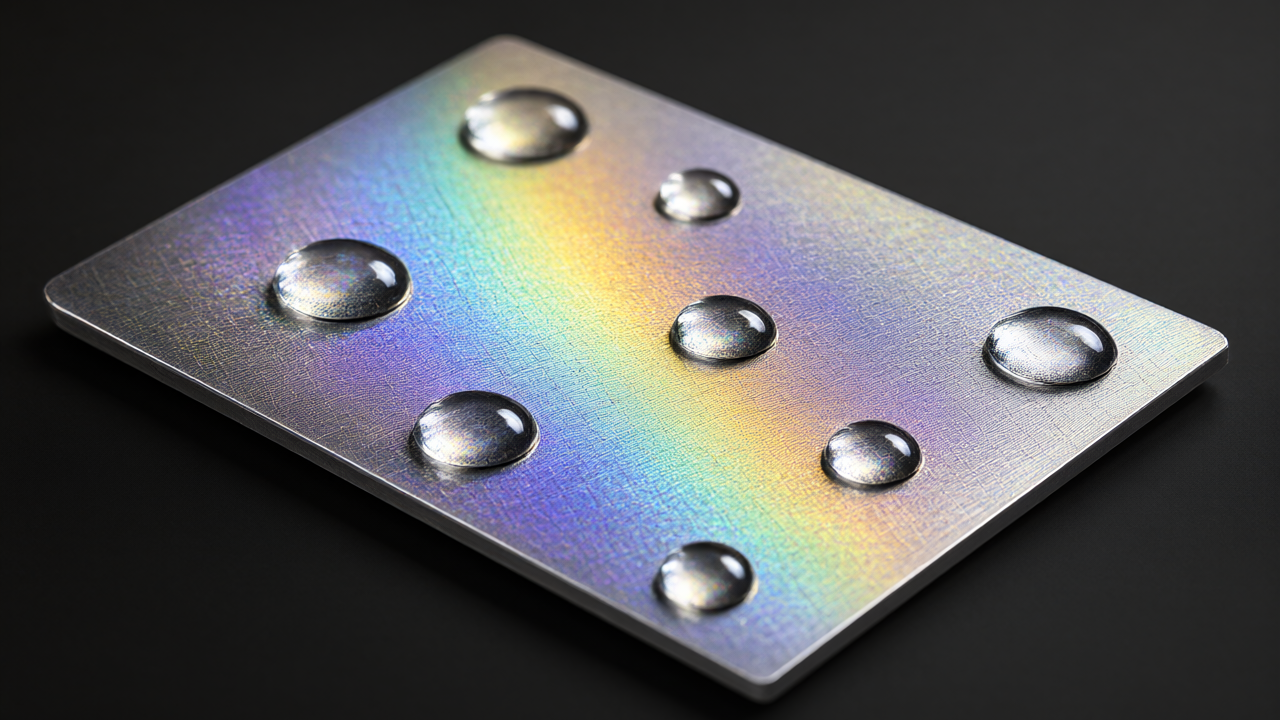
The developed coating for 7075 aluminium alloy demonstrates high durability and protective performance. It achieves a water contact angle of 163.4°, a sliding angle of 2.1°, and a corrosion protection efficiency of 99.86%. In anti-icing tests at –20 °C, the coating prolonged freezing time from 181 s to 857 s and reduced ice adhesion strength from 142 kPa to 34 kPa. These properties remained stable after 80 icing/de-icing cycles.
Technical Details
The coating process utilizes a multi-step strategy to ensure stability and low surface energy without using fluorine:
- Surface Texturing: Femtosecond laser texturing creates a biomimetic cauliflower-like hierarchical interface, which maintains the Cassie-Baxter wetting state.
- Interfacial Anchoring: An Al-O-Si layer is formed using γ-aminopropyltriethoxysilane (KH550).
- Structural Reinforcement: A spot-like reinforced skeleton is constructed using KH570-modified zinc oxide and low-solid-content E44 epoxy resin to prevent the backfilling of micro/nanostructures.
- Outer Layer: Octadecyltrimethoxysilane (OTMS) is applied to provide the final low-surface-energy layer.
Background and Context
Commercial adoption of superhydrophobic coatings for aluminium alloys has been limited by three primary factors: the regulatory scrutiny of fluorinated modifiers, weak interfacial adhesion, and the degradation of performance caused by the backfilling of micro/nanostructures. This research addresses these limitations by replacing fluorinated chemistry with a reinforced organic-inorganic skeleton and laser-induced biomimetic structures.
Significance and Outlook
The coating exhibits robust durability across various stress tests, including 240 abrasion cycles, 200 tape-peeling cycles, UV irradiation, thermal ageing, and 480 h immersion in wide-pH solutions. Electrochemical impedance spectroscopy after 100 h in 3.5 wt.% NaCl solution showed charge-transfer resistance increasing from 33.76 to 2.34 × 10⁴ Ω·cm². Due to its resilience in harsh environments, this fluorine-free strategy is positioned for potential use in the transport, marine, and aerospace sectors.
Get our weekly technology intelligence — free
Receive an infographic that lets you judge at a glance whether each field’s analysis report is worth reading.
Subscribe Free — Weekly Tech Intelligence
By subscribing, you’ll receive Troy-Technical’s weekly technology intelligence newsletter.
- Your email and selected fields are used only to deliver the newsletter.
- We never share your information with third parties.
- You can unsubscribe anytime via the link in each email.
See our Privacy Policy for details.
Takes about a minute · Unsubscribe anytime