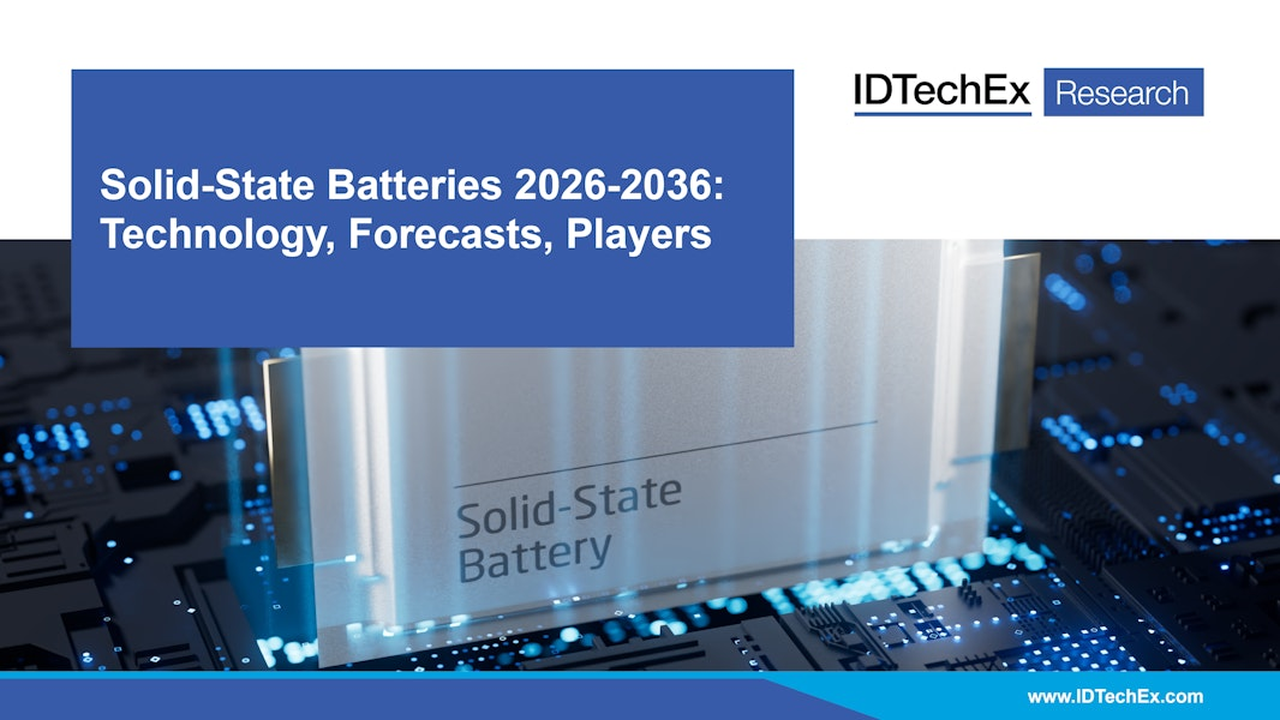
This article provides an overview of the market research report “Solid-State Batteries 2026-2036: Technology, Forecasts, Players” published by IDTechEx.
Report Overview
This IDTechEx report focuses on the all-solid-state battery (ASSB) market from 2026 to 2036. The report provides a detailed analysis of ASSB technological evolution, market growth forecasts, and key player activities, outlining the future of ASSBs across a wide range of application areas, including EVs, consumer electronics, and stationary energy storage. It delves particularly deeply into the characteristics of each solid electrolyte type (sulfide, polymer, oxide) and the associated technical and manufacturing challenges.
Key Findings
The report emphasizes that all-solid-state batteries have the potential to bring transformative advancements in safety, energy density, and simplified design compared to conventional lithium-ion batteries (LIBs). However, it points out that several significant challenges remain for their commercialization:
- Manufacturing Process Complexity: Low compatibility with existing battery manufacturing lines necessitates new capital investment and technological development.
- High Costs: High material costs and complex manufacturing processes tend to result in significantly higher final product costs compared to LIBs.
- Lithium Dendrite Formation: When using lithium metal anodes, dendrites can form during charge-discharge cycles, posing risks of short circuits and reduced safety.
- Limited Low-Temperature Performance: For some solid electrolytes, ionic conductivity decreases at low temperatures, limiting performance.
- Reduced Cycle Life during Fast Charging: Fast charging can accelerate dendrite formation, potentially shortening battery lifespan.
The report also analyzes the main solid electrolyte types:
- Sulfide Electrolytes: Offer high ionic conductivity but face challenges with air instability, toxicity, and manufacturing difficulty.
- Polymer Electrolytes: Scalable and flexible, but generally require high operating temperatures and may have stability issues.
- Oxide Electrolytes: Provide excellent stability against lithium metal anodes but are challenged by high interfacial resistance and manufacturing costs.
The report underscores the importance of manufacturing process adaptability, highlighting the need for cost-effective methods that can integrate new materials and components.
About the Publisher
IDTechEx is a global market research and business intelligence firm that provides independent analysis, reports, and consulting services on technology markets. The company focuses on emerging technologies, with deep expertise in areas such as energy storage, flexible electronics, robotics, and electric vehicles. Through detailed technical analysis and market forecasting, IDTechEx helps companies and investors understand future markets and make strategic decisions.
Source: https://www.idtechex.com/en/research-report/solid-state-batteries/1130




Comments