Key Findings
NTT has announced the latest progress in its Photonic-Electronic Convergence technology, a core component of the IOWN (Innovative Optical and Wireless Network) initiative. The company reports groundbreaking achievements in intra-data center optical connectivity, demonstrating a 50% reduction in power consumption and a remarkable 90% decrease in data transmission latency compared to conventional electrical connections. This innovation holds immense significance as a foundational technology for dramatically enhancing the power efficiency and performance of next-generation AI and HPC infrastructure.
Technical / Clinical Details
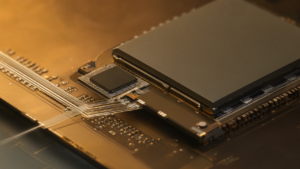
- The technology announced primarily focuses on improving photonic-electronic converged devices that maximize the conversion efficiency between optical and electrical signals within chips and on circuit boards. Specifically, it has successfully reduced the energy consumption per bit to the femtojoule level by combining highly efficient microring resonator modulators with low-power photodetectors.
- Furthermore, by shortening optical paths and minimizing the number of optical-to-electrical conversions, data transfer latency has been significantly reduced, achieving ultra-low-latency communication in the order of nanoseconds. This offers a decisive advantage for real-time AI processing and quantum computing interconnects.
- This technology is being developed on a silicon photonics platform, enabling high-density integration and promising cost-effective, high-volume deployment.
Background & Context
With the proliferation of cutting-edge technologies like AI and 5G/6G, data center data processing volumes are exploding, leading to severe challenges in terms of power consumption and communication latency. Within data centers, in particular, vast amounts of energy are consumed by data movement between GPUs and between CPUs and memory, while network latency limits overall performance. The IOWN concept aims to fundamentally resolve these issues by realizing an All-Photonics Network that connects everything from the network to terminals with light, with photonic-electronic convergence at its core.
Strategic Significance & Outlook
NTT’s latest announcement signifies solid progress towards the full commercialization of its core photonic-electronic convergence technology within the IOWN initiative. If introduced into data centers, this technology will resolve existing bottlenecks in AI and HPC systems, enabling faster and more environmentally friendly data processing. NTT aims for commercial deployment of this technology by 2030, which is expected to significantly accelerate the realization of the future society envisioned by IOWN, including smart cities, autonomous driving, and remote medicine. The company also aims to contribute to international standardization, potentially leading global infrastructure transformation.
Source: https://www.ntt.co.jp/news2026/XXXXXX/IOWN_photonics.html
Get our weekly technology intelligence — free
Receive an infographic that lets you judge at a glance whether each field’s analysis report is worth reading.
Subscribe Free — Weekly Tech Intelligence
By subscribing, you’ll receive Troy-Technical’s weekly technology intelligence newsletter.
- Your email and selected fields are used only to deliver the newsletter.
- We never share your information with third parties.
- You can unsubscribe anytime via the link in each email.
See our Privacy Policy for details.
Takes about a minute · Unsubscribe anytime