Key Findings
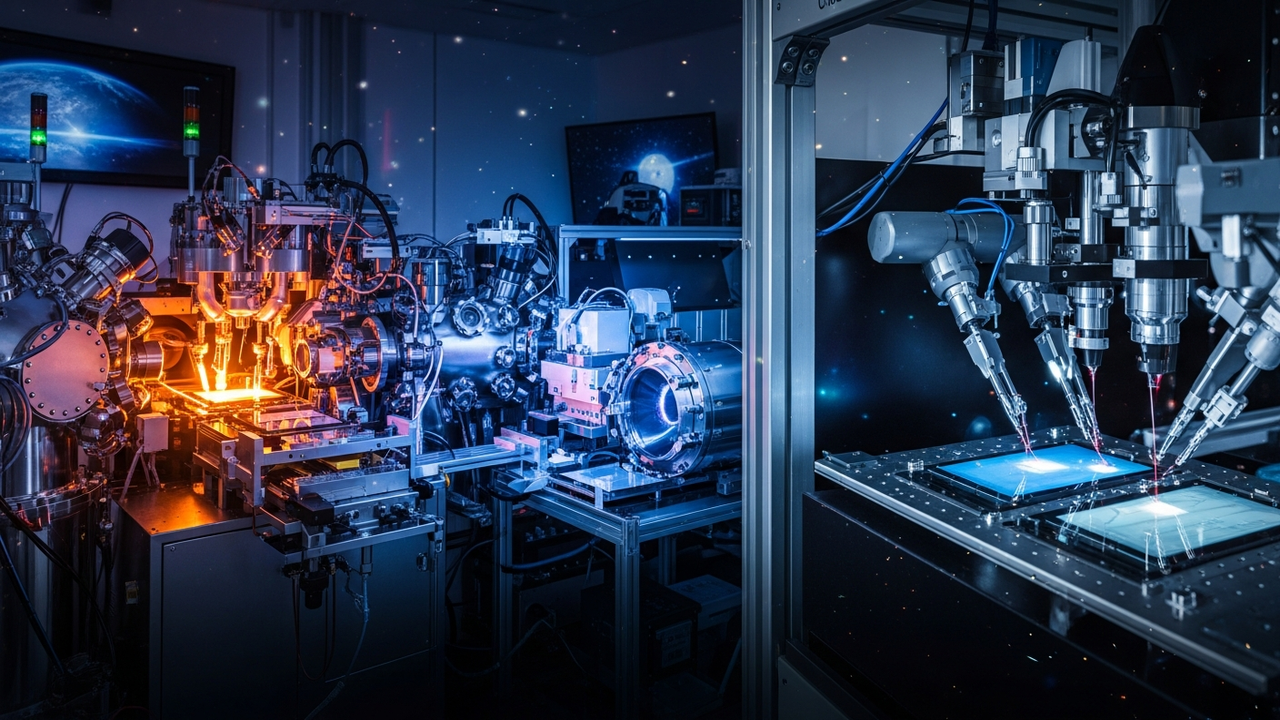
The Journal of Vacuum Science & Technology A/B, published by the American Vacuum Society (AVS), has released several groundbreaking fundamental research papers directly relevant to space materials and next-generation electronic component manufacturing processes. Notably, studies on stable oxide flux generation techniques in molecular beam epitaxy, improved uniformity in through-silicon via (TSV) etching, and the surface properties of novel two-dimensional materials are poised to enhance device performance in extreme space environments.
Technical & Research Details
- Stable Oxide Flux Generation via Molecular Beam Epitaxy: High-quality oxide thin films are essential for space-grade sensors, optoelectronic devices, and radiation-hardened electronic circuits. This research developed a method for generating highly stable oxygen flux using the surface oxidation of refractory metals (e.g., tungsten or tantalum) in molecular beam epitaxy (MBE). This enables precise compositional control and the growth of high-quality oxide thin films, thereby improving long-term reliability in space.
- Enhanced Uniformity in Through-Silicon Via (TSV) Etching: TSVs are key elements in 3D integrated circuit (3D-IC) technology, contributing to the miniaturization, acceleration, and low power consumption of high-performance processors and memory for space applications. This paper proposes a new etching technique that significantly improves uniformity (e.g., via shape, depth, sidewall smoothness) in the deep etching process used to form TSVs. This is crucial for increasing the yield and reliability of 3D-ICs, which are essential for high-performance devices required in space missions.
- Surface Structure and Air Stability of 2D Material 1T-HfSe2: Two-dimensional (2D) materials are highly anticipated for next-generation space electronic devices and sensors due to their unique electrical and optical properties. This study provides a detailed analysis of the atomic surface structure and air stability of 1T-HfSe2, a type of transition metal dichalcogenide (TMD). Air stability, in particular, is a critical property for preventing material degradation during launch, storage, and operation in space.
Background & Industry Context
The space environment is characterized by harsh conditions, including extreme temperature variations, high vacuum, and cosmic radiation, demanding high resistance and reliability from electronic components and materials. Therefore, the development of space-grade devices requires innovation across a wide range of fields, from fundamental materials science to advanced manufacturing process technologies. These studies directly contribute to improving the performance of electronic systems and materials for next-generation satellites, deep-space probes, and lunar bases.
Future Outlook
These research findings provide crucial foundational technologies that will lead to the miniaturization, higher performance, extended lifespan, and enhanced environmental resistance of space-grade devices. Stable oxide thin films will enable more reliable sensors, uniform TSVs will facilitate higher-density 3D-ICs, and air-stable 2D materials will result in more robust space electronic devices. These advancements are indispensable for pushing the boundaries of space exploration and accelerating the further development of the space economy.
Source: https://pubs.aip.org/avs
Get our weekly technology intelligence — free
Receive an infographic that lets you judge at a glance whether each field’s analysis report is worth reading.
Subscribe Free — Weekly Tech Intelligence
By subscribing, you’ll receive Troy-Technical’s weekly technology intelligence newsletter.
- Your email and selected fields are used only to deliver the newsletter.
- We never share your information with third parties.
- You can unsubscribe anytime via the link in each email.
See our Privacy Policy for details.
Takes about a minute · Unsubscribe anytime




Comments