Background: Data Center Energy Demand and Sustainability Challenges
With the advancement of digitalization, the number of data centers continues to grow globally, leading to enormous electricity consumption. Data centers require continuous operation 24/7, making power supply reliability one of the most critical factors. Traditionally, diesel generators have been widely used as backup power during outages; however, these emit carbon dioxide (CO2) during operation, incur high maintenance costs, and thus, alternative technologies are sought from a sustainability perspective. Particularly, with increasing corporate commitments to ESG (Environmental, Social, and Governance) goals and decarbonization, the urgent need for cleaner and more efficient backup power solutions has intensified.
Key Findings / Results: Expanded BESS Adoption in the Data Center Industry
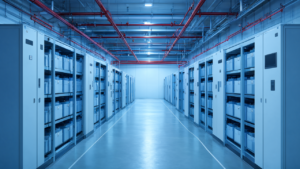
In the data center industry, the adoption of Battery Energy Storage Systems (BESS) is rapidly expanding as a next-generation backup power source, replacing traditional diesel generators. BESS offers high-speed power delivery responsiveness to address instantaneous outages, ensuring the stable operation of mission-critical data centers. Furthermore, BESS emits no exhaust gases during operation and eliminates the need for fuel storage or routine maintenance associated with diesel generators, significantly reducing environmental impact and operational costs. Major cloud service providers and colocation operators have already begun integrating BESS into their data center infrastructure, contributing to improved reliability and the achievement of carbon footprint reduction targets simultaneously.
- Adoption Objectives: Operational reliability (instantaneous power supply) and achievement of decarbonization goals.
- Replacement Technology: Transitioning from conventional diesel generators.
- Key Advantages: High-speed response, reduced CO2 emissions, lower maintenance costs.
- Primary Adopters: Major cloud providers like Google and Microsoft.
- Impact: Improved data center energy efficiency and enhanced integration with renewable energy.
Technical Significance and Business Opportunities
The accelerated adoption of BESS in data centers clearly demonstrates its functionality as a mission-critical backup power source with high responsiveness and reliability. Technically, advanced Battery Management Systems (BMS) and Energy Management Systems (EMS) enable stable system operation and efficient charge/discharge control. Moreover, BESS can be easily integrated with renewable energy sources like solar power, promoting renewable energy procurement through Power Purchase Agreements (PPAs) for data centers and accelerating overall decarbonization. This creates immense business opportunities for energy storage solutions within the specific data center industry, forming a significant market for BESS suppliers, system integrators, and operation and maintenance service providers. Future challenges include initial investment costs, optimizing footprint, and establishing appropriate cooling and safety management systems, but BESS is undoubtedly becoming an indispensable component for the sustainable growth of data centers.