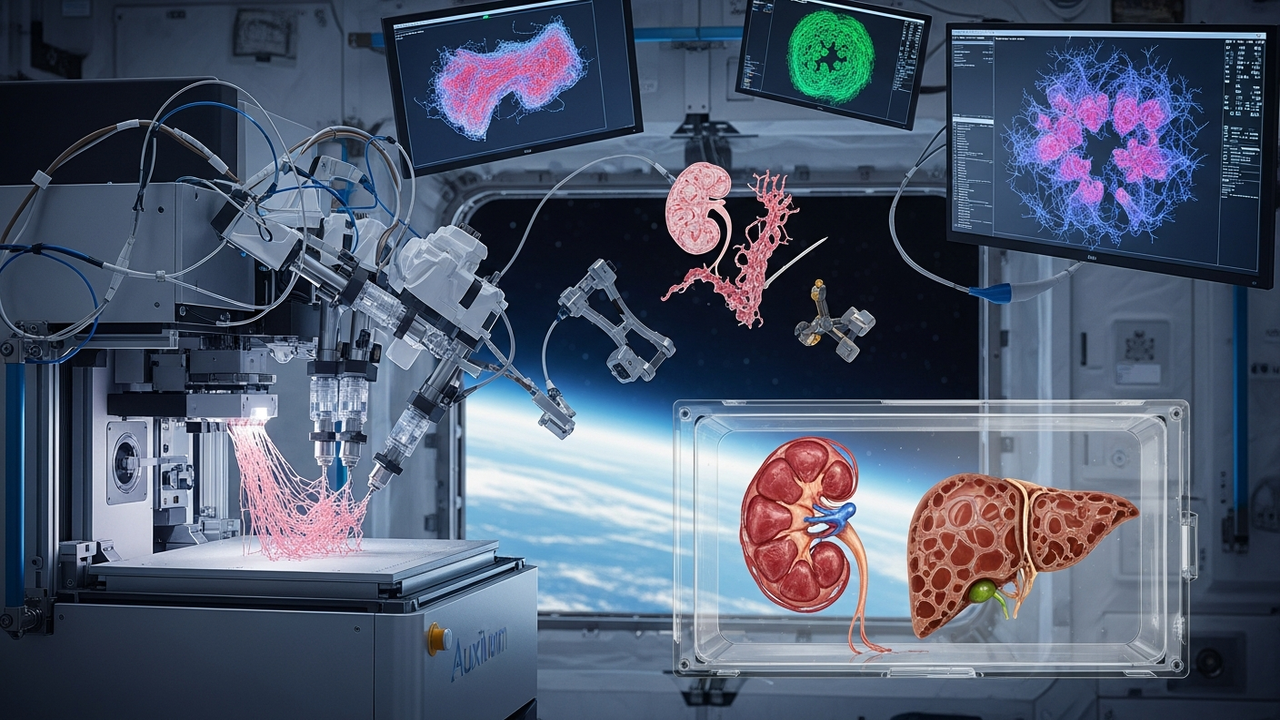
Key Findings: Auxilium Biotechnologies Successfully 3D Bioprints Kidney and Liver Tissue in Space
Auxilium Biotechnologies has achieved a monumental breakthrough in space-based 3D bioprinting, announcing the successful first-ever bioprinting of kidney and liver tissue aboard the International Space Station (ISS). This historic achievement validates the long-standing hypothesis that the microgravity environment on the ISS can facilitate the construction of tissues that more closely mimic natural organ structures, by allowing for more complex and functional layered cellular arrangements that are challenging to achieve on Earth due to gravitational forces. This represents a critical step towards advanced biomedical research in space, particularly for the production of functional organoids essential for drug development and disease modeling.
Technical & Clinical Details: Microgravity’s Innovation in Tissue Engineering
On Earth, bioprinting faces challenges where gravity can cause cells to shift from their intended positions or compromise tissue structure. However, in the microgravity environment of the ISS, these gravitational constraints are significantly reduced, enabling more precise cell placement and the formation of complex three-dimensional tissue structures. Auxilium Biotechnologies layered specific types of kidney and liver cells with biocompatible bio-inks using a bioprinter, constructing tissues that mimicked micro-tubule structures and nascent vascular networks. Upon return to Earth, these bioprinted tissues underwent functional evaluations, confirming that they replicated some of the filtration functions of kidneys and metabolic activities of the liver. This technology holds future potential for providing high-fidelity human tissue models for drug screening and eventually for producing transplantable organ tissues.
Background & Industry Context: The Convergence of Space and Regenerative Medicine
The space environment, with its unique physiological and physical characteristics, offers opportunities for life science research that are difficult to replicate on Earth. In recent years, space agencies, including NASA, and private companies have increasingly focused on the effects of microgravity on cell growth, differentiation, and tissue formation, promoting research into space-based bioprinting and tissue engineering. The demand for organ transplants is globally high, and the shortage of donor organs is a critical issue. Auxilium Biotechnologies’ success demonstrates the feasibility of generating functional organ tissues in space, potentially representing a major breakthrough in the field of regenerative medicine. This signifies that space development is opening new frontiers not just for exploration, but for contributing to the resolution of human medical challenges.
Strategic Significance & Outlook: Accelerating Drug Development and Paving the Way for Future Organ Generation
The successful bioprinting of kidney and liver tissue on the ISS could significantly impact drug development processes on Earth. The availability of more accurate human tissue models would enhance the precision of new drug toxicity testing and efficacy evaluations, potentially reducing clinical trial failure rates. Auxilium Biotechnologies is expected to further develop this technology for the production of more complex and functional organ tissues, as well as for the development of long-term cell culture systems in space. In the long term, this technology also holds the potential to help alleviate the shortage of donor organs and transform the future of transplant medicine. Furthermore, the unique conditions offered by the space environment might lead to novel biological discoveries and the development of cell therapy techniques impossible on Earth. Future research progress and the specific impacts this technology will have on regenerative medicine and pharmaceutical development will be closely watched.
Source: https://lasvegassun.com/news/2026/jul/09/auxilium-biotechnologies-achieves-historic-space-b/
Get our weekly technology intelligence — free
Receive an infographic that lets you judge at a glance whether each field’s analysis report is worth reading.
Subscribe Free — Weekly Tech Intelligence
By subscribing, you’ll receive Troy-Technical’s weekly technology intelligence newsletter.
- Your email and selected fields are used only to deliver the newsletter.
- We never share your information with third parties.
- You can unsubscribe anytime via the link in each email.
See our Privacy Policy for details.
Takes about a minute · Unsubscribe anytime



Comments