Key Findings
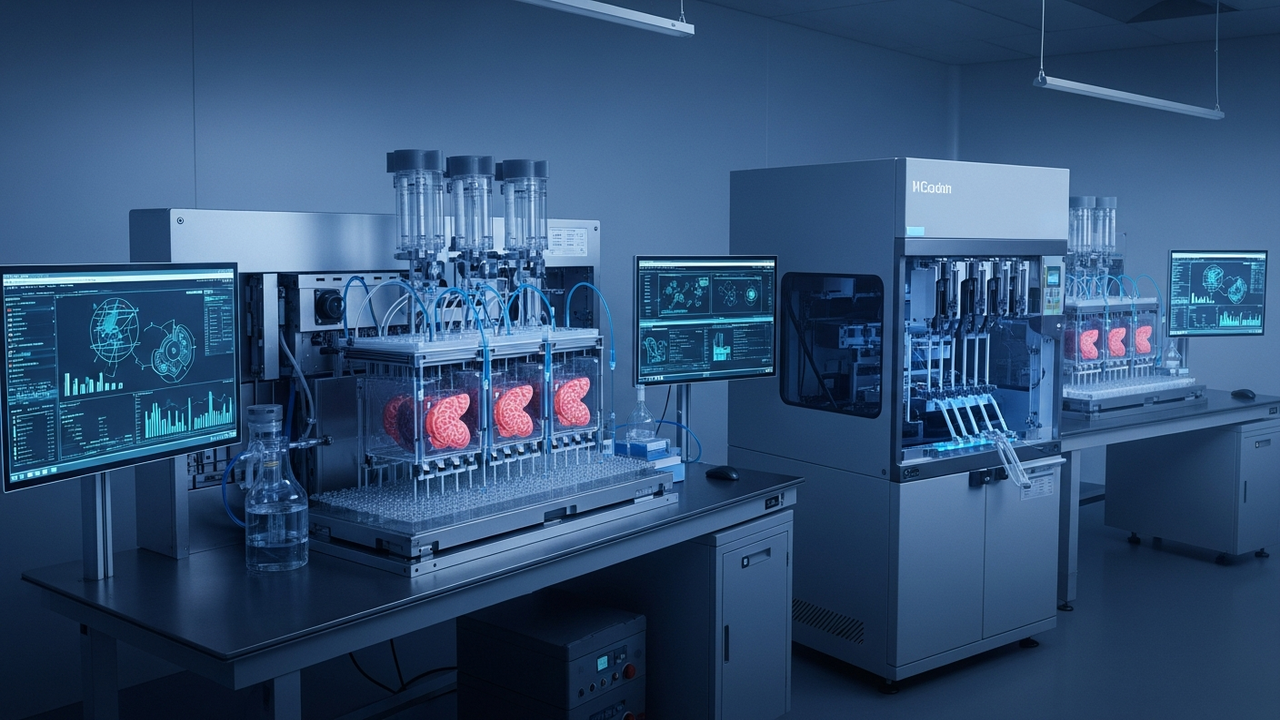
Organ-on-a-chip (OoC) technology is rapidly expanding its role in modeling human diseases and evaluating drug responses, moving significantly closer to integration within drug discovery pipelines. These sophisticated microfluidic devices are constructed with living human cells, faithfully replicating crucial microenvironmental aspects of human organs such as authentic tissue structures, physiological fluid flow, and mechanical forces acting on cells. A key emphasis for further advancing this technology is the development of automated organ chip culture systems that integrate higher throughput, lower costs, in-line imaging, advanced sensors, artificial intelligence (AI), and computational modeling.
Technical/Clinical Details
Organ-on-a-chip devices are designed on polymer substrates with micro-channels and chambers, mimicking the smallest functional units of specific organs, such as blood vessels, alveoli, intestinal villi, or renal nephrons. Cells are cultured within these channels, perfused with nutrient-rich media, and subjected to physiologically relevant shear stress and mechanical strains. This environment more accurately reflects human biological responses than conventional 2D cultures or animal models. In drug discovery, organ chips serve as high-throughput screening platforms for evaluating the efficacy, toxicity, and metabolic profiles of new drug candidates. Specifically, integrated in-line imaging techniques and sensors enable continuous, real-time monitoring of parameters such as cell viability, morphological changes, metabolic activity, and gene expression. AI and computational modeling analyze these vast datasets to construct predictive models of drug responses, contributing to lead compound optimization and improving the success rate of preclinical trials.
Background and Industry Context
Traditional drug discovery processes have long faced challenges of high cost, extended timelines, and high failure rates. Animal testing presents ethical concerns and limitations in predictability due to species differences, while 2D cell cultures fail to replicate in vivo complexity. Organ-on-a-chip technology addresses these limitations by providing more accurate human physiological models, holding great promise for more efficient and ethical drug development. Regulatory bodies are actively exploring the use of organ chips in new drug development, with the FDA already implementing legislation to promote the use of ‘alternative methods’ in lieu of some animal studies. This allows pharmaceutical developers to identify promising therapies more quickly and cost-effectively.
Strategic Significance & Outlook
The future of organ-on-a-chip technology largely depends on its level of automation and integration. The development of ‘human-on-a-chip’ systems, which connect multiple organ chips to simulate systemic physiological functions, will enable a more comprehensive understanding of pharmacokinetics (PK) and pharmacodynamics (PD), opening avenues to assess the effects of complex diseases and polypharmacy. Furthermore, patient-derived iPSC-based organ chips could become the ultimate platform for realizing personalized medicine. The deeper integration of AI and biosensors will enable real-time, data-driven decision-making, intelligently optimizing the entire drug discovery process. This promises a future where safer and more effective drugs can be delivered to patients more rapidly.
Get our weekly technology intelligence — free
Receive an infographic that lets you judge at a glance whether each field’s analysis report is worth reading.
Subscribe Free — Weekly Tech Intelligence
By subscribing, you’ll receive Troy-Technical’s weekly technology intelligence newsletter.
- Your email and selected fields are used only to deliver the newsletter.
- We never share your information with third parties.
- You can unsubscribe anytime via the link in each email.
See our Privacy Policy for details.
Takes about a minute · Unsubscribe anytime






Comments