Key Findings
A team of Chinese researchers has achieved a new world record certified power conversion efficiency of 27.31% for inverted perovskite solar cells (IPSCs) by employing an innovative dual-molecule interface engineering strategy. This breakthrough simultaneously resolves critical efficiency and stability challenges that have been major barriers to the commercialization of perovskite solar cells.
Technical Details
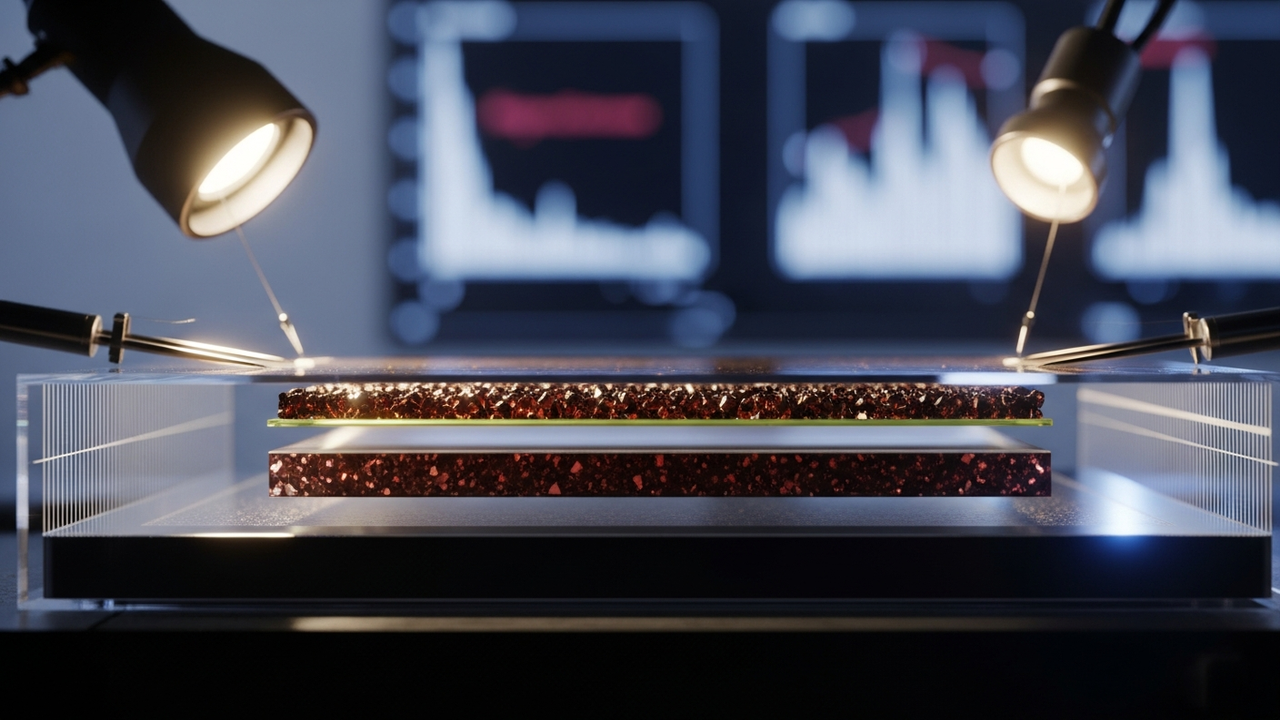
The dual-molecule interface engineering was specifically designed to tackle interfacial recombination losses and chemical instability issues prevalent at the NiOx/perovskite junction. The research team successfully utilized a combination of two distinct molecules, Me-4PACz and CzOTf, to effectively pin charge extraction and passivate lead (Pb) defects at the interface. This approach led to an increase in the open-circuit voltage (Voc) of the device and a significant improvement in long-term operational stability. Notably, large-area devices measuring 766 cm² fabricated with this technology achieved a power conversion efficiency of 21.54%. Furthermore, these devices demonstrated outstanding stability, retaining 92% of their initial efficiency after 2000 hours of continuous light exposure under ambient conditions. The molecular interface also acts as a barrier against ion migration at the NiOx contact, decelerating chemical drift and interfacial phase destabilization.
Background & Context
Inverted perovskite solar cells have garnered significant attention due to their advantageous optical properties and ease of fabrication. However, defects and instabilities at the interface with hole transport layers, such as NiOx, have hindered the simultaneous achievement of high efficiency and long-term stability. This dual-molecule interface strategy represents a groundbreaking approach to fundamentally resolve these issues, making it pivotal for accelerating the commercial deployment of IPSC technology. Achieving high efficiency and stability in large-area devices is a substantial step toward practical applications.
Strategic Significance & Outlook
The impressive 27.31% certified efficiency approaches the theoretical efficiency limits of conventional silicon solar cells, indicating a potential for significant disruption in the existing photovoltaic market. This technology is expected to further enhance the cost-competitiveness and flexibility of perovskite solar cells, fostering their adoption in a wide range of applications, including building-integrated photovoltaics (BIPV) and flexible electronics. Future research will likely focus on further improving the scalability of this technology and evaluating its stability under more extreme environmental conditions to pave the way for widespread commercialization.
Get our weekly technology intelligence — free
Receive an infographic that lets you judge at a glance whether each field’s analysis report is worth reading.
Subscribe Free — Weekly Tech Intelligence
By subscribing, you’ll receive Troy-Technical’s weekly technology intelligence newsletter.
- Your email and selected fields are used only to deliver the newsletter.
- We never share your information with third parties.
- You can unsubscribe anytime via the link in each email.
See our Privacy Policy for details.
Takes about a minute · Unsubscribe anytime





Comments