Passivation– tag –
-

Unlocking Perovskite Performance: Bandgap-Dependent Defect Passivation Suppresses Non-Radiative Recombination
AIP Publishing USA Overview New research elucidates bandgap-dependent defect properties in mixed-halide perovskites, a crucial advancement for materials science. The study reveals that in bromine-rich wide-bandgap perovskites, defect act... -
Sulfur Small Molecule Unlocks 21.15% Efficiency and Enhanced Stability in Inverted Perovskite Solar Cells via Dual-Site Passivation
ACS Publications USA Overview Researchers have developed a novel molecular-level reconstruction and dual-site passivation strategy utilizing 2-thiopheneethanamine hydriodide (2-TEA·HI) to simultaneously boost the efficiency and stability... -
Uniform Potential Reconstruction Strategy Achieves 25.06% Efficiency and 1,000-Hour Durability in Perovskite Solar Cells
OAE Publishing Inc. Unknown Overview A new strategy has been introduced to suppress non-radiative recombination caused by surface defects and non-uniform surface potentials in perovskite films, involving the introduction of (Ferrocenylme... -
LONGi Shatters Solar Efficiency Record with 35.5% Perovskite-Silicon Tandem Cell, Verified by ESTI
LONGi China Overview LONGi has achieved a groundbreaking 35.5% power conversion efficiency for its perovskite-silicon tandem solar cells, independently verified by the European Solar Test Installation (ESTI). This new world record was en... -
Solar Module Prices Stabilize, Perovskite Tandem Cells Poised for 2028 Mass Market Entry with 30%+ Efficiency Potential
TaiyangNews Unknown Overview TaiyangNews reports stabilizing solar module prices driven by TOPCon and BC module demand, while manufacturers intensify efforts in perovskite solar cell technology. Perovskite tandem cells, in particular, sh... -
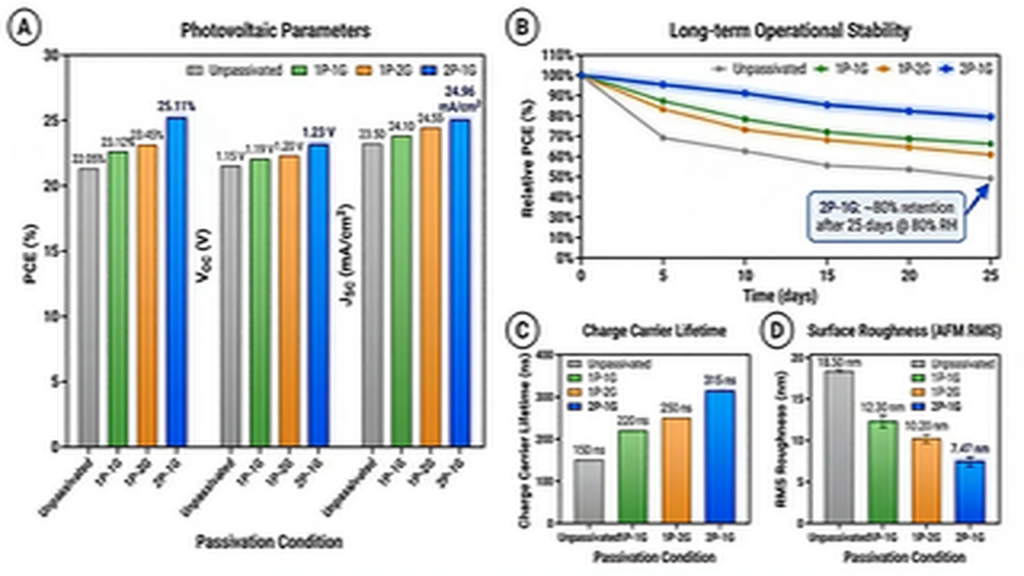
Dual Surface Passivation Boosts Perovskite Solar Cell Efficiency from 21.37% to 25.11% and Enhances Long-Term Stability
PLOS One USA Overview A study published in PLOS One reports a significant performance improvement in perovskite solar cells (PSCs) through the introduction of dual surface passivation layers. This technique increased power conversion eff... -
Redox-Modulated Polyoxometalate-Incorporated Carbazole-Based Interface Boosts Performance of Perovskite Photodetectors
PubMed Unknown Overview High-performance self-powered perovskite photodetectors require hole transport layers (HTLs) with excellent energy level alignment, optimal wettability, and effective defect passivation. This study addresses the l... -
Data-Driven Atomistic Modeling Unravels Surface Passivation Mechanism of Hybrid Halide Perovskites
arXiv Unknown Overview Molecular passivation of surface defects is critical for enhancing the optoelectronic performance of hybrid halide perovskite materials, yet its atomistic mechanism has remained incompletely understood. This study ... -
Protonated Cyclohexylamine Passivation Layer Boosts Perovskite Solar Cell Efficiency to 21.53%, Demonstrates 720-Hour Stability
ACS Applied Energy Materials International Overview Researchers have developed high-performance perovskite solar cells utilizing protonated cyclohexylamine as an effective passivation layer. This modified device achieved a champion power... -
Chinese Researchers Boost Wide-Bandgap Perovskite Solar Cell Efficiency to 23.54% with Dual-Molecule Surface Passivation
perovskite-info.com China Overview A Chinese research team has developed a dual-molecule surface passivation strategy that significantly enhances both the efficiency and operational stability of wide-bandgap (WBG) perovskite solar cells....