Dual Surface Passivation Elevates Perovskite Solar Cell Efficiency to 25.11% and Significantly Boosts Long-Term Stability
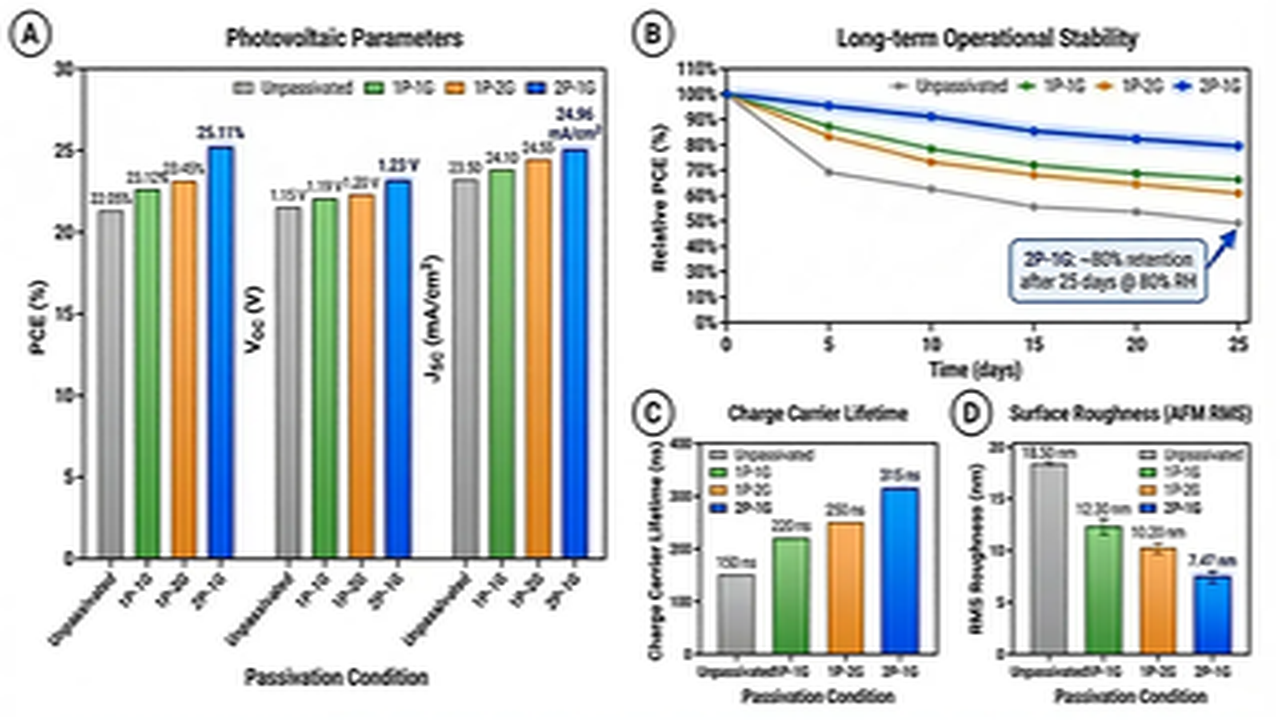
A significant breakthrough toward enhancing the performance and ensuring the long-term stability of perovskite solar cells (PSCs) has been published in the academic journal PLOS One. This research demonstrates that the introduction of dual surface passivation layers dramatically improves the power conversion efficiency (PCE) of PSCs and substantially enhances the device’s long-term stability. Specifically, compared to unpassivated control cells, PCE increased from 21.37% to 25.11%, a groundbreaking achievement that accelerates the practical application of next-generation solar PV technology.
Technical and Research Details
- Mechanism of Dual Surface Passivation: The perovskite layer’s surface and bulk contain crystal defects and trap sites, which cause non-radiative recombination of charge carriers, leading to reduced PCE and compromised stability. The dual surface passivation technique employed in this study introduces specialized material layers on both the top and bottom surfaces of the perovskite layer, effectively passivating these defects. This extends the lifetime of charge carriers, improves photocurrent and open-circuit voltage, and consequently enhances overall conversion efficiency.
- Efficiency Improvement and Stability:
- Power Conversion Efficiency (PCE): Passivation led to an increase in PCE from 21.37% to 25.11%. This represents an approximately 17.5% relative efficiency improvement, highlighting the critical importance of material design and interface engineering optimization.
- Long-Term Stability: The passivation layers also act as a protective barrier against environmental factors like moisture and oxygen, significantly enhancing the device’s long-term stability. This resolves one of the primary challenges for the practical outdoor deployment of PSCs.
- Defect Reduction and Suppression of Non-Radiative Recombination: The dual passivation layers effectively fill defects at perovskite grain boundaries and surfaces, reducing carrier trapping. This suppresses “non-radiative recombination,” where photo-generated electrons and holes recombine and are lost as heat, allowing more charge carriers to be extracted to the external circuit.
Background and Industry Context
Perovskite solar cells have garnered significant attention as a promising alternative to traditional silicon solar cells due to their high power conversion efficiency and potential for low-cost manufacturing. However, their vulnerability to humidity and heat, and the resulting challenges in long-term stability, have been major barriers to commercialization. This dual surface passivation technology offers a concrete solution to this stability problem, significantly advancing the practical application of PSCs.
Future Outlook
These research findings open the door to significantly improving the long-term reliability of perovskite solar cells and enabling a wider range of applications. It is expected that research will accelerate to integrate this passivation strategy into large-scale manufacturing processes and to push the boundaries of efficiency and stability even further. Dual surface passivation technology is poised to become an essential component in realizing low-cost, high-performance next-generation solar power systems, with the potential to contribute significantly to the energy transition.
Source: https://journals.plos.org/plosone/article?id=10.1371/journal.pone.0351439
Get our weekly technology intelligence — free
Receive an infographic that lets you judge at a glance whether each field’s analysis report is worth reading.
Subscribe Free — Weekly Tech Intelligence
By subscribing, you’ll receive Troy-Technical’s weekly technology intelligence newsletter.
- Your email and selected fields are used only to deliver the newsletter.
- We never share your information with third parties.
- You can unsubscribe anytime via the link in each email.
See our Privacy Policy for details.
Takes about a minute · Unsubscribe anytime





Comments