Background
Inverted perovskite solar cells offer significant advantages for tandem structures and transparent solar cell applications due to the transparent conductive film being on the top layer. However, their stability, particularly in high-humidity environments, has remained a major challenge for commercialization. Interfacial passivation is one of the most effective strategies for improving the performance and longevity of perovskite solar cells, and the introduction of molecules capable of blocking water molecule infiltration represents a crucial breakthrough in this field. This research demonstrates that the development of new materials and precise control of interface engineering are key to resolving the bottlenecks in perovskite solar cell commercialization.
Key Findings
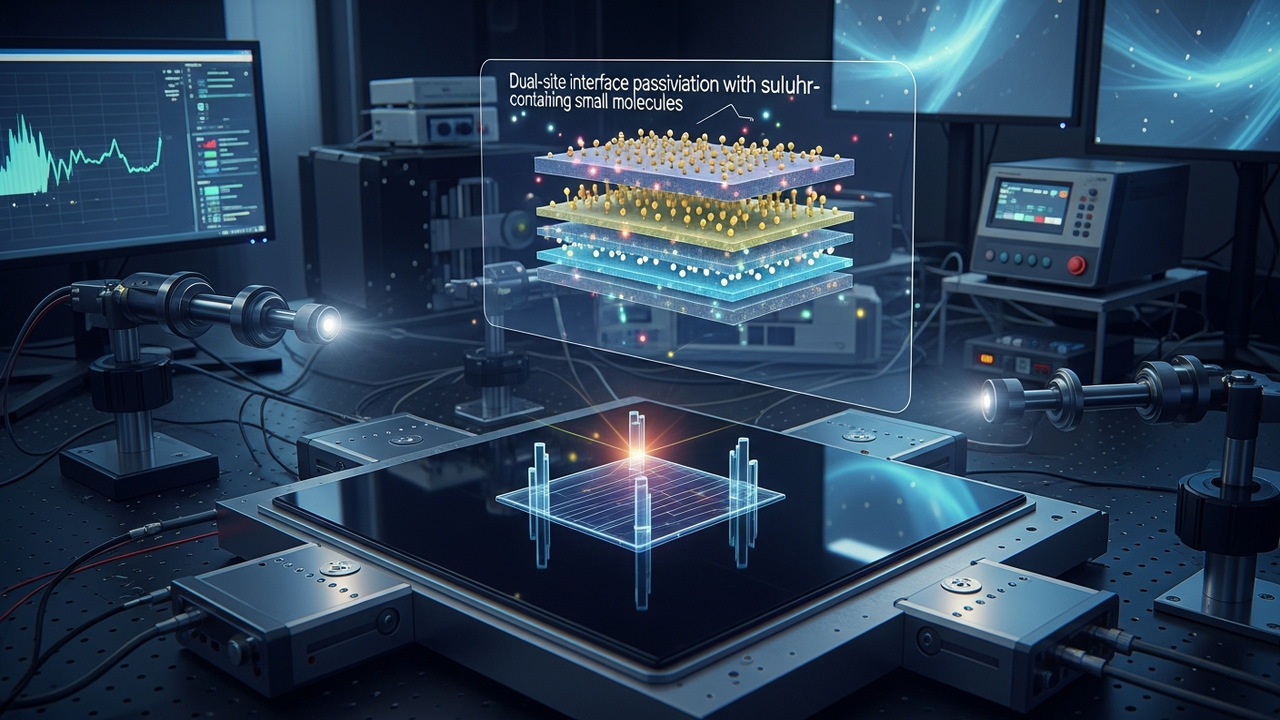
Researchers have developed an innovative dual-site interfacial passivation strategy utilizing 2-thiopheneethanamine hydriodide (2-TEA·HI), a sulfur-based small molecule, to simultaneously and dramatically enhance the power conversion efficiency (PCE) and long-term stability of inverted perovskite solar cells (PSCs). This novel approach achieved a high PCE of 21.15% and significantly improved environmental stability by effectively suppressing water molecule infiltration into the perovskite layer. The fact that unencapsulated cells maintained high efficiency after 500 hours under 30% relative humidity marks a crucial advancement towards practical application.
Technical Details
The performance and stability of perovskite solar cells are heavily dependent on defects at the perovskite layer’s surface and grain boundaries. These defects facilitate non-radiative recombination of charge carriers and act as pathways for water vapor and oxygen ingress, leading to device degradation. The 2-TEA·HI introduced in this study reconstructs the perovskite surface at a molecular level, effectively passivating defects at two distinct sites (dual-site). This minimizes recombination losses of electrons and holes, improving open-circuit voltage (Voc) and fill factor (FF), and consequently enhancing PCE. Furthermore, 2-TEA·HI also functions as a hydrophobic barrier, physically impeding water molecule infiltration into the perovskite layer, which significantly boosts stability in high-humidity environments. This combined effect enables the simultaneous achievement of high PCE and excellent environmental stability.
Strategic Significance & Outlook
This dual-site interfacial passivation strategy is expected to significantly impact future research and development as a groundbreaking method for enhancing the long-term reliability of inverted perovskite solar cells. Specifically, the improved humidity resistance will enable outdoor deployment in a wider range of climatic conditions, opening pathways for broad applications such as building-integrated photovoltaics (BIPV) and flexible solar cells. Future focus areas will include scaling up this technology for larger areas, optimizing manufacturing costs, and verifying its applicability to different perovskite compositions. This is expected to accelerate the practical implementation of highly efficient and durable next-generation solar cells.
Source: https://pubs.acs.org/doi/10.1021/acsami.6b05269
Get our weekly technology intelligence — free
Receive an infographic that lets you judge at a glance whether each field’s analysis report is worth reading.
Subscribe Free — Weekly Tech Intelligence
By subscribing, you’ll receive Troy-Technical’s weekly technology intelligence newsletter.
- Your email and selected fields are used only to deliver the newsletter.
- We never share your information with third parties.
- You can unsubscribe anytime via the link in each email.
See our Privacy Policy for details.
Takes about a minute · Unsubscribe anytime