Key Findings
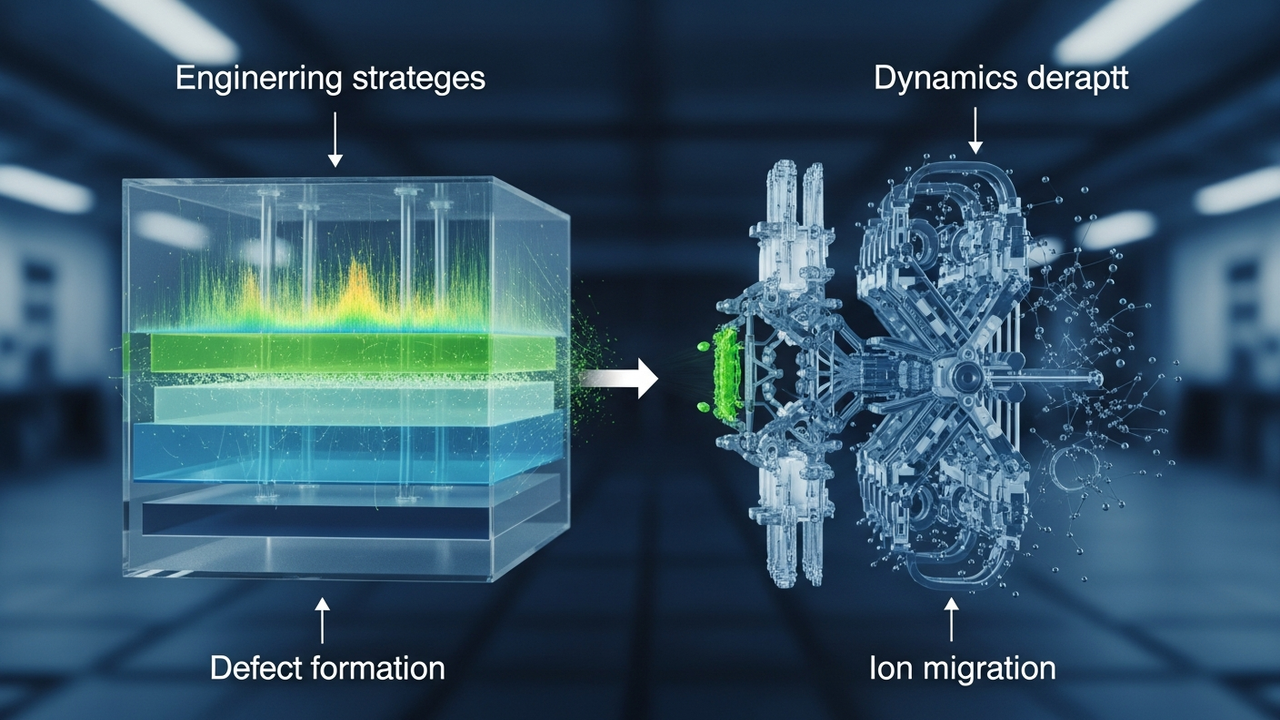
Addressing the insufficient operational stability—a primary barrier to the commercialization of perovskite solar cells—new research has focused on the evolution of dynamic stress and strain and engineering strategies for its control. This study reveals that mechanical stress and strain significantly contribute to degradation mechanisms such as defect formation, ion migration, cracking, and delamination, demonstrating that understanding and appropriately managing these phenomena are essential for enhancing long-term outdoor performance.
Technical Details
Conventional stability tests (e.g., steady-state high-temperature, high-humidity tests) have been recognized as insufficient to fully capture the complex degradation pathways in real outdoor operation. Solar cells are constantly exposed to dynamic stress and strain from daily thermal cycling, wind-induced vibrations, and structural load variations. This research meticulously analyzed how these dynamic loads affect the perovskite crystal lattice and device interfaces, promoting ion migration or generating microscopic cracks. Specifically, technical strategies involving controlling the thermal expansion coefficient of certain interfacial materials were explored to increase compressive strain in the perovskite film, thereby enhancing the activation energy for ion migration. This also suggested the suppression of degradation mechanisms like light-induced halide segregation.
Background & Context
Perovskite solar cells are garnering significant attention as a next-generation photovoltaic technology due to their high power conversion efficiency and potential for low-cost manufacturing. However, for practical implementation and market adoption, ensuring long-term reliability and durability—comparable to or exceeding existing silicon solar cells—is paramount. Particularly, reliability evaluation in outdoor environments cannot rely solely on laboratory benchmark tests; it demands assessment under more realistic operating conditions and device designs capable of withstanding them. This research provides a crucial scientific foundation for bridging this reliability gap.
Strategic Significance & Outlook
A deeper understanding of dynamic stress and strain will enable the design of more robust and durable perovskite solar cells. This insight will contribute to the development of new materials, optimization of device structures, and the formulation of more realistic accelerated degradation test protocols. In the future, this work will pave the way for perovskite solar cells to function stably under diverse environmental conditions and become a reliable option for a wide range of applications. This represents a significant step towards the commercialization of perovskite technology and the realization of a sustainable energy society.
Source: https://pubs.acs.org/doi/10.1021/acsenergylett.6c01234
Get our weekly technology intelligence — free
Receive an infographic that lets you judge at a glance whether each field’s analysis report is worth reading.
Subscribe Free — Weekly Tech Intelligence
By subscribing, you’ll receive Troy-Technical’s weekly technology intelligence newsletter.
- Your email and selected fields are used only to deliver the newsletter.
- We never share your information with third parties.
- You can unsubscribe anytime via the link in each email.
See our Privacy Policy for details.
Takes about a minute · Unsubscribe anytime