Key Findings
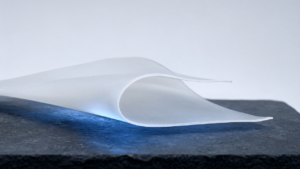
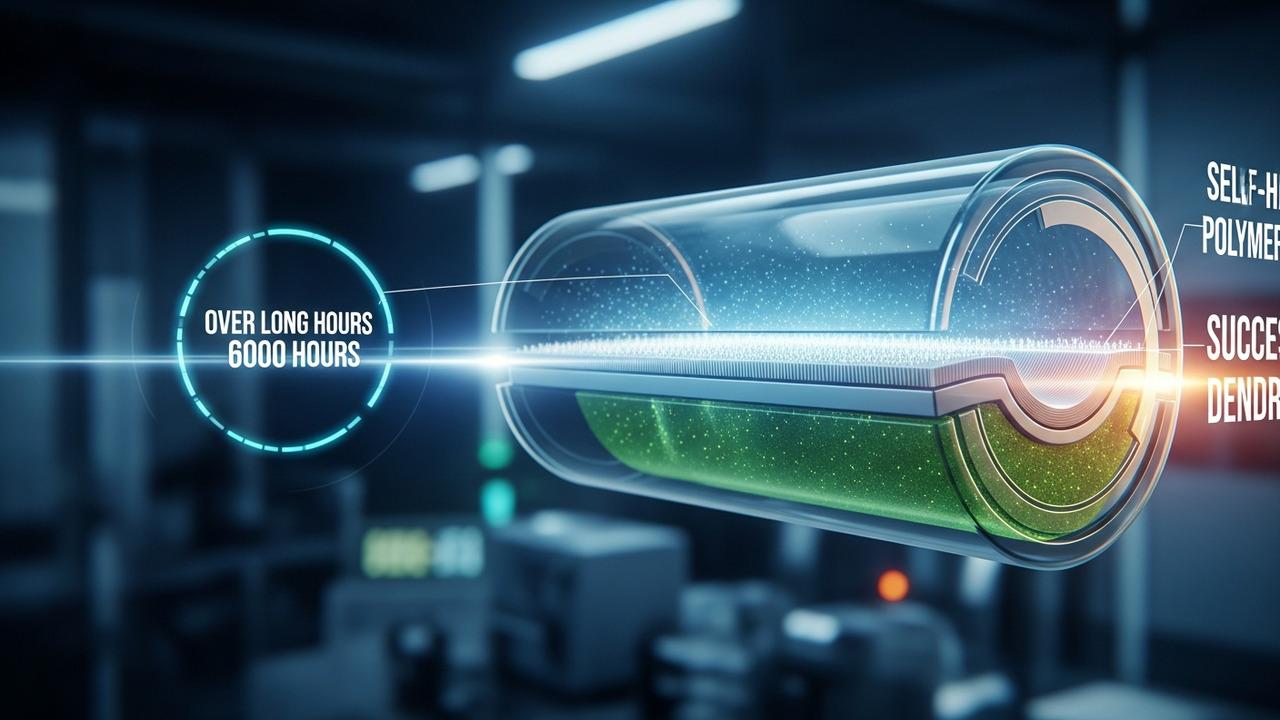
To address one of the most significant challenges in all-solid-state lithium metal batteries (ASSLMBs)—dendrite formation and interfacial degradation—researchers have developed a polyether-urethane-based self-healing solid polymer electrolyte (SPE) that integrates both disulfide and hydrogen bonds. This innovative SPE has achieved an ultra-long lifespan exceeding 6000 hours (3000 cycles) in symmetric lithium cells at a current density of 0.2 mA cm⁻², successfully suppressing dendrite growth and maintaining long-term electrode-electrolyte contact.
Technical & Clinical Details
- The developed polyether-urethane-based SPE possesses self-healing and external recovery capabilities by incorporating both reversible disulfide bonds and dynamic hydrogen bonds into its molecular structure. This allows the electrolyte layer to self-repair minor damage and suppress dendrite formation that occurs during lithium-ion charge-discharge cycles, maintaining its integrity.
- In symmetric lithium cell (Li||Li) tests, the SPE demonstrated extremely stable operation for over 6000 hours or 3000 cycles at a practical current density of 0.2 mA cm⁻². This represents a groundbreaking improvement in the cycle life of lithium metal batteries.
- This SPE effectively inhibits dendrite (tree-like crystal) growth both physically and chemically. Dendrites are a primary cause of internal short circuits, severely compromising battery safety and lifespan.
- Furthermore, SPE_TF/TMI-20, featuring a semi-interpenetrating dynamic network structure, also exhibited stable lithium plating/stripping behavior at 0.5 mA cm⁻². This network further promotes electrode-electrolyte interfacial stability and contributes to the suppression of interfacial degradation.
Background & Context
Lithium metal batteries are theoretically capable of approximately ten times the energy density of current lithium-ion batteries, making them a highly anticipated next-generation technology for dramatically extending the range of electric vehicles (EVs). However, dendrite formation during the charge-discharge cycles of lithium metal anodes, along with the resulting unstable interface with the electrolyte, has been the greatest challenge to ensuring safety and long cycle life. The advent of self-healing SPEs offers a fundamental solution to these long-standing issues, potentially accelerating the practical application of lithium metal batteries.
Strategic Significance & Outlook
The success of this self-healing SPE represents a significant advancement in the development of high-performance and safe all-solid-state lithium metal batteries. The achievement of an ultra-long lifespan is particularly crucial for reducing EV battery replacement frequency and lowering total ownership costs. Future efforts will focus on scaling up the manufacturing process for this SPE, validating its performance at higher current densities, and applying it to actual full cells (e.g., lithium metal/cathode material). If commercialized, this technology is expected to revolutionize a wide range of fields, including electric vehicles, drones, portable electronic devices, and large-scale energy storage.