Key Findings
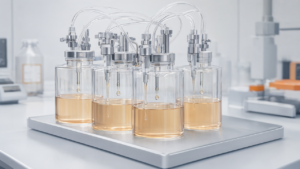
Fujifilm and HORIBA have jointly developed a high-sensitivity inline Raman measurement system that promises to revolutionize real-time monitoring of cell culture and purification processes in biopharmaceutical manufacturing. This system is expected to establish a new standard for Process Analytical Technology (PAT), significantly improving manufacturing process efficiency and product quality consistency.
Technical / Clinical Details
- High-Sensitivity Raman Measurement: The co-developed system is based on Raman spectroscopy, continuously and non-destructively analyzing chemical composition and reaction states in real-time within bioreactors and purification lines. This enables precise monitoring of cell growth, metabolite concentrations (e.g., glucose, lactate), target protein (e.g., antibody) concentrations, and impurity levels.
- Industry-Leading Signal-to-Noise Ratio: Through a combination of proprietary optical design technology and optimized probes, this system achieves the industry’s highest signal-to-noise (S/N) ratio. This allows for high-precision detection and quantification even of low-concentration components, enabling continuous measurement of antibodies and trace impurities during purification processes, which was previously challenging.
- Benefits of Inline Monitoring: Inline measurement eliminates the need for sample collection and off-line analysis, enabling real-time responses to process changes. This allows for immediate detection of process deviations and prompt corrective actions, reducing the risk of batch failures.
- Robustness and Reliability: Designed for use in biopharmaceutical manufacturing environments, the system features a robust design that ensures stable operation and reliable data delivery over extended periods.
Background & Context
Biopharmaceutical manufacturing continually faces challenges in deepening process understanding and control due to its complexity, high costs, and stringent quality control requirements. Process Analytical Technology (PAT) is a critical tool that addresses these challenges through real-time monitoring and supports the principles of Quality by Design (QbD). Raman spectroscopy, in particular, has attracted attention as a promising technology for bioprocess monitoring due to its molecular specificity and non-destructive nature, but high sensitivity and inline applicability have been hurdles.
Strategic Significance & Outlook
This high-sensitivity inline Raman measurement system, co-developed by Fujifilm and HORIBA, is poised to further accelerate the digitalization and automation of biopharmaceutical manufacturing. High-precision real-time process monitoring will contribute to optimizing manufacturing processes, improving yields, reducing production costs, and shortening time-to-market. This is expected to enable the delivery of higher quality, safer biopharmaceuticals to patients more quickly, significantly contributing to medical advancement. The technology will mark a crucial milestone towards the realization of Pharma 4.0.
Get our weekly technology intelligence — free
Receive an infographic that lets you judge at a glance whether each field’s analysis report is worth reading.
Subscribe Free — Weekly Tech Intelligence
By subscribing, you’ll receive Troy-Technical’s weekly technology intelligence newsletter.
- Your email and selected fields are used only to deliver the newsletter.
- We never share your information with third parties.
- You can unsubscribe anytime via the link in each email.
See our Privacy Policy for details.
Takes about a minute · Unsubscribe anytime